Self-Drilling Screw Selection: Drill Points, Gauge and Steel Thickness
By Sarah Zhan · 24 August 2026
A self-drilling screw looks like the dullest item in the fastener bin, which is exactly why it gets specified badly. Pick the wrong drill point and the screw either polishes the surface of the steel without biting, or shears off flush.
The fix is never a bigger driver, but three figures checked before the order goes out: drill point number, gauge, and the measured thickness of the steel.
What a Self-Drilling Screw Actually Does
Drilling and Tapping in One Revolution
A self-drilling screw cuts its own hole and then forms the mating thread in the same pass, so the separate pre-drilling stage disappears. Published guidance for cold-formed steel framing puts the working range between sheet as thin as 26 gauge and steel about half an inch thick. One fastener family therefore covers roof sheeting, stud-to-track work and considerably heavier structural fixings.
Because the whole job is done from one face, the self-drilling screw succeeds in positions where a conventional bolt cannot be installed.
- One pass — the self-drilling screw drills, taps and clamps with no separate prep.
- Single-sided access — nobody reaches behind the joint to hold a nut.
- Wide material range — one family covers thin cladding and heavy sections.
Drill Point Numbers Decide What Steel You Can Fasten
How Point Numbers Map to Steel Thickness
The number printed on the carton runs from #1 through #5 and describes the drill point, not the shank diameter. It is the most useful figure on the box.
| Drill point | Maximum steel thickness | Typical work |
|---|---|---|
| #1 and #2 | Thin sheet only | Light cladding, sheet metal |
| #3 | 1/8 inch (about 3 mm) | Light framing, purlins |
| #4 | 1/4 inch (about 6 mm) | Medium structural sections |
| #5 | 1/2 inch (about 13 mm) | Heavy sections, base plates |
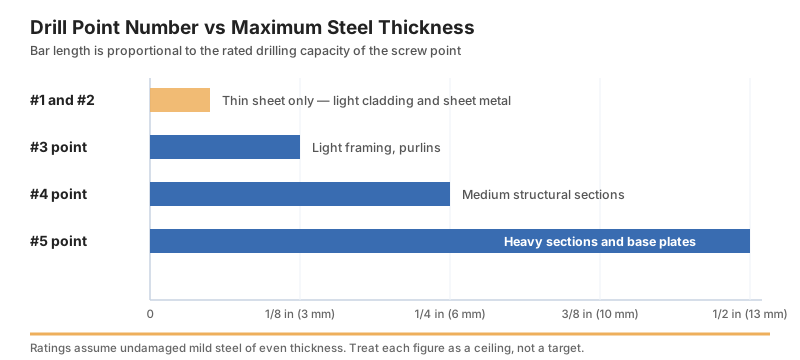
Read every published capacity as a ceiling, because the ratings assume undamaged mild steel of even thickness.
Why Drill Point Length Matters as Much as the Number
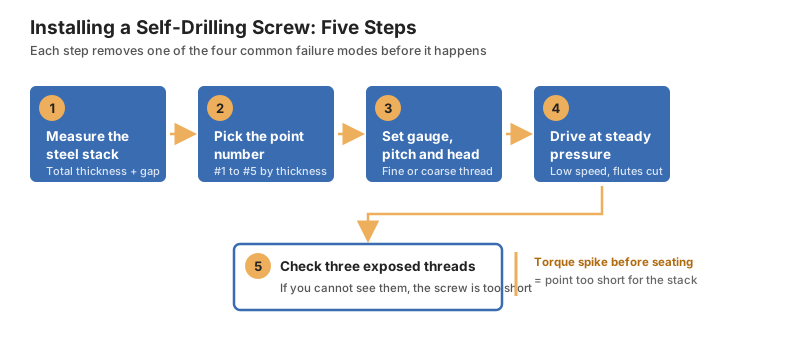
The self-drilling screw must finish drilling before the leading thread arrives, and forming a thread demands far fewer revolutions than drilling does. A point that is too short lets the thread bite while the tip is still cutting. Torque climbs sharply and the shank shears.
- Point length sets the stack — the tip must clear the full thickness before threads engage.
- Long points for thick steel — screws rated past 6 mm carry a longer point.
- Short points shear shanks — the commonest failure of a self-drilling screw on site.
Winged Points for Timber-to-Steel Work
Some drill points carry small wings just above the flutes, and those wings ream an oversized hole through the timber component of the connection. The timber is drilled rather than threaded, so the board cannot climb the shank before the point reaches steel.
The wings shear away on contact with the metal, leaving the threads to grip steel alone. Choose a winged point only where timber sits on top of the steel.
Gauge, Thread Pitch and Drilling Capacity
Reading Gauge as a Shank Diameter
Gauge is a shank diameter in an older numbering system, and converting it into millimetres clarifies the spec.
| Gauge | Shank diameter | Threads per inch | Maximum drill capacity |
|---|---|---|---|
| 10g | 4.8 mm | 16 | 3.5 mm |
| 10g | 4.8 mm | 24 | 4.5 mm |
| 12g | 5.5 mm | 14 | 4.5 mm |
| 12g | 5.5 mm | 24 | 6.0 mm |
| 14g heavy section | 6.3 mm | 20 | 12.0 mm |
- Gauge sets the shank — a higher number means a thicker, stiffer screw.
- Thread count moves the rating — two 12g screws can differ substantially in capacity.
Fine and Coarse Thread Pitches
Fine pitches work best in thin and medium-gauge steel, where additional engaged threads distribute the load across a shallow section. Coarse pitches grip better once the base material becomes appreciably thicker.
Head Styles and Sealing Washers
Hex Washer Heads Carry the Most Torque
A hex head carries far more driving torque than any other common style, which is why steel-to-steel work in heavy sections nearly always calls for one. The washer face also spreads bearing load and resists pull-over through thin sheet.
- Hex washer head — the highest driving torque of the common styles. - Preferred for steel-to-steel joints in heavier gauges. - The washer face spreads load and resists pull-over.
Countersunk and Pan Heads for Flush Work
Countersunk heads sink flush, which suits timber fixed down onto a steel substrate. Pan heads sit proud but drive cleanly, and they are a safe default for sheet-to-sheet joints.
Any self-drilling screw exposed to weather also needs a bonded sealing washer under the head.
- Countersunk head — sinks flush into timber fixed down onto steel.
- Bonded sealing washer — standard on roofing, cladding and exposed joints.
Length, Thread Engagement and Corrosion Protection
The Three-Exposed-Threads Rule
AISI S200 sets the length rule for cold-formed steel framing, and it says the self-drilling screw must be at least as long as the total material thickness including any gap. Three threads must also stay visible beyond the far face.
Three exposed threads is the site version of that rule. A self-drilling screw whose threads cannot be seen is too short for the joint.
Choosing Between Zinc, Coated and Stainless
Plain zinc plating is an indoor finish and nothing more, while coated screws are built to survive real outdoor service. Stainless is the right call on the coast and around chemicals.
The acceptance test behind those corrosion claims is a salt-spray exposure of at least twelve hours, permitting no white rust within the first three hours and no red rust by the end.
- Zinc plated — dry indoor work only, nothing beyond.
- Coated — qualified for exterior exposure, with salt-spray evidence.
- Stainless — the choice for coastal, chemical and humid conditions. - Confirm the salt-spray hours the batch was certified against. - Check the coating suits the metal it sits against.
Hydrogen Embrittlement and Dissimilar Metals
Case-hardened self-drilling screws are strong and brittle in roughly equal measure. Published guidance advises against using them outdoors or in permanently wet conditions, because hardened steel is vulnerable to hydrogen embrittlement. The same guidance cautions against combining them with dissimilar metals in a single connection.
Where a joint stays wet, a selectively heat-treated or stainless self-drilling screw is the safer call.
- No hardened screws in wet service — embrittlement fails without warning.
- No dissimilar metals in one joint — galvanic attack takes the fastener first.
Installing a Self-Drilling Screw Without Snapping It
Steady Pressure and Controlled Speed
The self-drilling screw wants steady axial pressure and a speed low enough to keep the flutes cutting rather than polishing. Drive it too fast and the tip work-hardens the very steel it is cutting.
The Four Failure Modes Worth Knowing
Almost every failed self-drilling screw belongs to one of four categories, and three of the four start in the spec rather than the installer.
- Point too small for the steel — the tip polishes instead of cutting, then burns out.
- Point too short for the stack — threads engage mid-drill and the shank shears.
- Screw too short overall — fewer than three threads clear the far face.
- Wrong finish for the exposure — the joint holds, then corrodes outwards from the fastener. - Zinc plating used outdoors is easily the commonest version of this mistake.
Frequently Asked Questions
Can a self-drilling screw be used in wood?
Winged points exist for timber fixed onto steel, so yes for that combination. Wood-to-wood joints are better served by a plain wood screw, which costs less and holds just as well.
What is the difference between a self-drilling and a self-tapping screw?
A self-tapping screw forms its own thread but still needs a pilot hole to start. A self-drilling screw makes that hole too, which is why it carries a drill point instead of a plain tip.
Do self-drilling screws need washers?
Washers are not always necessary, though thin sheet and any exposed joint gain from one. Bonded sealing washers are standard practice across roofing and cladding.
Which standards cover self-drilling screws?
ASTM C1513 is the material and performance standard for steel tapping screws in cold-formed steel framing, and it refers to SAE J78 for dimensions and performance. Screws made to that standard use a specified steel wire grade, then get case hardened to reach the required hardness, ductility and torsional strength.
Conclusion
A self-drilling screw is a specification, not a commodity, and three figures on the carton decide whether the joint survives. The drill point sets the thickness you can fasten, the gauge and pitch set the grip, and the finish decides how long the joint lasts.
Measure the steel first, then browse the full range of self-drilling screws, compare them against sheet metal screws, and review the wider drilling and tapping screw family.
Related Posts
HEPA Filter Guide: What the Grades Mean and Where One Belongs

Handrail Height: How to Get the Number Right in Every Code

Garage Floor Epoxy Coating: How to Test, Specify and Order It