HEPA Filter Guide: What the Grades Mean and Where One Belongs
By Nikhil Singh · 26 August 2026
Two suppliers quote you a HEPA filter. One writes H13, the other writes MERV 16, and the prices differ by a factor of three. Both quotes claim to cover the same duty.
Neither is lying. They are answering to different test standards, and the words on the label do less work than buyers assume.
This guide unpicks what a HEPA filter is measured against, how the grades line up, and which grade belongs in which room.
What a HEPA Filter Actually Is
The Definition Behind the Label
HEPA is an acronym for high efficiency particulate air, and the US Department of Energy owns the official definition.
A HEPA filter can remove at least 99.97% of dust, pollen, mould, bacteria and other airborne particles at a size of 0.3 microns.
That single figure is the whole basis of the claim. Everything else on a HEPA filter carton is marketing until it is tied back to a test.
Why the Test Uses One Awkward Size
The test size is not the smallest particle, and that surprises people.
It is the hardest particle to catch, known as the most penetrating particle size.
- Large particles are caught by impaction as the airstream bends.
- Small particles wander into fibres by diffusion and stick.
- Middle-sized particles slip past both mechanisms, which is why they set the score.
Anything larger or smaller than the test size is captured with even higher efficiency. A HEPA filter is therefore rated at its worst moment, not its best.
What "True HEPA" Is Not
The phrase "true HEPA" appears on packaging but not in any standard. Treat it as a claim to be checked rather than a grade to be trusted.
- Ask for the test standard by name and number.
- Ask for the tested efficiency, not a rounded marketing figure.
- Ask whether the whole filter was tested or only the media. - Media can pass while a badly sealed frame leaks. - The seal and gasket are part of the performance.
HEPA Filter Grades Under EN 1822 and ISO 29463
Outside the United States, a HEPA filter is usually specified by its EN 1822 class. ISO 29463 carries the same test into an international numbering scheme.
| EN 1822 class | ISO 29463 name | Integral efficiency at MPPS | Local efficiency |
|---|---|---|---|
| E11 | ISO 15 E | 95% or better | Not defined |
| H13 | ISO 35 H | 99.95% or better | 99.75% or better |
| H14 | ISO 45 H | 99.995% or better | 99.975% or better |
| U15 | — | 99.9995% or better | 99.9975% or better |
| U16 | — | 99.99995% or better | 99.99975% or better |
E11, H13 and H14
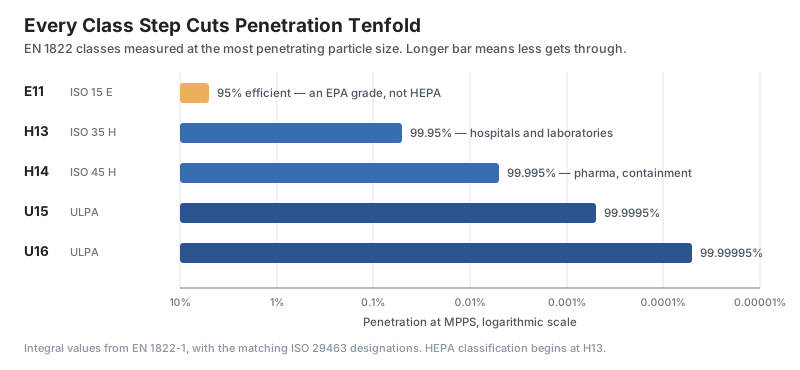
E11 is an EPA grade rather than a true HEPA filter, and it is often the right answer for a plant room. H13 and H14 are the two classes most specifications land on. Anything above them belongs to semiconductor and containment work.
Each step up the ladder cuts the particles that get through by about a factor of ten. That is why the jump from H13 to H14 costs so much more than the numbers suggest.
Integral Value Versus Local Value
Two numbers appear against each class, and only one of them describes the whole filter. The integral value is the average across the face. The local value is the worst single point found when a probe scans the finished filter.
A HEPA filter can pass on average and still fail at a pinhole. Insisting on the scanned local value is what stops that filter reaching your cleanroom.
The ISO 29463 Renaming
ISO 29463 keeps the EN 1822 test method and changes the labels.
H13 becomes ISO 35 H, and H14 becomes ISO 45 H.
If a datasheet quotes only the ISO name, the underlying performance is unchanged.
How a HEPA Filter Compares With MERV
What MERV Measures
MERV comes from an ASHRAE test method and reports how well a filter captures particles across three size bands. The rating runs from 1 to 16, and the bands are shown in the table below.
- The size bands run from 0.3 to 10 microns.
- MERV 8 is a common general-ventilation grade.
- MERV 13 is the level the US EPA suggests when upgrading a system.
- MERV 16 is the top of the scale, at 95% or better across every band. - The EPA table stops at 16 and lists HEPA on its own row. - That row is explicitly not a MERV rating.
Where MERV Stops
MERV 16 sits below the entry point for a HEPA filter, and the two scales do not convert cleanly. The EPA states plainly that HEPA particle size and capture efficiency are not based on the MERV rating system.
Treat any published MERV-to-HEPA conversion chart as an approximation.
| Grade | Test basis | Efficiency claim | Typical use |
|---|---|---|---|
| MERV 8 | ASHRAE, 1 to 10 µm bands | 70% or better at 3 to 10 µm | General ventilation |
| MERV 13 | ASHRAE, three size bands | 50% or better at 0.3 to 1 µm | Offices, schools, retail |
| MERV 16 | ASHRAE, three size bands | 95% or better in all bands | Final filter, prefilter to HEPA |
| H13 | EN 1822 at MPPS | 99.95% or better | Hospitals, labs, cleanrooms |
| H14 | EN 1822 at MPPS | 99.995% or better | Pharma, containment, semiconductors |
ISO 16890, the Global Alternative
ISO 16890 replaced EN 779 and now classifies general filters by group rather than class. It is the standard most of the world quotes below HEPA level.
- ISO ePM1 needs a minimum efficiency of 50% or better for particles up to 1 µm.
- ISO ePM2,5 applies the same threshold up to 2.5 µm.
- ISO ePM10 needs an average efficiency of 50% or better up to 10 µm.
- ISO Coarse is everything below that. - Reported efficiency is rounded down to the nearest 5% step. - Minimum efficiency is measured after the media is discharged.
Where a HEPA Filter Belongs
Cleanrooms and Pharma
This is the home ground for H14 and above. The filter is the last thing the air touches before it reaches the process. A scanned local value is not negotiable at this level.
Healthcare and Laboratories
H13 covers most hospital and laboratory duties, including isolation rooms and containment cabinets. The paperwork matters as much as the media here.
- Isolation rooms rely on the seal as much as the class.
- Safety cabinets are tested as installed, not as delivered.
- Extract paths may need a bag-in, bag-out housing. - Filters there are handled as contaminated waste. - The housing decides how they are removed.
Commercial HVAC
Most offices and schools do not need a HEPA filter at all.
A well-chosen ISO ePM1 or MERV 13 filter, changed on time, delivers more clean air than an oversized HEPA filter that the fan cannot push air through.
- Check the fan curve before specifying any high grade.
- Check the slot depth you actually have in the air handler.
- Check the housing seal type before ordering.
What a HEPA Filter Costs in Pressure Drop
Prefiltration Protects the Investment
A HEPA filter is expensive and slow to change, so it should never see raw air. A prefilter takes the coarse load and keeps the final stage clean for longer.
Two stages ahead of the HEPA filter is a common arrangement.
A coarse panel catches lint and insects, then an ISO ePM1 or pleated air filter removes the fine load.
Media Area and Format
Resistance falls as media area rises, which is why format matters more than it looks. A deep-pleat or minipleat air filter packs far more media into the same face area than a shallow panel.
- V-bank and box formats buy media area within a fixed slot.
- Minipleat construction lowers resistance at the same grade.
- Deeper frames last longer between changes.
Change-Out Timing
Change on measured pressure drop, not on the calendar. A manometer across the filter bank costs little and settles most arguments about whether a HEPA filter is spent.
- Record the clean pressure drop on the day of installation.
- Set a change limit from the manufacturer's figure.
- Log readings monthly so the trend is visible.
Buying and Fitting a HEPA Filter
Housings, Gaskets and Seals
A leak around a filter defeats the grade completely.
Gel seal and gasket seal housings solve the same problem in different ways, and the housing decides which filter you can buy.
- Gasket seal suits general HVAC and lower grades.
- Gel seal suits containment and higher grades.
- Bag-in, bag-out housings suit hazardous extract.
Certification Paperwork
Ask for the individual test certificate that belongs to the serial number on the frame. Our HEPA air filters list the class and the test standard against each product, which shortens that conversation.
Frequently Asked Questions
What does 99.97% actually refer to on a HEPA filter?
It refers to efficiency at the most penetrating particle size, which the US definition sets at 0.3 microns. Particles larger and smaller than that are captured at an even higher rate.
Is H13 the same as a HEPA filter?
Yes. H13 is the first true HEPA class under EN 1822, and it is listed as ISO 35 H under ISO 29463.
Can a MERV 16 filter replace a HEPA filter?
No. MERV 16 is the top of the ASHRAE scale but still sits below HEPA entry level, and the EPA states the two scales are not based on the same test.
Does a higher grade always mean cleaner air?
Not on its own. A high grade the fan cannot overcome moves less air, and a filter that is not sealed into its housing leaks past the media whatever its class.
How often should a HEPA filter be changed?
When the measured pressure drop across it reaches the limit set by the manufacturer or the system designer. Calendar intervals are a fallback, not a rule.
Conclusion
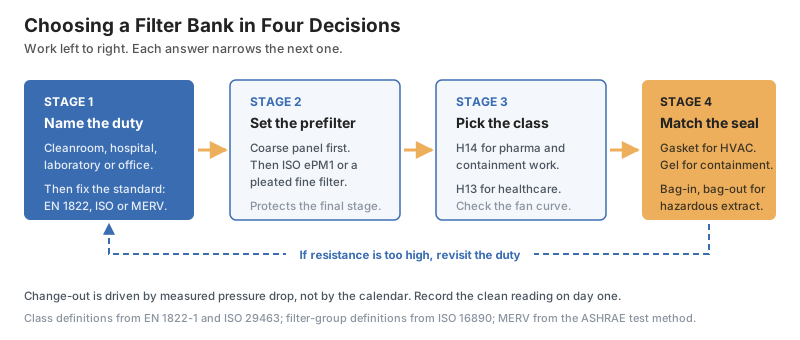
A HEPA filter is a test result wearing a label, and the label alone tells you very little. Ask which standard, which class, and whether the whole assembly was scanned rather than the media alone.
Then match the grade to the duty. Cleanrooms and pharma need H14, hospitals and laboratories usually need H13, and most commercial buildings are better served by a good prefilter changed on time.
Get those two decisions right and the HEPA filter does its job quietly for years.
Related Posts
Handrail Height: How to Get the Number Right in Every Code
Garage Floor Epoxy Coating: How to Test, Specify and Order It