Bus Duct Explained: Types, Ratings and Where It Beats Cable
By Miguel Duarte · 23 August 2026
A bus duct is the least glamorous part of a power system and one of the easiest to get wrong.
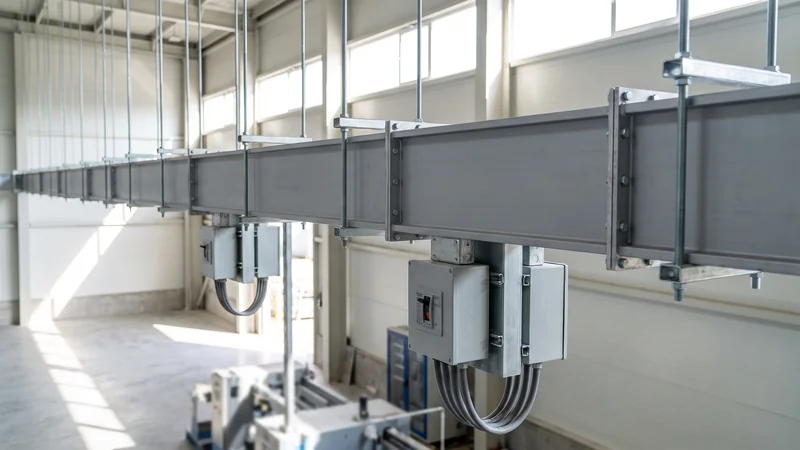
From the floor it looks like a plain metal box bolted to a ceiling. Inside are solid metal bars that carry more current than any sensible bundle of cable ever will.
Pick the right type and rating and the run outlives the building fit-out. Pick the wrong one and you pay in rework.
What a Bus Duct Actually Is
A bus duct is a factory-built assembly of solid copper or aluminium bars held inside a protective housing. Power travels along those bars instead of through insulated cable cores.
Insulation holds the bars apart inside a casing that bolts together on site. That is the whole idea. A bus duct arrives as sections, not on a reel.
The Parts Inside the Housing
- Conductors are flat copper or aluminium bars, sized for the current rating.
- Insulation is epoxy, polyester film or an engineered air gap between bars.
- The housing is a steel or aluminium casing that carries the mechanical load.
- Joints are bolted splice packs that link one section to the next: - Contact faces are usually silver plated. - Plating keeps joint resistance low for the life of the run.
- The earth path is an internal ground bus, a bonded housing, or both.
Bus Duct, Busway or Busbar Trunking
Three names, one product. North American catalogues say bus duct or busway, while British, Indian and Gulf specifications usually say busbar trunking system.
The IEC treats the whole family as one product and caps it at 1,000 volts AC. UL covers the same equipment for North America under its busway standard. The differences are in test regimes, not in what the thing is.
The Bus Duct Types You Will Meet
Feeder Bus Duct
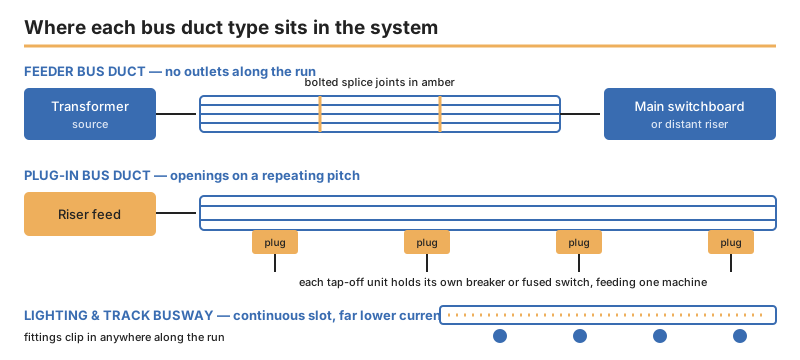
Feeder bus duct moves a large block of power from one point to another with nothing tapped off in between. It is the backbone of the system. Everything else hangs downstream of it.
- The typical route is transformer to switchboard, or switchboard to a distant riser.
- No outlets interrupt the run, so the housing stays sealed along its length.
- The highest ratings in any range live here.
Plug-In Bus Duct
Plug-in bus duct carries openings along the run so tap-off units land where the loads actually sit.
- Distribution on demand comes from plug-in units holding a breaker or fused switch.
- Standard sections of ten feet are common, so openings land on a repeating pitch.
- Layout changes cost far less than they do with cable: - Moving a machine means moving a plug, not re-pulling conductors. - Spare openings can be closed off until a tenant needs them.
Lighting and Track Busway
Lighting and track versions run at much lower currents and are built for constant access.
- A continuous slot lets fittings clip in anywhere rather than at fixed windows.
- Overhead use covers lighting rows, workshop benches and test bays.
- Lower ratings put these well below feeder territory.
Data centres and high-rise risers pushed overhead bus duct into the mainstream.
Both need power that can be re-arranged without an outage.
How to Read a Bus Duct Rating
Continuous Current Rating
This is the load the run carries all day without passing its temperature limit. One major manufacturer's low-voltage range spans 225 A to 4,000 A in aluminium and 225 A to 5,000 A in copper, in both feeder and plug-in builds.
Aluminium tops out lower for the same frame because it needs more cross-section per ampere.
Short-Circuit Withstand Rating
A bus duct also has to survive a fault long enough for the upstream breaker to clear it. Large institutional specifications commonly demand at least 125 kA rms symmetrical. The magnetic forces during a fault try to tear the bars apart, so bracing matters as much as metal.
Temperature Rise
Rise starts from the ambient the bus duct sits in, not from zero. A common requirement is a rise of no more than 55 degrees C at continuous rated current in a 40 degree C ambient.
| Nameplate figure | Typical value | What it limits |
|---|---|---|
| Continuous current | 225 A to 5,000 A | The load the run carries all day. |
| Short-circuit withstand | Often 125 kA rms symmetrical | What a fault does before the breaker clears. |
| Temperature rise | 55 degrees C over a 40 degree C ambient | How hot the bars get at full load. |
| System voltage | Up to 1,000 V AC under IEC rules | Where the product may go. |
Read all four together. A bus duct that satisfies the current figure and fails the fault figure is still the wrong product.
Bus Duct Versus Cable
Where Bus Duct Wins
- High current suits one assembly instead of several paralleled cable sets.
- Tap-off points put power where you need it long after handover.
- Change is cheap, because re-arranging a floor means unplugging rather than re-terminating.
- Space favours a flat housing over a bank of conduit or a loaded tray.
- Site labour drops, since sections bolt together instead of every core being pulled and dressed.
Where Cable Still Wins
- Small loads rarely justify a bus duct at all.
- Awkward routes suit cable, which bends around obstructions a rigid run cannot.
- Wet or corrosive areas need the right enclosure rating before bus duct belongs there.
- Short runs lose the advantage to joint count and feed units.
| Factor | Bus duct | Conduit and cable |
|---|---|---|
| Very high current | One assembly | Multiple paralleled sets |
| Adding a load later | Fit a plug-in unit | New termination and pull |
| Route flexibility | Straight runs and fitted elbows | Bends almost anywhere |
| Installed footprint | Compact | Bulky |
| Best fit | Risers, backbones, machine halls | Branches and small feeders |
Installing Bus Duct Without Rework
Support Spacing
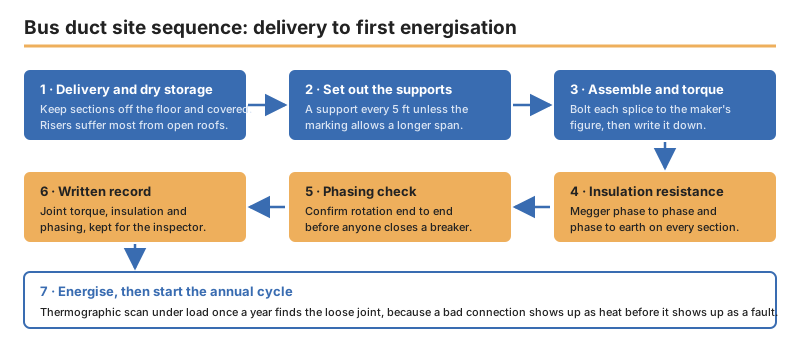
The National Electrical Code puts supports at intervals not exceeding 5 feet unless the busway is otherwise designed and marked. That marking is how product ranges rated for 10-foot centres exist.
Take that marking seriously. Hanging a 5-foot product on 10-foot centres is a defect, not a saving.
Risers and Floor Penetrations
Vertical runs take a support at every floor, usually an adjustable hanger that lets the run settle. Spring hangers carry the weight at each floor and absorb building movement and thermal expansion. The code also lets a run cross a wall in one unbroken length, so no splice sits inside the penetration.
Water Is the Enemy
Some jurisdictions have written explicit moisture rules into their amended code text. Indoor bus duct must be protected from moisture in storage and during installation, and riser bus duct gets special attention while roofs and walls are still open.
Where condensation or spillage is possible, drip pans or slant shields go in above the run.
Commissioning and Keeping It Healthy
Before the First Energisation
- Insulation resistance gets a megger test on every section, between phases and to earth.
- Joint tightness is set to the maker's torque figure and recorded.
- Phasing gets a check end to end before anyone closes a breaker: - A reversed riser is far cheaper to find now than after connection. - Some jurisdictions require the written test record for the inspector.
The Annual Checks
- Thermography under load finds the loose joint, because it shows as heat first.
- Housing integrity means looking for water staining, dents and missing covers.
- Plug-in units need a look, so that unused openings stay properly closed.
Frequently Asked Questions
What is a bus duct used for?
A bus duct carries high current between major equipment and distributes it along its length. Typical uses are building risers, plant-room feeders, machine halls and data centre power rows.
What is the difference between bus duct and busway?
Nothing at all, because they are two names for the same enclosed bar system, and busbar trunking system is the third name used in IEC markets.
Is bus duct cheaper than cable?
It depends on current and length. A bus duct usually wins on labour and space at high currents, while cable stays cheaper for small branch loads.
What ampere ratings does bus duct come in?
Standard ratings step from 100 A up to 5,000 A in copper, and 4,000 A is the usual aluminium ceiling. Building ranges often start at 225 A, while lighting and track versions sit far below that.
How often should bus duct joints be checked?
Maintenance standards now put a 12-month ceiling on infrared inspection of electrical equipment, and busway joints are on that list. Any joint running hotter than its neighbours gets opened and re-torqued.
Conclusion
Choosing a bus duct is a systems decision, not a shopping decision.
- Fix the type first, because feeder, plug-in or lighting decides everything after it.
- Read all four ratings together: current, fault withstand, rise and voltage.
- Respect the marking, since support spacing is a listed property rather than a preference.
- Test before energising with insulation resistance, torque and phasing, all written down.
Get those four right and the bus duct becomes the part of the installation nobody thinks about again. Browse the full range of busbars and busways, compare busway sections and bus plugs, and pick the system your load schedule actually calls for.
Related Posts
HEPA Filter Guide: What the Grades Mean and Where One Belongs
Handrail Height: How to Get the Number Right in Every Code


Garage Floor Epoxy Coating: How to Test, Specify and Order It