Drain Cleaner Guide: Matching the Bottle to the Blockage
By Angela Siniscalo · 22 August 2026
Most blocked drains get the wrong bottle poured into them.
The label says drain cleaner, so it goes down the drain.
What is really sitting in that pipe decides whether the product works or just floats on top of the clog doing nothing at all.
What a Drain Cleaner Actually Does
Nothing in the bottle pushes the blockage out of the way. Every drain cleaner works by changing what the clog is made of, until water can move through the pipe again.
Three Ways the Product Works
Poison Control splits the whole drain cleaner category cleanly in two.
Enzyme products carry live bacteria and enzymes, while the rest rely on acids or alkalis to break down the debris in the drain.
- Alkalis turn fat into soap, which water can carry away.
- Strong acids break hair and protein down into bits.
- Bleach and peroxide attack organic waste head on.
- Heat does part of the work on its own: - Some products give off heat as their contents mix. - That heat helps melt grease and other oily material.
What It Cannot Do
A drain cleaner is a chemical, not a tool. It will not cut roots, it will not fetch back a dropped ring, and it will not shift the hard scale that narrows a pipe over years of use.
Those jobs belong to drain cleaning and plumbing hand tools, or to a jetting contractor with a hose. Reaching for a stronger bottle instead is how a slow drain turns into a damaged pipe.
The Four Drain Cleaner Types
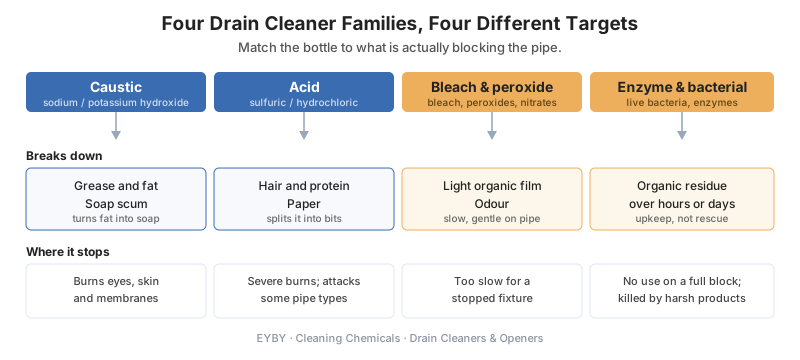
Four families cover the whole shelf, and each one goes after something different.
Pick your drain cleaner by what is in the pipe, not by what is on sale.
Caustic Drain Cleaner
Caustic products are the workhorse of the trade. The common alkalis are sodium hydroxide and potassium hydroxide, and sodium hydroxide turns up in a great many drain and oven cleaners.
NIOSH describes it as odourless white crystals that pull water out of the air. It is caustic enough to burn the eyes, the skin and the inner membranes, and it can even cause short-term hair loss.
- Best on grease, soap scum and food waste.
- Sold as liquid, crystal and gel.
- High-density gels are sold to sink through standing water: - The gel reaches the clog instead of floating above it. - That matters when the water will not go down at all.
- Gives off heat as it meets water and the blockage itself.
Acid Drain Cleaner
Acid products sit at the heavy end of the shelf, and they are the family that demands the most training. They are also the ones that do the most damage when they go wrong. No other drain cleaner needs quite this much respect.
- Sulfuric and hydrochloric acids are the usual actives.
- Best on hair, paper and protein.
- Rough on some pipe types and fittings.
- Highest hazard of the four families by a wide margin: - NIOSH calls sulfuric acid destructive to skin, eyes, teeth and lungs. - Severe exposure can result in death.
Bleach and Peroxide Drain Cleaner
This family uses bleach, peroxides or nitrates rather than a strong acid or alkali. It is kinder to pipework and slower to act, which suits a different job entirely.
Use it to keep a slow drain moving, not to rescue a fixture that has already stopped. It is a top-up product rather than a rescue one. Think of it as the drain cleaner you use before there is a problem.
Enzyme and Bacterial Maintainers
This family is not a rescue product at all. An enzyme drain cleaner carries live bacteria and enzymes that eat organic residue slowly, over hours or days rather than minutes.
- Best used on a schedule, never in a crisis.
- Safe on the pipe types that acids attack.
- Slow by design, because biology takes longer than chemistry does.
- Killed by the harsh products people reach for first: - Never dose enzymes into a drain that still holds acid or caustic. - Flush the pipe through with water first.
| Type | Usual actives | Best on | Main risk |
|---|---|---|---|
| Caustic | Sodium or potassium hydroxide | Grease, soap scum, food waste | Burns to eyes, skin and membranes |
| Acid | Sulfuric or hydrochloric acid | Hair, paper, protein | Severe burns; attacks some pipework |
| Bleach and peroxide | Bleach, peroxides, nitrates | Light organic build-up | Slow; reacts with other products |
| Enzyme and bacterial | Live bacteria, enzymes | Routine upkeep | No use on a full blockage |
Matching Drain Cleaner to the Blockage
Work out the cause before you choose a drain cleaner.
The fixture itself usually tells you what is sitting in the pipe below it.
Kitchen Sinks Are a Grease Problem
Kitchen waste is fats, oils and grease, held together by cooled fat. A caustic drain cleaner is the standard answer, because turning that fat into soap is exactly the reaction the job needs. Nothing else on the shelf suits a kitchen waste pipe as well.
Bathrooms Are a Hair Problem
Showers and basins block with hair bound up in soap scum. Acid or strong caustic products both handle it, though a hair trap in the waste is what stops it coming back.
Floor Drains Need Upkeep, Not Rescue
These block slowly and quietly, and nobody notices until the water pools. A booked enzyme dose keeps them running far better than the odd emergency bottle ever will.
| Blockage | First choice | Escalate to |
|---|---|---|
| Kitchen grease | Caustic liquid or gel | Mechanical rodding |
| Hair and soap scum | Acid or caustic, per label | Hair snake, then a trap fitting |
| Slow floor drain | Enzyme dose on a schedule | Caustic, then jetting |
| Standing water over a full block | Gel that sinks through water | Plunger and rod |
| Suspected object or root | None | Camera survey and mechanical work |
Where Drain Cleaner Should Never Go
Some drains are governed by rules rather than by preference.
Three of them are worth knowing before you open a bottle of drain cleaner.
Grease Traps and Interceptors
A grease trap is a collection device, and it only works while the grease stays put. Breaking that grease up so it flows onward defeats the whole point of fitting one. Any drain cleaner that loosens it simply moves the problem into the sewer.
Wastewater rules say so directly. One regional water utility allows hot water, steam, chemicals or biological additives in normal upkeep, but forbids using any of them in a way that releases fats, oils and grease from the trap.
- Emptying is the real maintenance job, not dosing.
- Every three months is the outer limit for an outdoor in-ground trap.
- A quarter of the operating depth filled with grease and solids triggers it sooner.
- Inspections run quarterly on indoor and outdoor units alike.
Septic Systems
A septic tank does its work with living bacteria. The EPA warns that pouring toxins down the drain can kill those organisms and harm the system, and it tells owners to avoid chemical drain openers on a clogged septic drain. Boiling water or a drain snake is the route it points to instead.
Drains That Already Hold Another Product
This is the mistake that sends people to hospital. Two workers were poisoned when a drain cleaner holding sodium hydroxide, sodium nitrate and aluminium chips reacted with arsenic residues already sitting in a drain, and the reaction gave off arsine gas.
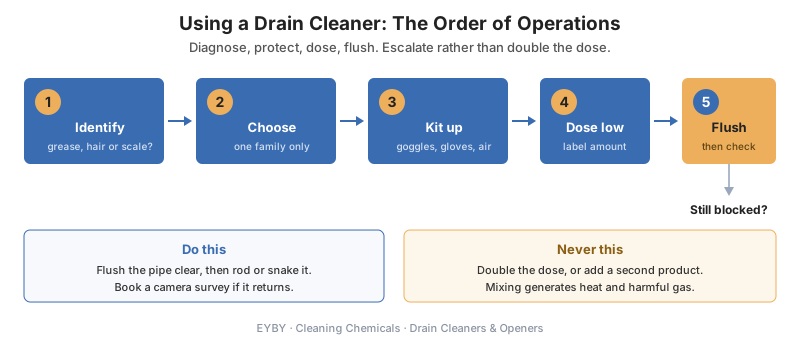
The rule that follows is simple enough. One product, one drain, flushed clear before anything else goes anywhere near it.
Does Baking Soda and Vinegar Work?
It is the most searched home remedy in the whole category, and the science does not back it up.
What Actually Happens
Baking soda is alkaline and vinegar is acidic, so mixing the two gives off carbon dioxide. The fizzing looks convincing enough in the sink.
Drains are not airtight, though. The gas escapes out through the drain cover, so it almost never builds the pressure needed to shift a blockage. A real drain cleaner does not depend on pressure at all.
Why It Fails on Real Clogs
Poison Control is blunt about the limit. The mixture is not likely to be strong enough to melt away the tough clogs that oil and grease create.
- Fine for odour and very light residue.
- Useless on a set plug of grease.
- Harmless, at least, next to the other options on the shelf.
Handling Drain Cleaner Safely
Protect Yourself First
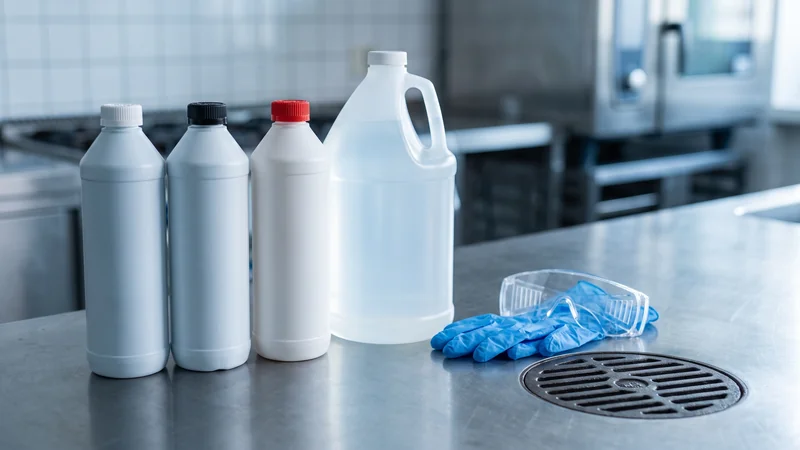
Goggles and rubber gloves are the baseline here. In a commercial kitchen or plant, chemical resistant gloves matched to the active are the better call.
- Air the room before you start work.
- Pour low, and close to the drain opening.
- Never overdose a drain that has stopped completely.
- Keep containers closed, clean and away from children: - Decanting into unlabelled bottles is how people swallow this stuff. - Store acids and caustics well apart from each other.
Splash-Back Is the Common Injury
Two habits cause most of it. Pouring from too high above the drain, and tipping in far too much product when the fixture has already stopped draining.
If Something Goes Wrong
Burns from these products move quickly, so treat any contact as urgent. Rinse the area, strip off soaked clothing, and get medical advice rather than waiting to see whether it settles down.
Frequently Asked Questions
What is the strongest drain cleaner?
Acid products are the most aggressive of the four. They are also the most dangerous, and they attack some pipe types, so raw strength is a poor way to choose.
Can I mix two drain cleaner products?
No. Combining them can give off heat and harmful gas, and one recorded poisoning came from a drain cleaner reacting with residues already sitting in the drain.
Does baking soda and vinegar unblock a drain?
Rarely. The gas escapes through the drain cover instead of building pressure, and the mixture is too weak for a clog made of grease.
Is drain cleaner safe for a septic tank?
The EPA tells septic owners to avoid chemical drain openers, because pouring toxins down the drain can kill the organisms that treat the waste. Boiling water or a drain snake is the recommended route instead.
Can I use drain cleaner in a grease trap?
No. The trap exists to hold fats, oils and grease back, and wastewater rules forbid using chemicals in a way that sends that content downstream.
Conclusion
Buying a drain cleaner is really a judgement call, not a shopping decision.
- Read the fixture before you read the shelf.
- Match the product to grease, hair or routine build-up.
- Keep enzymes for upkeep and caustics for grease.
- Stop at the boundary of grease traps, septic tanks and loaded drains.
The right bottle clears the pipe in a single dose, and the wrong one costs you a pipe. Browse the full range of drain cleaners and openers and pick the one your blockage actually calls for.
Related Posts

HEPA Filter Guide: What the Grades Mean and Where One Belongs

Handrail Height: How to Get the Number Right in Every Code

Garage Floor Epoxy Coating: How to Test, Specify and Order It