Garage Floor Epoxy Coating: How to Test, Specify and Order It
By Sonali Patel · 25 August 2026
A garage floor epoxy coating fails for boring reasons. Almost never the product, and almost always the slab underneath it.
The decision that matters is made before anything reaches the trolley.
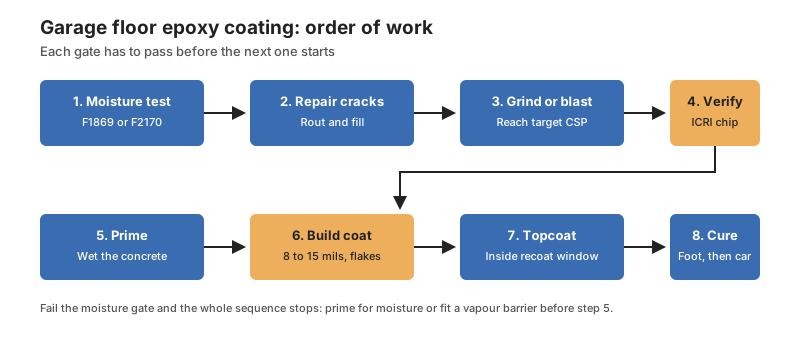
Test the concrete, then measure the profile. Those two numbers pick the garage floor epoxy coating.
What a Garage Floor Epoxy Coating Actually Is
Two Parts That Cure Rather Than Dry
A garage floor epoxy coating is a two-component system. Resin and hardener react chemically and lock a rigid film into the concrete.
Paint, by contrast, simply dries.
That difference drives everything below. A reacted film has a pot life, a recoat window and a temperature range. None of the three is optional.
- Two components — resin and hardener, mixed at the stated ratio.
- Chemical cure — the film hardens by reaction, not by air drying. - Once mixed, the clock runs whether you are ready or not.
- Mechanical key — the film grips the profile ground into the slab.
Solids Content Decides the Film You Get
Solids content is the share of wet product that survives the cure. It is the most useful figure on a garage floor epoxy coating datasheet.
Water-based products carry roughly 40 to 60 percent epoxy solids, so much of the film leaves with the water. Solvent-based versions build thicker but need respirators. A 100 percent solids product keeps its wet thickness.
| Type | Typical solids | Build per coat |
|---|---|---|
| One-part epoxy paint | Low, waterborne | Under 2 mils |
| Water-based epoxy | 40 to 60 percent | Thin film |
| 100 percent solids | 100 percent | 8 to 15 mils |
Test the Slab Before You Buy Anything
Moisture Vapour and ASTM F1869
Concrete pushes water upward for years. ASTM F1869, the calcium chloride test, reports it in pounds per 1,000 square feet per day.
Most resinous systems want three pounds or less. Above that, vapour pressure lifts a garage floor epoxy coating off the slab from below.
Relative Humidity and ASTM F2170
The second method is the in-situ probe defined in ASTM F2170. Sensors read humidity inside the slab, not at its face.
Published limits usually sit at 75 percent, and at 80 percent at most.
A slab that fails either test is not ready. It needs a moisture-tolerant primer or a vapour barrier first.
- Test bare concrete — sealers and residues distort both readings.
- Stabilise the room — temperature and humidity must be steady.
- Test the whole floor — a dry doorway says nothing about the back wall. - Spread the points out, then treat the worst reading as your number.
- Keep the paperwork — garage floor epoxy coating warranties ask for it.
Surface Profile Is the Whole Job
Reading the ICRI CSP Scale
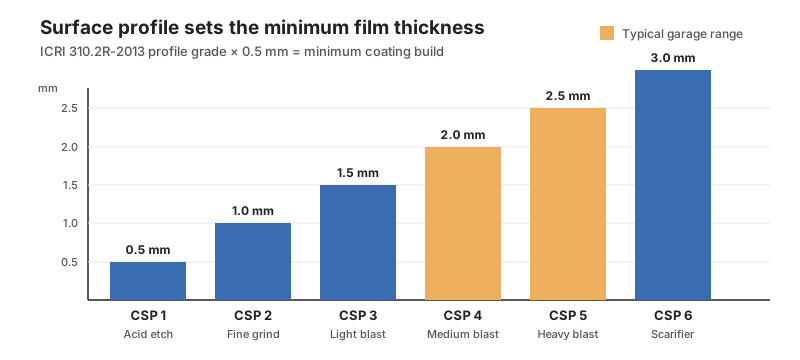
The International Concrete Repair Institute publishes Technical Guideline 310.2R-2013. It defines ten replica chips, numbered CSP 1 to CSP 10.
Lay a chip beside the prepared floor under raking light and compare. The chip that matches is your profile. It also decides which garage floor epoxy coating can bond to it.
| Profile | How it is produced | Coating it supports |
|---|---|---|
| CSP 1 to 2 | Acid etch or fine grind | Sealers and stains |
| CSP 3 | Grind plus light shotblast | Water-based epoxy |
| CSP 4 | Medium shotblast | Solids epoxy, about 1 mm |
| CSP 5 | Heavier shotblast | Self-levelling epoxy, 1.5 to 3 mm |
The Half-Millimetre Rule
Multiply the CSP number by half a millimetre and you have the minimum film thickness that profile needs.
The reason is physical. A topcoat has to bury the highest peaks, or aggregate shows through as permanent texture.
- Under-profiled — the film sits on glassy concrete and lets go, often within 6 to 18 months. - Blisters and edge curl start at drains, doorways and thresholds.
- Over-profiled — deep valleys trap air, so pinholes open in the film.
- Budget damage — over-profiling pushes consumption 30 to 50 percent above design quantity.
- Acid etching — it reaches about CSP 1, too smooth for a garage floor epoxy coating.
Choosing the Chemistry for Your Garage
Straight Epoxy and What It Is Good At
A 100 percent solids garage floor epoxy coating resists hot tyres, scratches, oil and chemical spills. Published guidance credits it with a life of up to twenty years.
Its weakness is ultraviolet light, because epoxy ambers where sunlight reaches it.
- Hot tyre resistance — why it beats floor paint in a working garage.
- Cheap film build — an epoxy build coat runs 8 to 15 mils.
- UV sensitivity — bare epoxy yellows behind glass or an open door.
Polyaspartic and Polyurethane Topcoats
A polyaspartic or polyurethane topcoat is UV-stable and stays clear. It also cures fast enough for a full system in one day.
The trade-off is working time. Epoxy pot life is commonly quoted at about an hour, while polyaspartic can gel inside twenty minutes.
| Factor | Solids epoxy | Polyaspartic |
|---|---|---|
| Installed cost | $3 to $7 per sq ft | $5 to $12 per sq ft |
| Published lifespan | 10 to 15 years | 15 to 20 years |
| Sunlight | Ambers | Stays clear |
| Pot life | About an hour | 20 to 60 minutes |
The Three-Coat System Most Trades Specify
Industry guidance recommends at least three coats. A primer wets the concrete, a build coat carries the thickness, and a topcoat takes the sunlight.
A garage floor epoxy coating and a polyaspartic are two layers of one specification rather than rivals.
Ordering a Garage Floor Epoxy Coating
Coverage Follows Thickness, Not Area
Coverage printed on a tin assumes a stated film thickness. Halve the thickness and you double the area, which is how a garage floor epoxy coating ends up too thin.
Order against your measured profile instead.
- Measure the slab — length by width, deducting nothing for the car.
- Fix the target thickness — the CSP number times half a millimetre. - A CSP 4 floor needs roughly twice the material of a CSP 3 floor.
- Add a waste allowance — 10 percent on a smooth slab, more on a rough one.
- Buy one batch — colour shifts between production runs.
Flakes, Grip and the Broadcast Rate
Flakes are broadcast into the wet build coat, and the rate changes both look and grip.
- Light scatter — reads as a speckle over the base colour.
- Full broadcast — reads as terrazzo and wants a thicker clear coat.
- Grip — a flaked garage floor epoxy coating stays walkable when wet.
Application Conditions and Sequence
Temperature, Dew Point and Timing
Epoxy wants roughly 50 to 55 °F as a minimum and struggles above 85 to 90 °F. Outside that band the film cures wrong.
Keep the slab at least 5 °F above the dew point.
The Recoat Window
Each coat has a window inside which the next one bonds chemically. Miss it and the next coat is only stuck mechanically.
- Mix what you can lay — split large batches rather than stretch pot life.
- Keep a wet edge — lap marks set permanently. - Cut the edges first, then roll the field into the wet line.
- Work in pairs — one person mixing, one rolling.
Cure and Return to Service
Foot traffic returns well before vehicles do, and full cure takes days.
- Follow the datasheet — a film can feel hard and still mark.
- Keep vehicles off longest — a warm tyre prints into a green garage floor epoxy coating.
Frequently Asked Questions
How long does a garage floor epoxy coating last?
Published figures put a 100 percent solids system at 10 to 15 years. A polyaspartic topcoat pushes that towards 15 to 20 years.
Can I apply a garage floor epoxy coating over painted concrete?
Not without removing the paint first. A garage floor epoxy coating bonds to whatever it touches, so it is only as strong as the old paint.
Does a new slab need to cure before coating?
Yes, because fresh concrete is still releasing its mixing water. The moisture tests above confirm readiness better than counting days.
Will a garage floor epoxy coating hide cracks?
No. Cracks need routing and filling first, since a rigid film cannot bridge a joint that still moves.
Is a garage floor epoxy coating slippery when wet?
Smooth gloss finishes are. Broadcast flakes or an anti-slip aggregate into the topcoat wherever water, snow or oil is likely.
Conclusion
A garage floor epoxy coating is a specification, not a purchase, and two measurements settle it. The moisture reading says whether the slab can hold a film; the profile says how thick.
Test first, prepare properly, then match the chemistry. Compare garage floor coatings, add floor chips for grip, and pick up rollers from coating applicators.
Related Posts
HEPA Filter Guide: What the Grades Mean and Where One Belongs
Handrail Height: How to Get the Number Right in Every Code