Flashlight Guide: How to Choose the Right Type for Every Job
Flashlight Guide: How to Choose the Right Type for Every Job
By Dmitry Shevlenko · 19 July 2026
A flashlight looks like a simple tool. In fact, the wrong pick can leave you short on light right when a job needs it most.
This guide breaks down what lumens and candela really mean, how to read water and drop ratings, and which specs matter for common work tasks.
Why Flashlight Specs Matter
Before 2009, flashlight boxes used vague terms like "high-flux LED" or "1 million candlepower." None of that let buyers compare one light to another.
ANSI/NEMA FL-1 fixed that gap. It is a voluntary standard that sets fixed test methods for six specs: light output, beam intensity, beam distance, runtime, water resistance, and impact resistance.
Three facts decide if a flashlight fits your job:
- How much light it puts out, and how that light is focused.
- How well it holds up to water and drops.
- How long it runs, and how the brightness fades over time.
Skip any one of these and you risk buying a light that looks strong on paper but fails on site.
Lumens vs. Candela: What Brightness Really Means
Two numbers drive most flashlight specs, and mixing them up leads to the wrong buy.
Light Output (Lumens)
Lumens measure total light sent out in every direction. A bare bulb in an integrating sphere gives a full lumen count, no matter where that light lands. More lumens does not always mean a brighter-looking beam.
A wide flood of light can measure high in lumens while lighting up almost nothing at a distance.
Peak Beam Intensity (Candela)
Candela measures how bright the beam looks at its hotspot, the center point. This is closer to what your eye reads as "brightness" when aiming a light at one spot. A reflector or lens can take the same lumens and focus them into a tight, far-throwing beam.
That raises candela sharply without changing the lumen count at all.
Beam Distance
Beam distance is the range at which the beam still matches full-moon light, about a quarter lux. FL-1 sets the formula as distance in meters equals the square root of four times the candela value. Double the candela and the beam distance grows by less than double, since the math runs on a square root.
Typical output ranges by flashlight type:
- Compact, everyday-carry lights: 50 to 300 lumens, 500 to 3,000 candela, 30 to 100 meters of throw.
- General work lights: 200 to 500 lumens, 2,000 to 8,000 candela, 80 to 180 meters.
- Flood or area lights: 500 to 1,500 lumens, 1,000 to 5,000 candela, 60 to 140 meters.
- Tactical or duty lights: 500 to 1,200 lumens, 10,000 to 30,000 candela, 200 to 350 meters.
- Long-throw search lights: 300 to 1,000 lumens, 50,000 to 200,000 candela, 450 to 900 meters.
Matching Beam Type to the Job
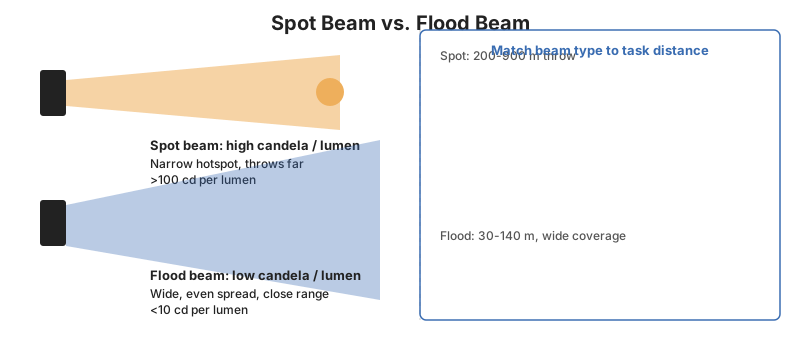
The ratio of candela to lumens tells you whether a flashlight throws a tight spot or a wide flood. Check that ratio before you compare beam distance between two lights.
Spot Beams
Spot beams pack light into a narrow hotspot, often above 100 candela per lumen. They reach far but can feel too harsh for work up close.
Flood Beams
Flood beams spread light wide, usually under 10 candela per lumen. Work lights use this pattern since even coverage matters more than throw at close range.
Pick beam type by task:
- Close-range panel or bench work: flood beam, low glare off shiny surfaces.
- Site walks and area scanning: a mix of flood and moderate throw.
- Long-distance search or ID work, such as: - Spotting a person or object across a lot. - Reading a sign or number from far off.
- Confined space or crawl space checks: flood beam, wide and even.
Perceived brightness does not scale evenly with candela either. It takes roughly four times the candela for a beam to look twice as bright to the eye.
Water and Impact Resistance Ratings
A great beam is wasted if the flashlight dies the first time it gets wet or dropped.
IPX Water Ratings
The IP in IPX stands for Ingress Protection, and the X means no dust rating was tested. Each number reflects one specific water test, and the ratings do not stack on each other.
Two things to remember about IPX numbers:
- A higher number does not always cover a lower one, since submersion and jet spray are separate tests.
- Look for a dual rating, such as: - IPX5/IPX7, if the flashlight needs to survive both hose spray and a drop in water. - A single IPX number, if only one type of exposure was tested.
IPX rating and what it means on site:
| IPX Rating | Test | Practical Meaning |
|---|---|---|
| IPX4 | Splashing water from all directions, 5 minutes | Heavy rain, job-site splash |
| IPX5 | 6.3 mm water jet, all directions, 3 minutes | Hose spray, washdown |
| IPX6 | 12.5 mm water jet, all directions, 3 minutes | High-pressure washdown |
| IPX7 | Submerged 1 meter, 30 minutes | Dropped in water, temporary flooding |
| IPX8 | Continuous submersion past 1 meter | Dive or underwater work |
A light rated IPX7 was tested for submersion, not for jet spray. Some makers test and list both, but if only one rating shows up, that is the only test the light passed.
Impact Resistance
Impact resistance is a drop test onto solid concrete, six times, from a stated height. The light must still switch on and run after every drop.
Rated drop height by use case:
- 1 meter: general use, belt or desk-height drops.
- 1.5 meters: work use, shoulder-height drops on site.
- 2 meters: tactical or industrial use, overhead work.
A drop rating does not cover:
- A vehicle rolling over the flashlight.
- A heavy load landing on it.
- Repeated stress on the internal circuit board over time.
Some makers run a separate, tougher crush test beyond what FL-1 requires.
Runtime and Battery Types
The runtime number on a box is not how long a light stays at full power.
Runtime Testing
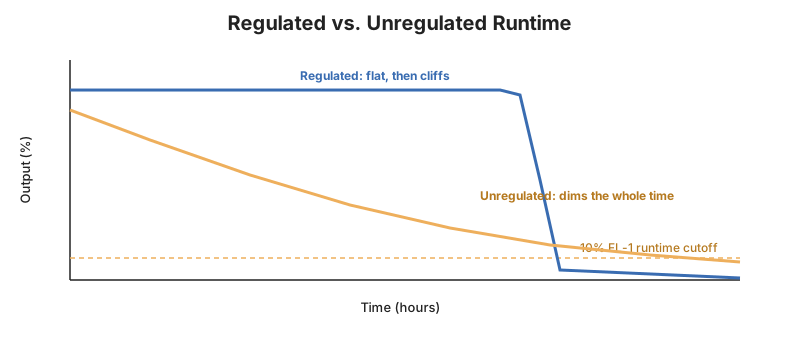
FL-1 runtime counts from 30 seconds after turn-on until output drops below 10% of the start level. Two lights with the same runtime number can behave in very different ways.
Watch for the output curve, not just the hours:
- A flat, regulated output holds near-full brightness, then drops off fast at the end.
- A gradual, unregulated output starts bright and dims slowly the whole time.
- Ask for a runtime graph if the box only lists one number.
Battery Types
Flashlights run on a mix of battery cell types, and each type brings its own tradeoffs to a flashlight's weight and cold-weather output.
Common cell types on the job:
- Alkaline: cheap and easy to find, but voltage drops fast under load.
- Lithium primary: better cold-weather output, long shelf life.
- Rechargeable lithium-ion: steady output, needs a charger on hand, such as: - A dock or cradle charger for a fixed light. - A USB cable for a light that charges in place.
- NiMH: rechargeable, works in standard AA or AAA sizes.
Keeping a set of spare rechargeable battery packs on the charger avoids a dead light mid-shift.
Minimum Specs by Task
Match the light to the job with a short checklist instead of guessing.
Baseline specs by common work task:
| Task | Lumens | Candela | IPX | Impact |
|---|---|---|---|---|
| General maintenance | 150+ | Any | IPX4 | 1 m |
| Electrical work | 200+ | Any | IPX4 | 1 m |
| Confined space entry | 200+ | Any | IPX7 | 1.5 m |
| Outdoor construction | 300+ | 5,000+ | IPX4 | 1.5 m |
| Security or patrol | 500+ | 10,000+ | IPX7 | 2 m |
| Search and rescue | 500+ | 30,000+ | IPX7 | 2 m |
Electrical work also calls for a non-conductive body, and confined space entry may need an intrinsically safe light if the air could be hazardous. Stocking a mix of handheld flashlights and headlamps covers most of these tasks without over-buying on any one spec.
Frequently Asked Questions
What is the difference between lumens and candela? Lumens measure total light output in every direction. Candela measures how bright the beam looks at its center point, which matters more for how far a light throws.
Does a higher lumen count always mean a better flashlight? No, a tightly focused 200-lumen beam can throw light much farther than an unfocused 1,000-lumen flood.
Is ANSI/NEMA FL-1 testing required by law? No, it is voluntary. A manufacturer that claims FL-1 compliance must follow the exact test methods. No regulation forces any flashlight maker to test at all.
What does an IPX7 rating actually confirm? It confirms the light survived being submerged in 1 meter of water for 30 minutes. It does not confirm the light passed a water-jet or spray test unless that is listed too.
Why do two flashlights with the same runtime behave so differently? The FL-1 runtime number only marks when output drops below 10% of starting brightness.
One light can hold near-full output the whole time, then cut off fast. Another can dim steadily from the moment it turns on.
When does a job need an intrinsically safe flashlight? Confined spaces or areas with a possibly hazardous atmosphere need a light certified under UL 913, on top of any FL-1 rating.
Conclusion
Picking the right flashlight comes down to three checks: how the light is focused, how it holds up to water and drops, and how its runtime actually behaves.
Match beam type to the distance you need to cover, check the IPX and impact ratings against your work conditions, and look past the headline runtime number to the output curve behind it. A light chosen this way earns its spot on the truck instead of getting swapped out after one bad job.
Related Posts