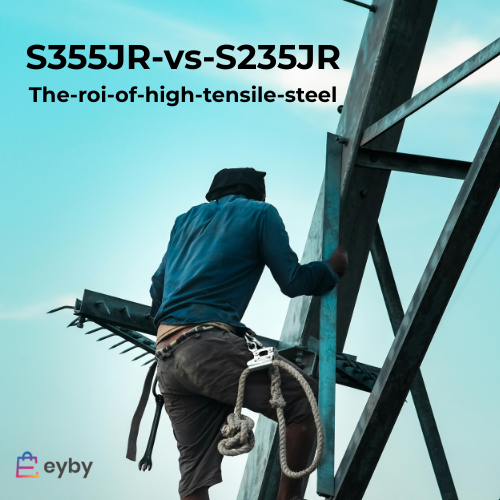
S355JR vs. S235JR Cost-Benefit Analysis: The ROI of High-Tensile Steel
📌 Summary:
- Key Finding: While S355JR has a 20-25% higher raw material cost than S235JR, it offers 50% higher yield strength, enabling weight reductions of up to 30%.
- Logistics Impact: Reduced structural weight leads to a direct reduction in shipping costs and lower embodied carbon for the project.
- Structural Logic: Using S355JR allows for smaller cross-sections (slenderizing), which decreases foundation loads and speeds up onsite erection.
- Standard Reference: Both grades comply with EN 10025-2. S355JR is the preferred choice for heavy-duty load-bearing structures like bridges and high-rises.
🔬 The Mechanical Reality: 235 vs. 355
In the world of structural engineering, the numbers in the steel grade represent the minimum yield strength in megapascals (MPa).
- S235JR: Yield strength of 235 MPa.5
- S355JR: Yield strength of 355 MPa.6
This roughly 50% increase in strength means that for the same applied load, an S355JR beam can have a significantly smaller cross-section than an S235JR equivalent.
📈 The Economic Ripple Effect: How S355JR Saves Money
At first glance, procurement teams may favor S235JR due to its lower price per ton. However, a "Total Cost of Ownership" (TCO) analysis reveals that S355JR is often the more economical choice for large-scale projects.
1. Direct Material Savings
Because S355JR is stronger, you need less total steel by volume to achieve the same structural safety factor.
- Example: Replacing a heavy S235 column with a slimmer S355 section can reduce the weight of that single component by 20% to 35%.
- Calculation: If S355 costs 25% more but uses 30% less material, the net material cost is actually lower.
2. Lower Shipping & Logistics Costs
Steel is heavy, and transportation is often a primary cost driver in 2026.
- Freight Optimization: A 30% reduction in structural weight means 30% fewer trucks on the road or fewer shipping containers at sea.
- Onsite Handling: Lighter beams allow for the use of smaller, less expensive cranes during the erection phase, reducing daily rental costs.
3. Foundation and Civil Works
The total "deadweight" of a building determines the size of the concrete foundations.
- Direct Cause & Effect: Lighter steel frames → Smaller foundations → Reduced concrete and excavation costs.
🚢 Shipping Cost Impact: A Sample Project
To illustrate the ROI, consider a project requiring a structural capacity of 1,000 Tons using S235JR.
|
Project Metric |
Option A: S235JR |
Option B: S355JR |
|
Required Tonnage |
1,000 Tons |
~720 Tons (28% reduction) |
|
Material Cost (Per Ton) |
$800 |
$1,000 (25% Premium) |
|
Total Material Cost |
$800,000 |
$720,000 |
|
Total Shipping Units |
40 Trucks |
29 Trucks |
|
Logistics Savings |
$0 (Baseline) |
~27% Savings |
🛠️ Fabrication Considerations
While S355JR wins on weight and shipping, it requires slightly more care in the workshop.
- Weldability: Both are highly weldable, but S355JR has a higher Carbon Equivalent (CEV). For sections thicker than 30mm, preheating is often required to prevent cracking.
- Tooling: S355JR is harder. Machining and Abrasives will wear down slightly faster than when working with the "softer" S235JR.
🛒 Sourcing High-Tensile Steel via EYBY Marketplace
EYBY Marketplace specializes in optimizing steel procurement for 2026 industrial needs.
- Weight Calculation Tools: Our platform helps you compare the tonnage requirements for different grades before you buy.
- Global Shipping Network: We leverage our logistics partnerships to pass the "high-tensile weight savings" directly to you through lower freight rates.
- Quality Assurance: All S355JR plates and sections are supplied with 3.1 Mill Certificates, ensuring the 355 MPa yield strength is verified.
❓ FAQ: S355JR vs. S235JR
Is S355JR always better than S235JR?
Not for every project. For low-load, secondary structures like handrails or small fences, the extra strength of S355JR is unnecessary, and the lower cost of S235JR makes it the better choice.
Does using S355JR affect the project timeline?
Yes, it usually speeds it up. Lighter beams are easier to handle and require fewer logistical trips, though you must account for specialized welding procedures if using very thick plates.
Is S355JR better for the environment?
Yes. By using less material, you reduce the "embodied carbon" of the building. Furthermore, fewer transport trips result in lower CO2 emissions for the overall project.
Related Posts
Drywall Anchors: How to Choose the Right Type for Every Wall
Sandpaper Grit Guide: How to Choose the Right Grit for Any Job
Gutter Guards: How to Choose the Right Type for Every Roof