How to Choose a Vacuum Pump: Types, Vacuum Levels and Sizing
By Macy Chen · 14 August 2026
Most vacuum pump purchases go wrong in the same place. The buyer shops on flow, gets a machine that moves plenty of air, and then discovers it cannot hold the pressure the process actually needs.
Pressure comes first and flow comes second, so this guide covers the pressure ranges, the four industrial technologies that serve them, and the sizing maths that decides whether the pump you order will reach the number on the spec sheet.
What a Vacuum Pump Actually Does
It Removes Gas, It Does Not Pull
A vacuum pump does not create suction. It removes gas molecules from a sealed chamber, and atmospheric pressure outside does the rest of the work.
Every molecule taken out makes the next one harder to reach, which is why the last stretch of a pump-down takes far longer than the first.
- Removal, not attraction: the pump extracts, the atmosphere pushes.
- Diminishing returns: fewer molecules left means slower progress.
- Sealing: a leak refills the chamber faster than any pump empties it. - Rate of rise tells you more than the gauge reading. - A sealed chamber is worth more than a bigger machine.
Wet and Dry Designs
Vacuum pump technologies split into wet and dry families, depending on whether the gas being moved touches oil or water during compression.
Wet pumps seal and lubricate themselves with fluid, and industrial vacuum pump makers note that this fluid can taint the swept gas. Dry pumps rely on tight clearances, dry PTFE seals or a diaphragm instead.
Dry does not mean oil-free everywhere, because oil or grease still lubricates the gears and bearings, kept separate from the compression side.
- Wet: oil-sealed or water-sealed, cheaper, deeper vacuum.
- Dry: no fluid in the gas path, no oil disposal, no mist.
- Hybrid reality: dry pumps still carry oil in the gearcase. - Oil disposal is a running cost on wet machines. - Contamination risk is the reason food plants go dry.
Vacuum Levels Decide Everything Else
The Five Pressure Ranges
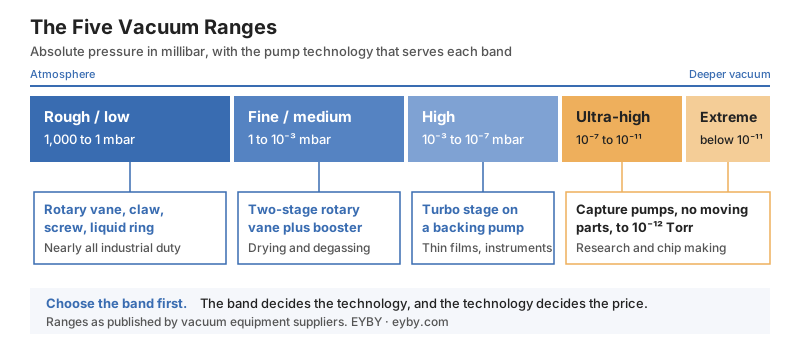
Vacuum is not one condition but a span of roughly fourteen orders of magnitude, which vacuum equipment suppliers divide into five named bands.
| Range | Absolute pressure (mbar) | Absolute pressure (Torr) | Typical work |
|---|---|---|---|
| Rough / low | 1,000 to 1 | 760 to 0.75 | Packaging, handling, forming |
| Fine / medium | 1 to 10⁻³ | 0.75 to 7.5 x 10⁻⁴ | Drying, degassing, coating prep |
| High | 10⁻³ to 10⁻⁷ | 7.5 x 10⁻⁴ to 7.5 x 10⁻⁸ | Thin films, analytical instruments |
| Ultra-high | 10⁻⁷ to 10⁻¹¹ | 7.5 x 10⁻⁸ to 7.5 x 10⁻¹² | Surface science, chip making |
| Extreme high | below 10⁻¹¹ | below 7.5 x 10⁻¹² | Research only |
Where Industry Actually Lives
Nearly all industrial work happens in the rough band, and a good deal of the rest in the fine band. Packaging, material handling, woodworking and general process duty rarely go below one millibar.
High vacuum needs a second pump in series, and capture pumps that trap molecules on cold or reactive surfaces reach as low as 10⁻¹² Torr with no moving parts at all.
- Rough: one pump, one stage, most of the market.
- Fine: two-stage machines or a booster on top.
- High and below: staged systems, usually a turbo or capture stage. - A backing pump still sits behind every high-vacuum stage. - Staging adds cost long before it adds capacity.
The Four Industrial Vacuum Pump Types
Rotary Vane
The rotary vane vacuum pump is the default choice for point-of-use duty. Vanes slide in an eccentric rotor, sweeping gas from inlet to exhaust, with oil sealing the clearances.
Pump maker data puts the ultimate pressure of a single-stage oil-sealed machine between a tenth and half a millibar, which covers packaging, woodworking, plastics, paper and printing, and material handling. Two-stage designs go further, to roughly 10⁻³ mbar.
The trade is service. Vanes wear, oil needs changing, and the exhaust needs a mist filter.
Liquid Ring
A liquid ring vacuum pump uses a fixed-blade impeller mounted off-centre in a cylindrical casing. Rotation throws liquid outward into a ring that seals the blade tips and forms the pumping chambers.
This is the technology for wet, dirty and vapour-laden gas. It tolerates liquid carryover that would destroy a dry machine, which is why distilling, drying and dewatering duties use it. Nothing else handles condensables as calmly.
Single-stage efficiency is very good above 200 mbar, and capacities generally run from 170 to 37,500 m³/h.
Dry Claw
Two claw-shaped rotors turn in opposite directions without touching, timed by a precision gear. Nothing oils the pumping chamber, so no oil reaches the process gas.
Flows vary between 65 and 1,230 m³/h. Ultimate vacuum for a claw is typically 140 mbar absolute, and the latest designs reach 50 mbar absolute. Neither number is deep, and neither needs to be.
Two-stage versions run two chambers in series and work below 200 mbar, which suits continuous drying, degassing and solvent recovery.
Rotary Screw
Rotary screw vacuum pumps borrow proven screw compressor geometry. Two counter-rotating screws form chambers that move gas axially from suction to discharge.
Maximum flow lands around 5,004 m³/h, and the technology is optimised to perform at 400 mbar and below. Above that, another technology usually wins. Claw or liquid ring normally takes over.
Variable speed drive is the reason these dominate large central systems. Suppliers report that a central vacuum system can cut energy consumption by up to 50 percent.
| Technology | Ultimate pressure | Flow range | Best for |
|---|---|---|---|
| Rotary vane (oil-sealed) | 0.1 to 0.5 mbar single-stage, about 10⁻³ mbar two-stage | Small to mid | Packaging, printing, handling |
| Liquid ring | Efficient above 200 mbar | 170 to 37,500 m³/h | Wet and vapour-laden gas |
| Dry claw | 140 mbar, down to 50 mbar | 65 to 1,230 m³/h | Clean, oil-free duty |
| Rotary screw | Optimised at 400 mbar and below | Up to about 5,004 m³/h | Large central systems |
Sizing a Vacuum Pump Correctly
Pumping Speed and Throughput
Throughput is the quantity that matters. A vacuum technology textbook gives it simply as pressure times pumping speed, where speed is a volume flow rate. Litres per second, cubic feet per minute and cubic metres per hour are the usual units.
The catch is that pumping speed is not constant. It falls as chamber pressure falls, and eventually reaches zero at the ultimate pressure of the machine.
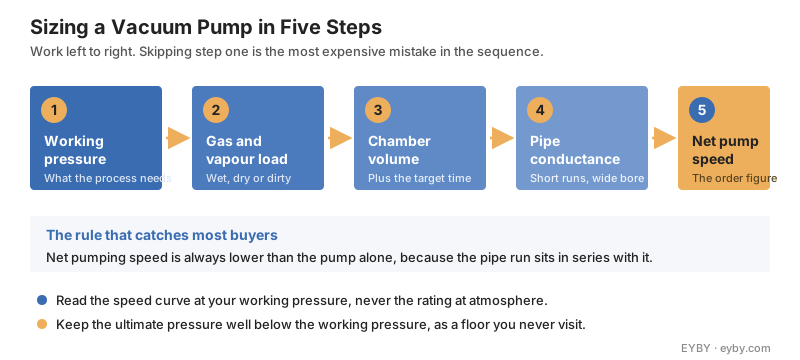
Manufacturers publish speed-versus-pressure curves for exactly this reason. Read the curve at your working pressure, never the headline figure at atmosphere.
- Rated speed: measured at or near atmospheric pressure.
- Working speed: what you get at the pressure you run.
- Zero speed: the ultimate pressure, where progress stops.
Conductance and the Pipe Run
Pipework is not neutral. The connecting line and valves have a conductance value, and it sits in series with the pump.
The same text gives the relationship as one over the net speed equals one over the pump speed plus one over the piping conductance. The net pumping speed is therefore always lower than the pump alone. Design the line so the difference stays small.
In practice that means short runs and wide bores. A long, narrow pipe can throttle an expensive pump down to the performance of a cheap one.
- Short: every extra metre costs conductance.
- Wide: bore diameter dominates the calculation.
- Straight: elbows and undersized valves both restrict flow. - Match the line bore to the pump inlet, never smaller. - A throttled inlet looks exactly like an undersized pump.
Ultimate Pressure Versus Working Pressure
Select a pump whose ultimate pressure is comfortably below the pressure the process requires. A machine running at its own limit has no speed left to overcome leaks or outgassing.
A useful habit is to treat the ultimate pressure as a floor you never plan to visit. Size for the working pressure, then check the floor sits well underneath it.
- Working pressure: the number the process specifies.
- Ultimate pressure: the floor, with margin underneath.
- Leak rate: what quietly sets the real achievable pressure.
When a Blower Is the Better Answer
Regenerative Blowers
Plenty of applications labelled vacuum work do not need a vacuum pump at all. Regenerative blowers move large volumes at shallow vacuum or low pressure, which suits aeration, conveying and drying. Kinetic energy is added on every rotation as gas travels along the side channel, raising pressure by stages rather than in one squeeze.
Positive Displacement Blowers
Positive displacement blowers sit between blowers and pumps. They deliver constant volume against varying pressure, which is what pneumatic conveying and wastewater aeration both need. If your duty is high flow at shallow vacuum, a blower is usually cheaper to buy and cheaper to run than the equivalent vacuum pump.
- Regenerative: high flow, shallow vacuum, oil free.
- Positive displacement: constant volume, variable pressure.
- Vacuum pump: when the pressure target goes deep.
Browse the rotary vane vacuum pumps, the liquid ring vacuum pumps and the rotary claw vacuum pumps side by side before committing to a technology.
Vacuum Pump Installation and Maintenance
Oil, Filters and Exhaust
An oil-sealed vacuum pump lives or dies on its oil. Contaminated oil raises the ultimate pressure long before anything sounds wrong.
Inlet filtration protects the pumping chamber from dust and process carryover. Exhaust mist filters protect the room. Both are cheap next to a rebuild.
- Oil condition: cloudiness signals moisture or process ingress.
- Inlet filter: cheaper than a set of vanes.
- Exhaust filter: keeps oil mist out of the workspace.
Leak Checking Beats Oversizing
When a system will not reach pressure, the instinct is to order a bigger vacuum pump. That is usually the expensive wrong answer.
Leaks and outgassing set the achievable floor, and a system that leaks will defeat any pump you fit.
- Isolate and hold: watch the rate of rise, not the reading.
- Fix the seals: gaskets and fittings before hardware.
- Then resize: only once the system holds.
Frequently Asked Questions About Vacuum Pumps
What is the difference between a wet and a dry vacuum pump?
A wet vacuum pump uses oil or water inside the pumping chamber to seal and lubricate it, and that fluid can taint the gas being pumped. A dry vacuum pump keeps the chamber fluid-free using tight clearances, PTFE seals or a diaphragm.
Which vacuum pump type reaches the deepest vacuum?
Among the common industrial technologies, oil-sealed rotary vane machines go deepest. A single-stage machine reaches a tenth to half a millibar and a two-stage machine roughly 10⁻³ mbar, while capture pumps reach as low as 10⁻¹² Torr.
How do I size a vacuum pump?
Start with the working pressure your process needs, then read the published pumping speed at that pressure rather than the rated figure at atmosphere. Add the chamber volume, the target pump-down time and the conductance of the pipe run to arrive at a net pumping speed.
Why does my vacuum pump not reach its rated pressure?
Nine times out of ten the system leaks, outgasses, or the oil is dirty. Pumping speed also falls steeply as pressure drops. A pump sized on its atmospheric rating will always disappoint at working pressure.
Do I need a vacuum pump or a blower?
Choose a blower for high flow at shallow vacuum, such as conveying, aeration or drying. Choose a vacuum pump once the target drops well into the rough range, where the claw, screw and vane technologies are optimised.
Conclusion
Buy a vacuum pump in three moves. Fix the working pressure first, pick the technology that owns that band, then size the pumping speed at that pressure rather than at atmosphere.
Rotary vane for deep point-of-use vacuum, liquid ring for wet gas, claw for clean processes, screw for large central systems.
After that it is plumbing and housekeeping. Keep the pipe short and wide, keep the oil clean, and check for leaks before you order anything bigger, alongside the regenerative blowers that may do the job for less.
Related Posts
Sandblasting Sand: Why the Cheapest Abrasive Costs You the Most

Types of Pliers: Jaw Shapes, Grip and What Each Pair Is For