
Showing 0 products
Frequently Asked Questions
What changes when there is no shower tray?
The floor becomes the waterproof layer.
A tray is waterproof in itself.
A wet room floor has to be made so.
And the drain becomes part of it.
Not a fitting sitting in it.
How does the drain join the waterproofing?
Through a flange it is designed to receive.
The membrane laps onto it.
And is clamped or bonded down.
That joint is the whole detail.
Nearly every failure happens there.
Why is a failure there so serious?
Because it is invisible and buried.
Under screed and a finished floor.
By the time it shows, it has been leaking.
Often into the structure below.
Getting it right first time is the only option.
What decides which drain will fit?
The depth available under the floor.
Body plus trap has an overall height.
That must fit above whatever is below.
A slab, joists, or a ceiling below.
Resolve it before the floor is built.
How does the floor fall to the drain?
Differently for each type here.
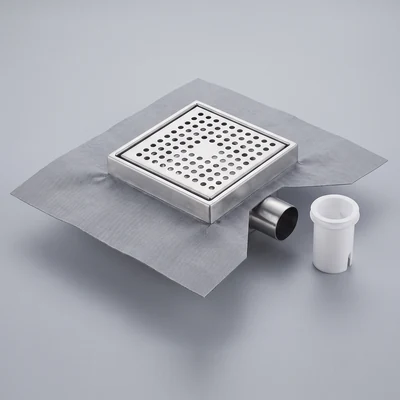
A point drain needs falls from all sides.
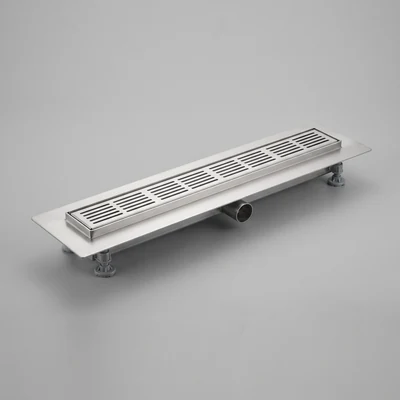
A linear channel needs one slope.
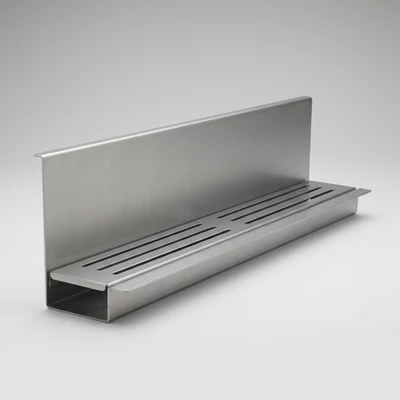
A wall channel takes that to the edge.
The arrangement is the choice.
Why does tile size come into it?
Because a rigid tile cannot bend.
A floor falling two ways at once.
Needs tiles small enough to follow it.
A single-direction fall does not.
So the drain choice constrains the finish.
Does flow rate need checking?
Yes, and it is often assumed.
Modern showers deliver far more water.
Than the ones drains were sized for.
An undersized drain floods the floor.
Which in a wet room has nowhere to stop.