Silicone Sealant Guide: Types, Cure Times, and Uses
By Cecillia Wehmeyer · 11 July 2026
Grab the wrong silicone sealant and you find out the hard way. Acetoxy cure on a stainless steel frame turns into a corroded, discolored mess within a season. Neutral cure on a rush job that needed a fast skin just sits tacky for an extra twenty minutes you didn't have.
This guide breaks the choice down into what actually matters: cure chemistry, movement rating, substrate fit and cure time. Read it once and every future pick gets faster.
What Is Silicone Sealant?
Silicone sealant is a one-part, room-temperature-vulcanizing (RTV) elastomer. It cures by reacting with atmospheric moisture, not by drying or solvent loss. That single mechanism sets it apart from acrylic and polyurethane caulks.
That single fact explains most of how it behaves on the job:
- It skins from the outside in, so thick beads cure slower at the core than at the surface.
- Once cured, it stays flexible for decades, unlike rigid fillers that crack under movement.
- It bonds by adhesion, not mechanical interlock, so surface prep decides whether it holds or peels.
Two cure chemistries dominate the market, and they are not the same.
Acetoxy vs Neutral-Cure Silicone Sealant
Every formulation releases a byproduct as it cures. Which byproduct it releases determines where you can safely use it.
Acetoxy-Cure Silicone Sealant
Acetoxy silicone sealant cures by releasing acetic acid — the source of its sharp, vinegar-like smell during application. The chemistry is cheap and fast, but it comes with two hard limits.
- Never apply acetoxy silicone sealant on bare aluminum, steel, copper, brass, or zinc; the acid corrodes these metals.
- Avoid it on marble, limestone, travertine, and other calcareous stone; the acid can etch or stain the surface.
- Tack-free time runs about 10 to 15 minutes, with full cure finishing within 24 to 48 hours.
- It costs roughly 20 to 40 percent less than neutral-cure equivalents, which is why it still dominates glass and tile work.
It earns its keep on glass-to-glass joints, glazed ceramic tile, aquariums, and painted-metal trim where no bare metal or natural stone is involved.
Neutral-Cure Silicone Sealant
Neutral-cure silicone sealant releases non-corrosive alcohols or ketoximes instead of acid. That single change removes the metal and stone restrictions entirely. It costs more, but the wider substrate list often makes up the difference in avoided callbacks.
- Neutral-cure silicone sealant is safe on aluminum, steel, stainless steel, copper, brass, and zinc — the standard pick for window frames and curtain walls.
- Safe on natural stone when ASTM C1248-certified, confirming it will not stain porous surfaces.
- Tack-free time runs 20 to 30 minutes, with full cure typically taking 3 to 7 days.
- Priced 30 to 50 percent above acetoxy, a small premium against a corroded-frame or stained-stone callback.
Specify neutral-cure by default on any exterior, metal-contact, or natural-stone project. Reserve acetoxy for interior, non-metal, budget-driven work.

Silicone Sealant Cure Time Chart
It cures through its cross-section at a fairly constant rate, which means joint depth — not just chemistry — sets how long a project needs before it can take load or get wet.
| Bead depth | Approximate full cure | Notes |
|---|---|---|
| 3 mm (0.12 in) | 24 to 36 hours | Typical thin bathroom or window bead |
| 6 mm (0.24 in) | 48 to 72 hours | Standard expansion or perimeter joint |
| 10 mm (0.39 in) | 5 to 7 days | Deep structural or curtain-wall joint |
| 20 mm+ (0.79 in+) | 10 days or longer | Requires a low-modulus, deep-section product |
What Affects Cure Time
A few conditions push these numbers in either direction:
- Warm, humid air between 20°C and 30°C (68°F to 86°F) cures fastest.
- Cold conditions below 10°C (50°F) can double or triple cure time.
- Dry climates slow curing, since the reaction depends on ambient moisture, not heat alone.
Ambient conditions matter more than the label suggests. A cool, dry site can stretch a "48-hour" cure into four or five days. Plan schedules around the weather, not just the datasheet.
Treat "tack-free" and "fully cured" as two different milestones. Tack-free means safe to mask or touch; fully cured means it has reached its rated tensile strength and elasticity.
ASTM C920: Decoding a Silicone Sealant Spec Sheet
Commercial-grade product is rated under ASTM C920, a four-part system: Type, Grade, Class, and Use. Reading a spec sheet gets much easier once you know what each letter means.
| Code | Category | What it tells you |
|---|---|---|
| Type S / Type M | Component count | S = single-component, ready to use; M = multi-component, requires mixing |
| Grade P / Grade NS | Consistency | P = pourable, horizontal joints only; NS = non-sag, works vertical and overhead |
| Class 25 / 35 / 50 | Movement range | The percentage the joint can expand or compress without the sealant failing |
| Use T, NT, M, G, A, O | Substrate and exposure | T = traffic, NT = non-traffic, M = mortar/masonry, G = glass, A = aluminum, O = other |
A spec reading "Type S, Grade NS, Class 25, Use NT" means single-component, non-sag, rated for plus-or-minus 25 percent movement in a non-traffic envelope joint. Match all four codes, not just the movement class — a Grade P pourable product will run straight out of a vertical joint regardless of its rating.
Choosing Silicone Sealant by Substrate and Application
Silicone sealant chemistry narrows the field. The substrate and job type finish the decision.
- Glass and glazing: acetoxy or neutral both work; pick neutral if the frame is metal.
- Curtain walls and window frames: neutral-cure only, Class 25 or higher for real-world thermal movement.
- Natural stone and masonry: neutral-cure, ASTM C1248-certified to prevent staining.
- Wet areas and plumbing fixtures: mildew-resistant neutral or acetoxy formulation rated for continuous water contact.
- Automotive and equipment gaskets: a dedicated RTV gasket maker, not a construction tube, since gasket formulations resist oil and heat.
Browse EYBY's silicone caulks and sealants range for construction-grade options, or the RTV gasket maker line for equipment sealing.
Application Technique That Actually Works
Even the right product still fails if it goes down badly. Surface prep and tooling matter as much as the tube itself.
Surface Preparation
- Clean the joint to bare, sound substrate; nothing bonds over dust, oil, or old caulk residue.
- Wipe metal and glass with isopropyl alcohol, since residues left by other cleaners interfere with adhesion.
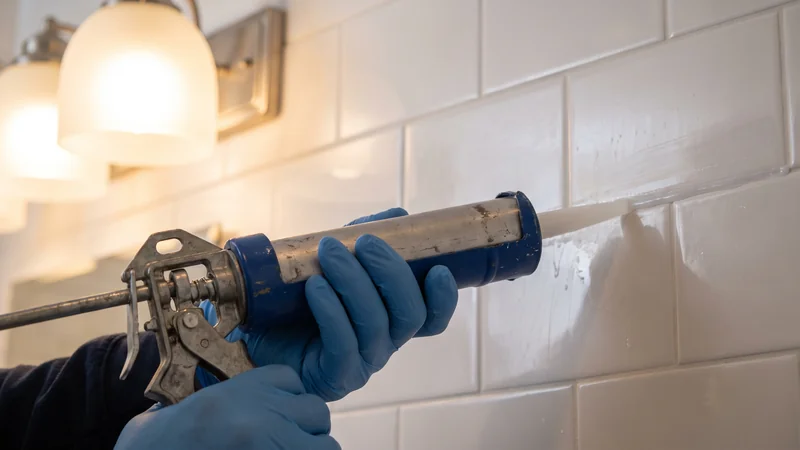
- Mask both sides of the joint with painter's tape before gunning the bead for a clean tooled line.
Fifteen minutes of prep buys years of adhesion.
Tooling the Bead
- Cut the nozzle at an angle matching the joint width, then gun the bead in one pass.
- Tool the bead within its working time, before a skin forms.
- Remove the masking tape immediately after tooling, while the bead is still wet, for a crisp edge.
Joint Design Rules
Per ASTM C1193, narrow joints run close to a 1:1 width-to-depth ratio; wider joints move toward 2:1, with depth capped near 12 mm. A backer rod, sized about a quarter larger than the joint, blocks the base so the bead bonds only the two opposing faces — bonding a third side restricts movement and tears the bead apart early.

Get the geometry right and the chemistry rarely gets a chance to fail.
FAQ: Silicone Sealant Questions Answered
What is the difference between caulk and silicone sealant?
"Caulk" is a broad market term covering acrylic, latex, and silicone products; silicone sealant specifically means 100 percent silicone RTV chemistry. It handles far more joint movement than acrylic caulk, but it usually cannot be painted once cured.
How long does silicone sealant take to fully cure?
A thin 3 mm bead cures in roughly 24 to 36 hours; a standard 6 mm joint needs 48 to 72 hours. Deeper, cooler, or drier conditions push that toward a week or more.
Can you apply silicone sealant over old sealant?
It does not bond reliably to cured silicone residue. Remove the old bead completely with a scraper and solvent wipe before applying a fresh one.
What does RTV mean on a silicone sealant label?
RTV stands for room-temperature-vulcanizing: it cures at normal ambient conditions through a reaction with atmospheric moisture, without needing heat or a separate hardener.
Conclusion
Picking the right silicone sealant comes down to four checks, in order.
- Match the cure chemistry to the substrate. - Neutral-cure for metal and natural stone, acetoxy for glass and interior non-metal work.
- Read the ASTM C920 code if the spec calls for one. - Type, Grade, Class and Use each answer a different question.
- Size the cure time to the joint depth. - Deeper beads and colder conditions both add days, not hours.
- Prep and tool the joint properly. - Clean substrate, correct width-to-depth ratio, and a backer rod on deep joints.
Get those four right and a silicone sealant joint outlasts the structure around it. Explore EYBY's full caulks, sealants and gasket makers range to stock the formulations your next job calls for.
Related Posts
What Bathroom Partitions Have to Survive
Pipe Fittings Explained: Types, Materials and How to Choose
Box Stapler Guide: Types, Staple Sizes and How to Choose One