Drawer Slides: How to Choose the Right Type for Every Application
By Andrew O'Malley · 17 July 2026
Every sticky, sagging drawer traces back to one cause: the wrong slide for the job. Buyers often default to whatever was used last time. That works fine until a file drawer sags under folder weight, or a tool drawer stops gliding after a few months of shop use.
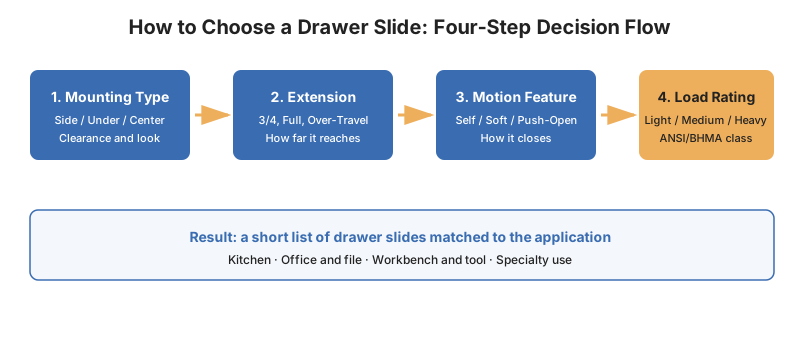
This guide breaks drawer slides down into four choices: mounting type, extension length, motion feature, and load rating. Each choice narrows the field. Only a few slides fit any one application.
What Drawer Slides Do and Why the Type Matters
A drawer slide is the track-and-carriage system that lets a drawer move in and out of a cabinet opening. Every drawer slide has to do three jobs at once.
- Support weight. It must carry the full load without sagging or binding.
- Travel far enough. It must extend enough for full access to the contents.
- Close reliably. It must close smoothly, without slamming or bouncing back open.
A kitchen drawer full of light utensils stresses these jobs differently than a lateral file drawer packed with folders. Picking the right type for that specific job is what separates hardware that lasts for years from hardware that needs replacing within months.
Common signs of the wrong slide:
- The drawer sags or tilts when fully extended.
- The drawer sticks or binds partway through its travel.
- The drawer slams shut instead of closing gently.
- The drawer creeps open on its own over time.
Any one of these signs means it is time to check the spec.
Drawer Slide Mounting Types: Side-Mount, Undermount, and Center-Mount
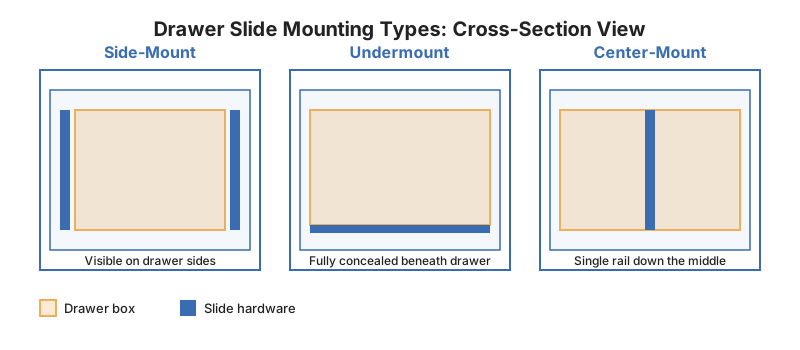
Mounting type is the first decision. It sets the clearance the cabinet needs and how visible the hardware will be once installed.
Side-Mount Drawer Slides
Side-mount drawer slides attach to the sides of the drawer box and the cabinet opening. Most need about 1/2 inch of clearance on each side.
- Two main versions exist: - Ball-bearing versions give smooth travel and support full-extension or over-travel. - Epoxy-coated (Euro-style) versions use a nylon roller and usually include self-closing action.
Undermount Drawer Slides
Undermount drawer slides sit beneath the drawer and stay fully hidden. This frees up extra width inside the drawer, but the drawer box needs exact side and depth sizes.
Undermount drawer slides are almost always full-extension and pair well with self-closing drawer slides hardware for a quiet close.
Center-Mount Drawer Slides
Center-mount drawer slides run a single rail down the middle of the opening. They stay concealed like undermount slides, but their weight capacity is lower.
Center-mount drawer slides are a common replacement pick for older cabinets, not a first choice for new builds.
The table below sums up the differences between the three mounting types.
| Mounting Type | Visibility | Clearance Needed | Common Extension |
|---|---|---|---|
| Side-Mount | Visible on drawer sides | ~1/2 in. per side | 3/4, full, or over-travel |
| Undermount | Fully concealed | Set by drawer depth spec | Full extension |
| Center-Mount | Fully concealed | Minimal (single rail) | 3/4 extension |
Extension Types: 3/4, Full, and Over-Travel
Extension describes how far a slide lets the drawer travel versus its own length.
3/4 Extension
3/4 extension is the most affordable option. The drawer box travels about 75% of the slide length, which suits most daily storage.
Full Extension
Full extension lets the drawer box travel the whole slide length. The full inside of the drawer becomes reachable.
Over-Travel
Over-travel pushes the drawer about an inch past full extension. This helps when items sit at the very back of a deep drawer.
Center-mount and epoxy-coated slides usually offer only 3/4 extension. Side-mount ball-bearing slides often offer all three options. Undermount slides almost always ship as full-extension only.
Motion Features: Self-Close, Soft-Close, and Push-to-Open
Most drawer slides today include at least one motion feature that controls how the drawer acts as it closes.
Self-Close
Self-close hardware pulls the drawer shut over the final few inches, using a spring or a ramped track. This keeps drawers from staying slightly open.
Soft-Close
Soft-close hardware adds a damper that slows the final few inches of travel. This cuts closing noise, reduces wear, and stops contents from shifting on impact.
Push-to-Open
Push-to-open hardware uses a spring that pops the drawer open when a user presses the drawer face. This removes the need for a visible pull, which suits clean designs and tight spaces.
Load Ratings and the ANSI/BHMA Pound Class System
Load rating causes the most mistakes, because two slides can look the same while they carry very different weights.
Makers rate drawer slides against ANSI/BHMA A156.9, the American National Standard for Cabinet Hardware. Spec sheets often list this standard next to BIFMA and KCMA benchmarks.
The standard sorts drawer slides into three Pound Class groups. These groups are maker guidelines, not one fixed test number, since actual capacity still depends on slide length and construction.
Light Duty Drawer Slides
Light duty drawer slides carry loads under about 75 lb.
- Typical uses: - Kitchen cabinets. - Bathroom vanities.
Medium Duty Drawer Slides
Medium duty drawer slides carry loads from about 80 to 100 lb.
- Typical uses: - Office desks and file drawers. - General kitchen cabinetry.
Heavy Duty Drawer Slides
Heavy duty drawer slides carry loads over 100 lb, and reinforced series reach up to 500 lb.
- Typical uses: - Workbenches and tool storage. - Pedestal and lateral file drawers.
| Pound Class | Typical Rating | Common Applications |
|---|---|---|
| Light Duty | Under 75 lb | Kitchen cabinets, bathroom vanities |
| Medium Duty | 80-100 lb | Office desks, file drawers, kitchen cabinetry |
| Heavy Duty | Over 100 lb (up to 500 lb on reinforced series) | Workbenches, file drawers, tool storage, millwork |
Matching Drawer Slides to Your Application
Each factor above works on its own. The last step is matching all four to how the drawer actually gets used.
Kitchen and Vanity Cabinets
Kitchen and vanity drawers usually pair side-mount or undermount hardware with full extension, soft-close motion, and a light-to-medium pound class.
Office and File Drawers
Office desks and lateral file cabinets need medium-to-heavy duty ball-bearing side-mount slides with full extension, since file folders pile weight toward the back.
Workbenches and Tool Storage
Workbench and tool drawers see frequent, forceful use, so heavy-duty ball-bearing side-mount hardware with a detent against creep-open is the standard pick.
Special Uses
Special uses, including keyboard trays, pantry pull-outs, and garbage pull-outs, need purpose-built slides sized for that one job.
Quick reference:
- Kitchen and vanity: side-mount or undermount, full extension, soft-close, light-to-medium duty.
- Office and file: ball-bearing side-mount, full extension, medium-to-heavy duty.
- Workbench and tool: heavy-duty ball-bearing side-mount with anti-creep detent.
- Special uses: purpose-built slide sized for the job.
Drawer slides also pair well with nearby cabinet hinges, since matching hardware families often share finish options. That shared finish makes both install and future replacement easier.
Frequently Asked Questions
Here are the questions buyers ask most often about drawer slides.
What is the difference between side-mount and undermount drawer slides?
Side-mount hardware attaches to the sides of the drawer and stays visible. Undermount hardware sits beneath the drawer and stays fully hidden. Undermount drawer slides usually cost more and need exact drawer sizes, but they free up inside width.
How do I know what load rating I need?
Match the pound class to the heaviest real load, not the average load. A light duty slide under 75 lb suits utensils. A file drawer or tool drawer needs a medium or heavy duty slide rated for steady weight near the back.
Can I mix extension types on the same cabinet run?
Yes. Each slide gets matched to its own drawer, not the whole cabinet run. A shallow utility drawer can use 3/4 extension while a deeper drawer nearby uses full extension.
Do soft-close drawer slides need more maintenance than standard slides?
Not usually. Soft-close hardware uses a sealed damper that needs no oiling under normal use. Keep the track free of dust and debris, the same as any other drawer slide.
Conclusion
Choosing the right drawer slide comes down to four questions, answered in order.
- How much clearance and concealment does the cabinet allow?
- How far does the drawer need to travel?
- What closing behavior does the application call for?
- How much weight will the drawer actually carry?
Work through mounting type, extension, motion feature, and ANSI/BHMA pound class in that order. A confusing hardware aisle turns into a short list of drawer slides that will hold up for years of daily use.
Related Posts

What Bathroom Partitions Have to Survive

Pipe Fittings Explained: Types, Materials and How to Choose

Box Stapler Guide: Types, Staple Sizes and How to Choose One