RFID Tags: How to Choose the Right Frequency and Form Factor

By Tracey Gold · 5 September 2026
Most failed asset tracking projects fail at the tag, not the software.
The reader gets specified carefully. Then somebody orders a box of RFID tags off a spec sheet, and the pilot dies in a warehouse full of steel racking.
RFID tags are not all alike. Frequency, power class and physical form each rule out large parts of the catalogue before price ever enters the conversation.
What RFID Tags Are and How They Differ
An RFID tag is a chip and an antenna on a carrier, read over the air by a reader. The build is simple; the choice is not.
The Three Parts That Matter
- The chip stores the identifier and any user data written to it.
- The antenna sets read range far more than the chip does. - Antenna size is why long-range tags are physically larger.
- The carrier is the label or case that survives the environment.
Why Frequency Decides Almost Everything
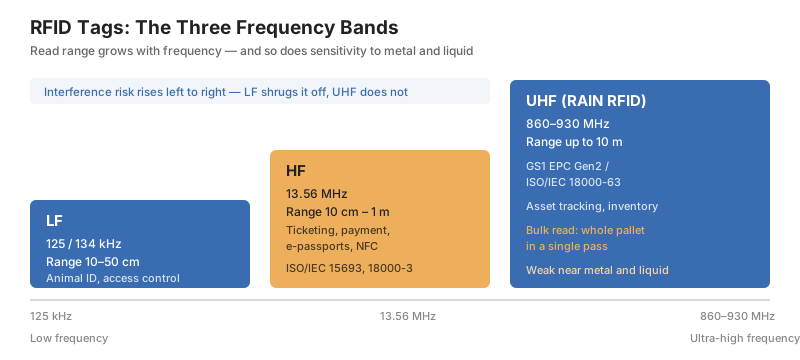
Radio waves act differently in each band, and that sets the range, the speed and the failure modes. GS1 groups RFID tags into three worldwide bands: low, high and ultra-high frequency.
Pick the band first. The rest is a narrowing exercise.
The Three Frequency Bands for RFID Tags
Low Frequency RFID Tags
LF systems run at 125 kHz and 134 kHz, with a read range of 10 to 50 cm.
- It shrugs off interference, which is why LF works near metal and liquid.
- Typical uses are animal ID and physical access control, per GS1.
- The protocol is ISO/IEC 18000-2, and LF is not a truly global application because frequencies and power levels differ slightly between countries.
High Frequency RFID Tags
Most HF RFID tags operate at 13.56 MHz with a read range of 10 cm to 1 m.
- Interference is a moderate risk, sitting between LF and UHF.
- Ticketing, payment and data transfer dominate the use cases.
- Secure documents such as e-passports also sit in this band.
- Item-tracking standards include ISO/IEC 15693 and ISO/IEC 18000-3, while NFC runs on ECMA-340 and ISO/IEC 18092 at the same frequency.
Ultra-High Frequency RFID Tags
UHF is the band that asset tracking actually wants.
Passive UHF RFID tags comply with GS1 EPC Gen2 and ISO/IEC 18000-63 across the 860 to 930 MHz band. GS1 calls this RAIN RFID, and read ranges reach up to 10 m depending on the environment.
- Bulk reading is the win, so a whole pallet clears a portal in one pass.
- Metal and liquid are the weakness, and both detune an ordinary label.
- GS1 keys travel in EPC format, which is what makes the data portable between trading partners.
| Band | Frequency | Read range | Interference | Typical use |
|---|---|---|---|---|
| LF | 125 kHz / 134 kHz | 10–50 cm | Very low risk | Animal ID, access control |
| HF | 13.56 MHz | 10 cm – 1 m | Moderate | Ticketing, payment, e-passports |
| UHF (RAIN) | 860–930 MHz | Up to 10 m | High near metal and liquid | Asset tracking, inventory |
Passive, Active and Battery-Assisted RFID Tags
Power class is the second fork, and it changes cost by two orders of magnitude.
Passive RFID Tags
Passive tags carry no battery and harvest their energy from the reader field. That one fact drives most of their behaviour.
- Unit cost is the lowest of the three classes, which is why they dominate volume deployments.
- Service life has no battery limit because there is nothing to go flat.
Active RFID Tags
Active tags carry their own battery and transmit on their own schedule. They are tracking hardware rather than labels.
- Range extends to tens of metres, sometimes further outdoors.
- Battery life is the constraint, and it dictates the replacement cycle.
- Cost per tag is high, so these suit vehicles, containers and plant.
Battery-Assisted Passive RFID Tags
BAP tags sit in between, using a battery to power the chip while still backscattering the reader signal.
- Sensitivity improves without the cost of a full active transmitter.
- Sensor logging becomes possible, which matters for cold chain runs.
Inside a UHF Tag: The Four Memory Banks
Specifying RFID tags on range alone ignores half the decision. Memory layout decides what the tag carries and whether anyone can silence it.
What Each Bank Holds
An EPC Gen2 tag has four non-volatile memory banks. Each answers a different question.
- Reserved memory holds the access password and the kill password.
- EPC memory holds the identifier that trading partners read.
- TID memory holds the chip's own factory identity.
- User memory holds whatever the operator writes, where offered.
Locking and Killing
The kill password is a 32-bit value stored at reserved addresses 00h to 1Fh, most significant bit first. It is the setting nobody should leave at its default.
- A tag ignores the kill command while its kill password is still zero.
- The kill is permanent and a reader uses that password once.
- Set the access password before RFID tags leave a controlled area.
Regional Frequency Rules That Break Deployments
This is where global rollouts come apart. UHF allocations are national, and a tag tuned for one region reads badly in another.
Two Rule Sets, One Band
GS1 publishes an overview of UHF allocations covering 83 countries in the 860 to 930 MHz band. The split runs broadly between an ETSI-style lower band and an FCC-style upper band.
| Market | UHF allocation | Maximum power |
|---|---|---|
| United States | 902–928 MHz | 4 W EIRP, FHSS |
| United Kingdom | 865.6–867.6 MHz and 915–921 MHz | 2 W ERP and 4 W ERP |
| India | 865–867 MHz | 4 W ERP |
| Australia | 920–926 MHz and 918–926 MHz | 4 W ERP and 1 W ERP |
| United Arab Emirates | 865.6–867.6 MHz | 2 W ERP |
What This Means When You Buy
- Buy globally tuned inlays if stock crosses regions, because narrow-band tags lose range off frequency.
- Check the reader, not only the RFID tags, because reader power is what regulators cap.
- Expect licensing conditions, since several markets require site registration or individual approval.
How to Choose the Physical Tag
Once the band and class are fixed, the environment picks the tag.
Start With the Mounting Surface
- Metal detunes a standard label, so an on-metal tag with a spacer or ground plane is a must.
- Liquid absorbs UHF energy, so drum and IBC tracking needs the same treatment. - Foam-spaced labels recover most of the lost range.
- Plastic, card and timber are benign, and ordinary wet inlays read well on them.
Then the Environment
- Temperature range rules out adhesive labels in autoclaves and paint lines.
- Chemical exposure decides between polyester, polyimide and moulded cases.
- Impact and abrasion push forklift and rail assets towards rigid sealed RFID tags.
Then the Attachment
- Adhesive suits smooth, clean indoor surfaces.
- Mechanical fixing through moulded holes survives washdown.
- Cable ties or straps handle irregular items such as scaffolding and hose reels. - Bar-coded backup printing on the same label keeps the asset readable when a reader is absent.
Combined RFID and barcode label printers encode the EPC and print readable text in one pass. Fixed and handheld RFID sensors, systems and tags cover portal and roaming reads. Pair either with inventory and production status tags where a visible record is needed too.
Frequently Asked Questions
What is the read range of RFID tags?
It depends on the band. GS1 puts LF at 10 to 50 cm, HF at 10 cm to 1 m and passive UHF at up to 10 m.
Do RFID tags work on metal?
Standard label tags do not. Metal detunes the antenna, so on-metal RFID tags use a spacer or an integrated ground plane.
Are RFID tags and NFC the same thing?
Not quite. NFC operates at 13.56 MHz under ECMA-340 and ISO/IEC 18092, the same frequency as HF RFID, but it is a distinct set of standards aimed at short-range phone interaction.
Can RFID tags be reused?
Usually. EPC memory can be rewritten unless locked, and hard-cased RFID tags are routinely moved between assets. Once killed with its 32-bit kill password, a tag is silent permanently.
Which frequency should an asset tracking project use?
UHF, in most cases. GS1 names fast asset ID, stock counts and tracking as the main RAIN RFID uses, and that band is where the bulk-read economics work.
Conclusion
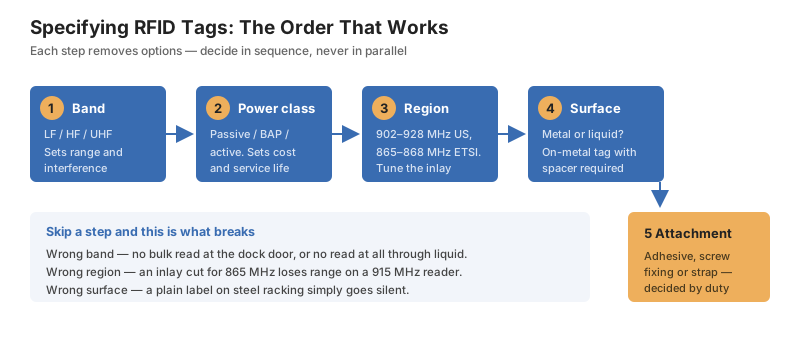
Specify RFID tags in a fixed order and the failure modes disappear one by one.
Band first, because that sets range and interference behaviour. Power class second, because that sets cost and service life. Regional tuning third, since border-crossing stock needs inlays that work either side of 900 MHz.
Physical form comes last, decided by the surface rather than the catalogue photo. Get those four right and the software argument becomes the easy part.
Related Posts