Test Instruments - Sound Meter
By Tamer Irmanto · 28 July 2026
A sound level meter is bought for one reason, and it is never curiosity. Someone has to prove a number to a regulator, a client or a court.
That is why the wrong meter is expensive twice over. You pay for the instrument, and then you pay again when the survey has to be repeated with a better one.
The choice comes down to a handful of settings on the spec sheet. Most are decided before you buy, and none can be fixed afterwards. This guide takes them in the order a buyer meets them.
Class, weighting, response and calibration are the four that matter.
What a Sound Level Meter Actually Measures
The decibel is a ratio, not a count
A sound level meter turns air pressure changes into a signal and reports it in decibels. The decibel is a ratio on a log scale against a fixed reference pressure, not a straight count of loudness.
That log scale is the source of most confusion on site. A rise of 10 dB looks small on the display, yet it carries ten times the sound energy. The meter reports energy, and the ear responds to something else.
Why noise levels do not simply add up
Two machines at 85 dB each do not make 170 dB, and they do not make 88 dB either. They add on an energy basis, so a matched pair lands 3 dB above one of them.
- Doubling the energy adds 3 dB, so two identical machines read 3 dB above one.
- Halving the distance from a point source adds about 6 dB in free field conditions.
- A quiet source near a loud one barely moves the total at all. - This is why silencing the second-loudest machine usually changes nothing.
The instrument in one line
A sound level meter tells you the level right now, at that microphone position, on the settings you chose.
Class 1 and Class 2: The Rating That Decides Everything
Every serious sound level meter is built to one of two classes, set by the IEC 61672 standard and its American twin. The class is the most important line on the datasheet.
What the class number buys you
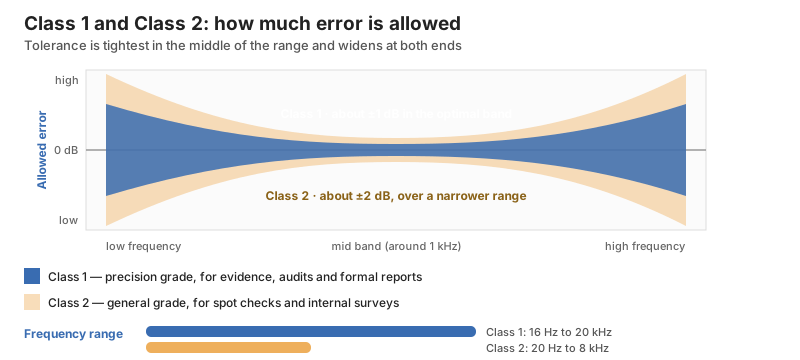
Class 1 is the precision grade and Class 2 is the general-purpose grade. What splits them is tolerance, which is how far the meter is allowed to be wrong.
- Class 1 holds roughly one decibel of tolerance across its optimal band.
- Class 2 is allowed roughly two decibels across a narrower band.
- Both classes can apply the same frequency weightings, so weighting is not what separates them. - A single decibel decides outcomes when a limit is written as a hard number.
Frequency range
A Class 1 sound level meter covers 16 Hz to 20 kHz, while Class 2 units run from 20 Hz to 8 kHz. That top end matters when noise carries real energy above 8 kHz, which is common around compressed air and high-speed cutting.
Where each class belongs
Buy the class that matches the consequence of being wrong.
- Boundary and site noise surveys normally demand Class 1, because the result becomes evidence.
- Traffic, wind farm and airport studies are often written as Class 1 in law.
- Internal spot checks and hearing walk-rounds are well served by Class 2.
- Screening apps on a phone are useful for a first look and nothing more.
| Question | Class 1 sound level meter | Class 2 sound level meter |
|---|---|---|
| Typical frequency range | 16 Hz to 20 kHz | 20 Hz to 8 kHz |
| Tolerance in the optimal band | About one decibel | About two decibels |
| Usual role | Evidence, audits, formal reports | Spot checks, internal surveys |
| Handling | Treat as a precision unit | Often more rugged in the field |
How a Sound Level Meter Weights Frequency: A, C and Z
Weighting is a filter that reshapes what the sound level meter counts.
A-weighting is the legal default
A-weighting bends the response to match how the ear behaves at ordinary levels. OSHA describes it as close to loudness judged against a 1,000 Hz reference tone at a 40-decibel sound pressure level. Nearly every workplace noise limit is written in A-weighted decibels, which is why the unit reads as dBA.
C-weighting for peaks and low frequency
C-weighting is much flatter at the bottom end, so it keeps the low-end energy that A-weighting throws away. Use it for peak and impulse work, and for judging how well ear defenders will cope.
Z-weighting for raw data
Z-weighting applies no correction at all across the band. Choose it when you want the raw signal, most often as the input to octave band analysis.
Sound Level Meter Settings That Catch People Out
Fast, slow and peak
Time weighting sets how fast the display chases a changing sound. Slow works on a one second time constant and fast on 125 milliseconds, so slow steadies a jumpy reading.
- Slow is the setting regulators expect for workplace noise.
- Fast suits short events where the shape of the noise matters.
- Peak is a separate reading of the true pressure maximum, not a fast one. - Peak is normally logged with C-weighting rather than A-weighting.
Threshold, criterion and exchange rate
Three more settings decide what a sound level meter counts as exposure, and the American regulator and its own research body differ on them. Get them wrong and two meters will disagree about one shift.
The exchange rate is the biggest divide. OSHA uses a five-decibel rule, so allowed time halves for every five decibels of rise. NIOSH uses three decibels, which is the equal-energy rule and the tighter of the two.
| Setting | OSHA compliance | NIOSH recommendation |
|---|---|---|
| Criterion level | 90 dBA over 8 hours | 85 dBA over 8 hours |
| Action level | 85 dBA over 8 hours | Protection above 85 dBA at any duration |
| Exchange rate | 5 dB | 3 dB |
| Frequency and time weighting | A, slow | A, slow |
Sound Level Meter or Noise Dosimeter?
The two answer different questions, and buying the wrong one is the commonest mistake here. A dosimeter is really a sound level meter that adds noise up over time.
What each instrument answers
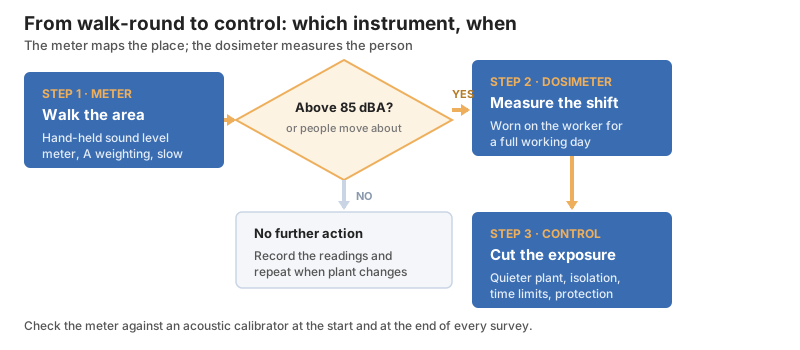
A hand-held sound level meter tells you how loud a place is. A dosimeter, worn on the worker, tells you how much noise that person actually collected across the shift.
- Use a sound level meter to map an area, rank sources and check whether a control worked.
- Use a dosimeter where the worker moves between zones, or the noise varies through the day.
- Use both on a first survey, because the map explains the dose.
What the regulator expects
OSHA treats the dosimeter as the main tool for checking compliance under its noise rule. The rule goes further and names the settings, calling for the A scale at slow response. OSHA, the mine regulator and the ACGIH all require slow response for dose work.
Calibration Keeps a Sound Level Meter Defensible
The field check before and after
An acoustic calibrator clamps over the microphone and feeds it a known tone, most often a nominal 94 decibels. Check the sound level meter before the survey and again at the end, because drift found later kills everything in between.
Laboratory calibration
The field check proves the meter has not drifted today, and it proves nothing about the year. Send the meter and its calibrator to a lab on the maker's schedule, and keep the certificate with the survey file.
- The calibrator needs a certificate too, since it is the reference the meter is judged against.
- File the before and after checks with the raw data from every survey.
- Log the serial numbers of meter, microphone and calibrator.
Windscreens and the microphone position
A windscreen is not an accessory outdoors, it is a requirement.
- Fit the foam windscreen for any reading where air moves across the microphone.
- Use a tripod and stand well back, because a body reflects sound into the microphone.
- Record the position and height, because a survey nobody can repeat is one nobody can defend.
Frequently Asked Questions About Sound Level Meters
Do I need a Class 1 sound level meter?
Only if the result has to survive a challenge. Boundary, planning and legal work calls for Class 1, while internal checks are usually fine on Class 2.
Is a phone app as good as a sound level meter?
For a first look, yes, and OSHA itself points the public at a screening app. For anything that goes in a report, no.
What does dBA mean on a sound level meter?
It means the reading has been A-weighted to follow the response of human hearing. Workplace limits are written in dBA, so this is the normal setting on any sound level meter.
Why do OSHA and NIOSH quote different numbers?
They answer different questions under different rules. OSHA sets an enforceable limit of 90 dBA over eight hours on a five-decibel exchange rate, and calls for a hearing conservation programme from 85 dBA. NIOSH advises 85 dBA on a three-decibel rate, which protects more people.
How loud is too loud without an instrument?
If you must raise your voice to talk to someone three feet away, the level is probably above 85 dBA. That is a prompt to measure, not a measurement.
How often should a sound level meter be calibrated?
Field-check it with an acoustic calibrator at the start and end of every survey. Send the sound level meter to a lab on the interval the maker states, and never let the certificate lapse.
Conclusion: Match the Sound Level Meter to the Decision
Start from the decision the number has to support, because that sets the class before anything else does. Evidence needs a Class 1 sound level meter. An internal walk-round does not.
Then fix the settings before you buy rather than in the field.
A-weighting and slow response cover nearly all workplace noise, and the exchange rate follows whichever rulebook you answer to. Get the class and settings right, check the meter at both ends of the survey, and the sound level meter stops being the weak link.
Related categories on EYBY:
- Browse sound testing instruments for meters, dosimeters and calibrators.
- Compare vibration testing instruments for the companion survey.
- Review data recording equipment for long unattended noise logging.
Related Posts
Sandblasting Sand: Why the Cheapest Abrasive Costs You the Most

Types of Pliers: Jaw Shapes, Grip and What Each Pair Is For