How to Choose an Anemometer: Types, Accuracy and Airflow Measurement
By Dan Dormani · 18 August 2026
Two air meters can share a price and a shape. One anemometer claims accuracy within one percent of reading, and the other quotes five percent of full scale. That gap is where most bad airflow data begins.
Probe placement wrecks even more readings than the sensor ever does.
So this guide covers the anemometer and the method together. Get both right and your numbers hold up.
What an Anemometer Actually Measures
An anemometer measures how fast a gas is moving, whether it sits inside a duct or blows across an open field.
Contained Flow Versus Open Air
Ducts, plenums, fume hoods and cleanrooms all carry contained flow, where the path is fixed and the duct size is known. Open air behaves nothing like that, because wind swings around and the sensor must answer to flow from any bearing.
Velocity Versus Volume
The sensor reads speed, but the drawing asks for volume. To convert, multiply mean speed by the inside area of the duct. Three phrases carry the risk:
- Mean speed — one mid-duct reading cannot stand in for the whole face.
- Inside area — measure inside the liner, not outside the sheet metal.
- Matched units — feet per minute needs square feet, never square inches.
Miss any one of the three and the volume comes out wrong, however good the anemometer is.
Three Anemometer Types Cover Most Jobs
DwyerOmega splits the field into three common designs. Between them they handle nearly every plant or building job you will meet.
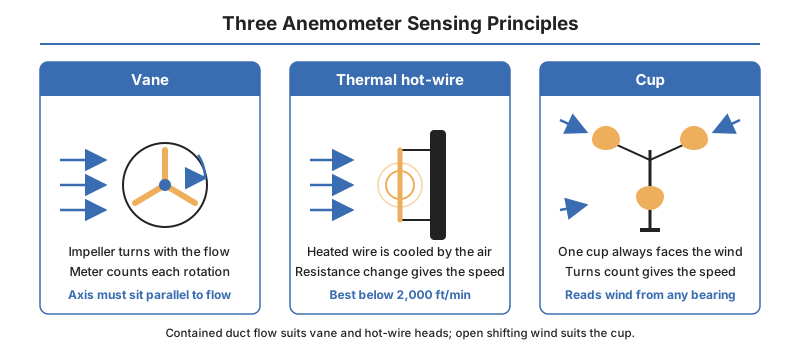
Vane Anemometers
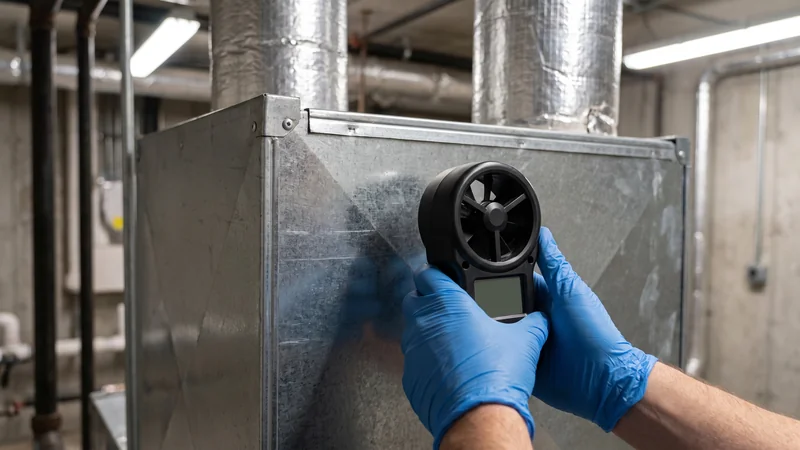
A vane anemometer works by spinning, with an impeller turning while the meter counts each rotation. It is the design most techs picture when someone says air velocity meter, and one rule then matters most:
- Stay parallel — the axis of the spin must line up with the airflow.
- Angle the head and you under-read — that error is quiet and easy to miss. - Grille work tempts people into holding the head at a slant. - Fit a duct probe rather than twisting your wrist.
- Dirty air is fine — a vane shrugs off dust that would kill a hot wire.
Thermal Hot-Wire Anemometers
A thermal anemometer heats a tiny wire above room temperature, and that wire is often only a few microns across. Tungsten is the usual metal because its resistance tracks heat steadily, so passing air cools the wire and the circuit turns that change into a speed.
You gain fast response and fine detail. That is why turbulence research leans on this design. You give up ruggedness, since a hot wire is easy to damage in transit.
Cup Anemometers
Three or four cup-shaped scoops ride on arms around a vertical shaft, and one cup always faces the wind, so the head turns whichever way the wind blows. Speed comes from counting turns over a set time, though the sum is no fixed constant:
- The anemometer factor shifts with shape — cup width and arm length move it.
- It lands between two and slightly over three — early designs assumed one value.
John Patterson built the three-cup anemometer in 1926. That design cut error and improved the answer to gusts. Brevoort and Joiner reshaped the cups in 1935 and reached a straight-line response with under three percent error up to sixty miles per hour.
| Anemometer type | Best for | Strength | Main limit |
|---|---|---|---|
| Vane | Ducts and grilles | Tough, cheap, easy to read | Must line up with the flow |
| Hot-wire | Slow air and turbulence | Fast response, fine detail | Fragile, needs clean air |
| Cup | Outdoor wind surveys | Reads wind from any bearing | Slow, useless in ducts |
| Pitot-static | Fast duct traverse | Rugged, no moving parts | Loses grip in slow air |
Match the Anemometer to Your Velocity Range
Range is the spec that decides whether an anemometer earns its place in the bag, so read it before the price tag.
Slow Air Under 2,000 Feet Per Minute
Hot-wire heads own this band, because they read slow air at speeds where a vane has not beaten its own bearing drag. Three job types live here:
- Fume hood face checks — slow air, tight limits, real safety weight.
- Blower-door and air-tightness tests — doors and windows at very low flow. - Leak hunting needs a probe that reacts within a second. - A vane in the same spot may simply read zero.
- Cleanroom checks — fine detail matters more than brute strength.
General HVAC and Duct Work
A portable vane or hot-wire anemometer gives this sector its best mix of accuracy, trust and cost.
For a volume total at a diffuser, reach for a capture hood instead, because it takes in the whole outlet face rather than a few scattered spots.
Wind and Site Work
Cup anemometers rule outdoor work because they answer to wind from any bearing. Some hot-wire models stretch to fifteen thousand feet per minute while staying sharp much lower, but they still belong indoors.
How to Run a Duct Traverse Correctly
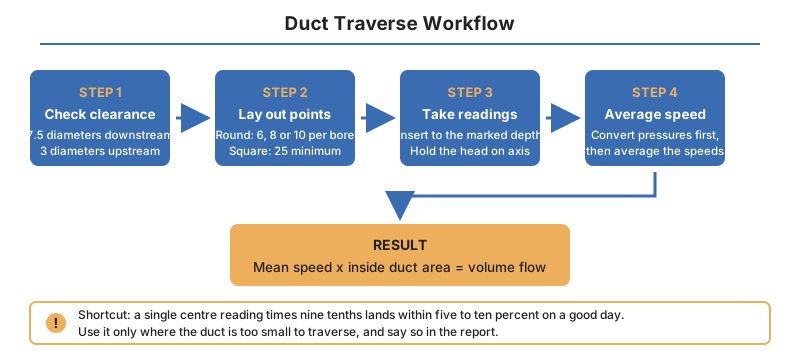
A traverse samples speed point by point across the whole duct face. ASHRAE Standard 111 and the ASHRAE Fundamentals Handbook set the layout, and TSI field notes turn it into practice.
Where to Place the Probe
Give the airflow room to settle before you drill:
- Seven and a half diameters downstream — stay clear of any turn or blockage.
- Three diameters upstream — keep that stretch clear as well.
- Two and one at a push — accuracy suffers, so flag it.
- Square ducts need an equal diameter — derive it from the side sizes.
Round Ducts and Equal-Area Rings
The log-Tchebycheff method splits a round duct into rings of equal area, then takes the same number of readings from each. Wall drag is built into the spacing, which is why it beats an even grid. Point counts follow duct size:
- Ten inch diameter and under — three rings, so six points per diameter.
- Above ten inches — four or five rings, so eight or ten points.
- Three holes at sixty degrees — prefer this pattern where access allows. - Run three passes and average every reading together. - A two-hole pattern at ninety degrees saves one pass.
Rectangular Ducts and the 25-Point Floor
Rectangular ducts split into adjusted areas instead of rings, and the point count follows how wide each side is.
| Duct side dimension | Points along that side |
|---|---|
| Under 30 inches | 5 |
| 30 to 36 inches | 6 |
| Over 36 inches | 7 |
Twenty-five readings is the accepted floor for a solid average. A five by five grid is therefore the smallest traverse anyone should sign off.
The Shortcut and What It Costs
One centre reading times nine tenths is the known fallback, and on a good day it lands within five to ten percent. Save it for ducts truly too small to traverse:
- Not a substitute — the error band sits far wider than a full traverse.
- Declare it — whoever leans on the number deserves to know.
Constant Temperature Versus Constant Power
Thermal anemometers differ in how the control circuit holds the sensor, and that shows up plainly in your data.
Why CTA Wins the Demanding Jobs
A constant-temperature anemometer holds the wire at one heat level and reports the power needed to keep it there.
- High frequency response — fast swings get caught, not smoothed.
- Low signal noise — the output stays clean at fine detail.
- Less burnout risk — a sudden gust will not destroy the wire.
- Hot-film ready — bare wire is not the only sensor option. - Gas and liquid flows both suit this control mode. - Turbulence research leans on it almost without exception.
Where Constant Power Falls Short
Constant-power designs run with no feedback loop, so wire temperature drifts as the flow rate changes.
- Slower response — fast swings flatten before reaching the display.
- Shaky zero — the shown value wanders with no flow at all.
- Weak heat compensation — room swings move the number by themselves.
Constant-current and constant-voltage setups sit between the extremes. Some anemometers use pulse width modulation instead, taking speed from the timing of current pulses.
Accuracy, Calibration and Field Errors
Spec sheets reward slow reading. Two anemometers can quote almost the same headline numbers and behave nothing alike in your hands.
Reading the Accuracy Spec
Accuracy quoted as a percent of reading scales down with the reading, while a percent of full scale stays fixed.
- One percent of reading is tight — the real error shrinks as the reading shrinks.
- Five percent of full scale is loose — in slow air it can beat the value itself.
How Often to Calibrate
Annual calibration is the sensible base, and you should shorten the gap for rough sites, heavy duty cycles, or readings that carry money or safety weight. Keep the certificate with the anemometer, because a traverse with no logged calibration is really just an opinion.
Mistakes That Ruin a Reading
- Averaging pitot pressures — turn each pressure into a speed first.
- Using outside duct sizes — a lined duct needs its inside size. - Liner thickness is easy to forget on a quick site walk. - Two inches of lost width can swing the volume badly.
- Holding the vane off-axis — line the head up squarely with the flow.
- Working right after an elbow — move downstream into settled air.
- Skipping sensor cleaning — hot-wire probes suffer first and worst.
The pitot error deserves a second look, because speed varies with the square root of pressure. Averaging pressures first therefore skews the answer badly. The damage grows once readings spread more than a quarter from the mean.
Frequently Asked Questions
What does an anemometer measure?
An anemometer measures the speed of a gas. That covers duct airflow as well as open wind, and many handheld models add heat and damp readings.
Which anemometer type is most accurate?
Accuracy depends on your speed range rather than the type alone. A hot-wire anemometer leads below two thousand feet per minute, while a vane quoting one percent of reading performs well at normal duct speeds.
How many points does a duct traverse need?
A rectangular duct needs at least twenty-five readings, while round ducts take six points per diameter up to ten inches and eight or ten points above that.
How often should an anemometer be calibrated?
Once a year is the base gap. Raise the rate for hard duty, rough sites, or readings that must survive a formal challenge.
Can one anemometer cover ducts and outdoor wind?
Rarely, because vane and thermal heads suit fixed-path contained flow while cup designs suit shifting wind outdoors.
What is a capture hood used for?
A capture hood reads total volume flow at a diffuser, grille or register. It takes in the whole outlet face at once instead of sampling a few spots.
Conclusion
Choosing an anemometer comes down to three questions. What speed range do you work in, is the flow contained or open, and does the spec quote percent of reading or percent of full scale.
Answer those honestly and the shortlist shortens fast: a hot-wire anemometer for slow air, a vane for daily duct work, a cup for anything outdoors, and a capture hood when the diffuser total is what you need.
Then protect that number with layout. Upstream clearance, honest point counts and correct averaging turn a good anemometer into data you can defend.
Browse air velocity meters to compare vane and thermal anemometer heads. For diffuser totals, see air flow capture hoods. For cleanroom checks, particle counters round out the kit.
Related Posts
Sandblasting Sand: Why the Cheapest Abrasive Costs You the Most


Types of Pliers: Jaw Shapes, Grip and What Each Pair Is For