Stainless Steel Grades: How to Choose the Right One for Every Job
By Brandon Richter · 28 July 2026
Most stainless steel grades get picked by habit, because someone put 304 on the last job and nobody asked why. That habit costs money in both directions.
You either pay for an alloy you never use, or you watch a cheap part stain out inside a season.
A grade number is not a score. It is a short code for a mix of metals, and each mix is built for one kind of service.
This guide covers the four families, what each added metal buys you, and how to read stainless steel grades against the work in front of you.
What the Numbers on Stainless Steel Grades Really Mean
Chromium is the entry ticket
Stainless is not a coated product, because the rust protection sits inside the metal itself. Chromium is what puts it there.
Chromium meets oxygen and forms a thin oxide skin over the surface. That skin heals itself, so a scratch does not start a rust patch.
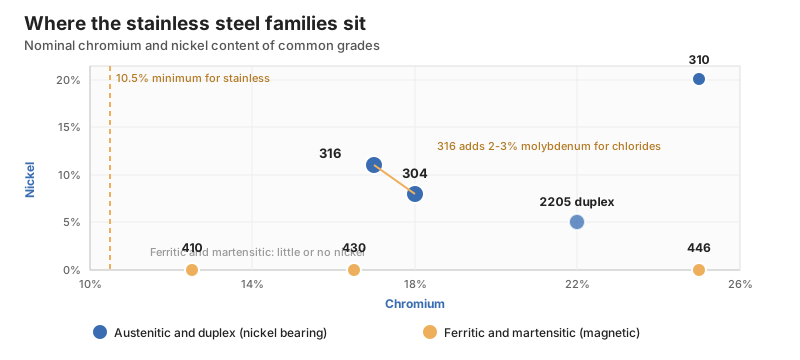
- The floor is fixed. The British Stainless Steel Association defines stainless as an iron alloy with at least 10.5% chromium.
- Trade grades sit just above it. Most grades on sale start at around 11% chromium.
- More chromium buys more. Levels over 20% raise corrosion resistance in wet service. - The same high chromium carries heat-resisting grades such as ferritic 446 and austenitic 310.
Nickel, moly and carbon do the rest
Chromium gets you through the door, but the other metals decide which room you may work in.
- Nickel changes the crystal structure, which brings easy forming, easy welding and cold toughness.
- Molybdenum goes to war with chlorides, so it earns its keep near the sea and in many plant fluids.
- Carbon makes steel hard, and it also makes welds risky.
- Manganese and nitrogen stand in for some nickel, which is what the 200-series does.
Why a higher number is not a better grade
Stainless steel grades carry AISI numbers from the American Iron and Steel Institute. Those numbers sort chemistry rather than rank it.
Grade 430 beats 304 on price, and 304 beats 430 in a car park by the sea. Neither is the better steel in the abstract, because the site decides.
The Four Families Behind All Stainless Steel Grades
The International Stainless Steel Forum sorts stainless steel grades into four families by structure. Read the family first and the number second.
Austenitic grades
These hold enough nickel to keep an austenite structure, which is also why they are not magnetic.
- The base mix is 18% chromium with 8% nickel, and that mix is grade 304.
- Nickel spans a wide band, from about 7% to over 20% across the family.
- They bend and weld well, and they stay tough at very low temperature. - Work hardening is the trade-off, and it makes heavy forming and machining harder.
Ferritic grades
Ferritic stainless behaves much like mild steel, except that it fights rust far better. It is magnetic, and it holds little or no nickel. Its price therefore stays steadier.
- Two mixes cover most of it, at roughly 11% and 16% chromium.
- The lower one goes mostly into vehicle exhaust systems.
- The higher one goes into cooking pans, washing machines and indoor architecture.
Duplex grades
Duplex is roughly half ferrite and half austenite. That split makes it mechanically stronger than either parent family.
- It is the newest family, tested in the 1930s and mass produced from the 1970s.
- It shrugs off stress corrosion cracking and holds good strength as supplied. - Its working temperature range is narrower than an austenitic grade.
- Process plant and sea water are its home ground.
Martensitic grades
Martensitic grades run 12% to 16% chromium with more carbon, then take a heat treatment that makes them very hard.
- Cutlery and razor blades are the classic use, along with turbine blades.
- Hardness is the point, not corrosion resistance.
- Welding is limited, so plan the joints before you order.
| Family | Example stainless steel grades | Magnetic | Strong at | Weak at |
|---|---|---|---|---|
| Austenitic | 304, 316 | No | Corrosion, forming, welding | Stress corrosion cracking |
| Ferritic | 410S, 430, 446 | Yes | Low cost, easy forming | Corrosion, strength when hot |
| Duplex | 2205 | Yes | Strength, stress cracking | Narrow temperature range |
| Martensitic | 410, 420, 431 | Yes | Hardness after heat treating | Corrosion, forming, welding |
304 vs 316: The Two Stainless Steel Grades You Meet First
These two cover most of what any general supplier sells, and the gap between them is a single metal.
What grade 304 gives you
304 is the base that all other stainless steel grades get judged against. It is the 18/8 mix, and it handles indoor air, food work and plain outdoor use without fuss.
It bends well, it welds well, and it is stocked nearly everywhere. Easy supply is worth as much as the metallurgy on a tight build.
What moly buys in grade 316
316 adds molybdenum, and that metal is aimed straight at chlorides. It is the grade for boat fittings, coastal rails, desalination plant and chemical work. It also fights the brown speckle that shows on 304 near the sea.
The price gap is real
Of the two stainless steel grades, 316 costs more, and the gap bites on a large order. Buy it where chlorides reach the part rather than as a blanket upgrade.
| Question | Grade 304 | Grade 316 |
|---|---|---|
| Molybdenum | None | About 2% to 3% |
| Chloride exposure | Poor choice | Built for it |
| Typical price gap | Base | Often 20% to 30% higher |
| Best fit | Indoor, food, plain outdoor | Boats, coast, chemical |
Stainless Steel Grades Beyond 304 and 316
Once the environment gets harder, the standard pair runs out of room.
Low-carbon L grades
316L is 316 with the carbon pulled down, which buys better welding and guards against sensitization. Ask for an L grade wherever the shop will weld a lot.
Stabilised grades for heat
321 and 347 add titanium or niobium to lock up carbon before heat can act on it. Exhausts, turbines and hot pipe runs are their usual homes.
Higher-alloy grades and nickel alloys
317 and 904L push molybdenum and nickel up again for acid and chloride duty. 904L also holds copper, which helps in reducing acids. Above duplex, nickel alloys take over at a price only a brutal environment justifies.
How to Match Stainless Steel Grades to the Job
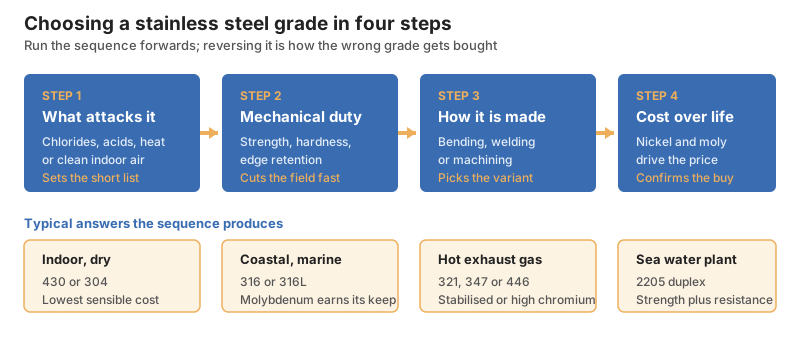
Work through stainless steel grades in this order, because reversing it is how the wrong one ends up on the order.
Start with what attacks the part
Name the enemy first. Chlorides, acids, heat and clean indoor air lead to four different short lists of stainless steel grades.
Then set the mechanical duty
Strength and hardness cut the field fast. A part that must hold a sharp edge rules out the austenitic grades outright.
Then check how it gets made
Ask the shop before you commit to anything.
- Heavy bending points to the austenitic grades.
- Heavy welding points to the low-carbon L grades.
- Heavy machining points to the free-cutting types. - Each swap can change the grade, so ask early rather than late.
Then compare cost over life
Nickel and molybdenum drive the price of stainless steel grades more than anything else on the mill certificate. A cheap grade that survives the design life beats a rich one bought for comfort.
Mistakes That Waste Money on Stainless Steel Grades
- Buying 316 as a blanket upgrade. Indoors and away from chlorides, it does nothing that 304 does not already do.
- Trusting the magnet test. A magnet tells you the family rather than the quality, and three of the four families are magnetic.
- Reading the number as a rank. Stainless steel grades are not ranked by merit, so 430 is not worse than 304.
- Skipping the surface finish. A rough or contaminated surface will stain on any grade in the book.
The 200-series trap
Chrome-manganese 200-series grades swap nickel for manganese to cut the price. The Australian Stainless Steel Development Association has tied the low-nickel versions to real corrosion failures, because low nickel usually means low chromium. Check the chromium figure on the mill certificate, not the headline price.
Frequently Asked Questions About Stainless Steel Grades
Which of the stainless steel grades is best overall?
There is no best grade, only a best fit, and 304 covers the widest span of ordinary work. That is why it is stocked more heavily than anything else.
Do all stainless steel grades fight rust equally?
No, because protection tracks chromium, molybdenum and nickel content. A ferritic 430 and a duplex 2205 sit at opposite ends of the same family tree.
Is magnetic stainless steel lower quality?
No, and the magnet is telling you the family rather than the quality. The ferritic, martensitic and duplex families are all magnetic by nature.
When is 316 really needed?
Wherever chlorides reach the part. Coastal air, sea water, pool chemistry and road salt are the cases where the pricier of the two common stainless steel grades pays back.
What does the L in 316L mean?
Lower carbon. It buys better welding and guards the grain boundaries, at a small loss of strength. Ask for it whenever a fabricator joins thick sections.
Do European and American names for stainless steel grades match up?
They run in parallel rather than matching exactly, so quote both systems when you buy across borders. Any competent supplier will recognise either form.
Conclusion: Specify the Site, Then Pick From the Stainless Steel Grades
Start with what attacks the part, because the enemy cuts the short list of stainless steel grades faster than any spec sheet will. Chlorides point at molybdenum. Heat points at high chromium.
Then read the family before you read the number.
The family tells you how the steel bends, welds and holds strength; the number only fine-tunes it. Buy on fit rather than reputation. Stainless steel grades are engineering choices, and the cheapest one that survives the site is right.
Related categories on EYBY:
- Browse stainless steel flat products for sheet, plate and coil.
- Compare stainless steel long products for bar, angle and section.
- Review stainless steel pipes for process and fluid lines.
Related Posts
Sandblasting Sand: Why the Cheapest Abrasive Costs You the Most
Types of Pliers: Jaw Shapes, Grip and What Each Pair Is For