Drywall Anchors: How to Choose the Right Type for Every Wall
By Andrew Lee · 12 July 2026
A shelf pulls loose. A mirror crashes overnight.
Almost every failure like that traces back to the same cause: the wrong drywall anchors, or none at all.
Picking the right drywall anchors is not guesswork.
Once you know the weight ratings and the wall type, the choice becomes quick and repeatable. This guide breaks down the five drywall anchors that procurement teams reach for most, how much weight each holds, and how to install one correctly.
What Drywall Anchors Do and Why They Matter
Gypsum board handles compression well but struggles under shear stress, and a bare screw creates exactly that kind of stress. Drywall anchors spread the load across a wider patch of board, so the fastener does not tear free.
Skipping an anchor is not a shortcut. It is a bet against the strength of paper-faced gypsum, and gypsum almost always loses that bet.
How Drywall Anchors Work
Most drywall anchors work through expansion. As a screw drives in, the anchor body widens, folds, or splays out behind the wall. That wider bearing surface turns a few square millimeters of thread into a connection rated for tens of pounds.
Not every job needs one, though:
- A mark that lands on a wall stud needs only a standard screw, since framing already holds more weight than any anchor.
- A load under 5 pounds on solid drywall often holds with a simple screw.
- A short-term hang, like a seasonal decoration, may not justify a permanent hole at all.
Standard Gypsum Board and Framing Basics
Gypsum wallboard sold in North America follows ASTM C1396, the standard covering wallboard, backing board, and related gypsum panel products. Half-inch wallboard is the default for interior walls and ceilings, rated for framing spaced 16 inches on center. Type X board adds at least one hour of fire resistance on 2×4 studs at that same spacing.
Knowing the board thickness before buying drywall anchors prevents a common mismatch: a heavy-duty anchor bought for a wall too thin to fit it.
Types of Drywall Anchors and Their Weight Capacities
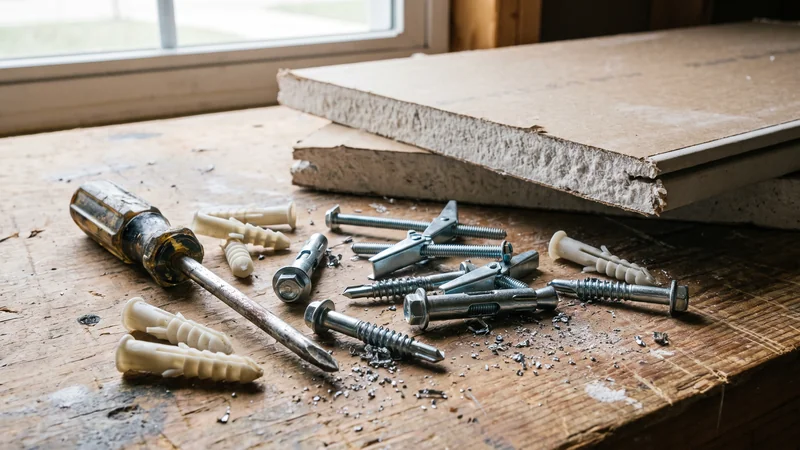
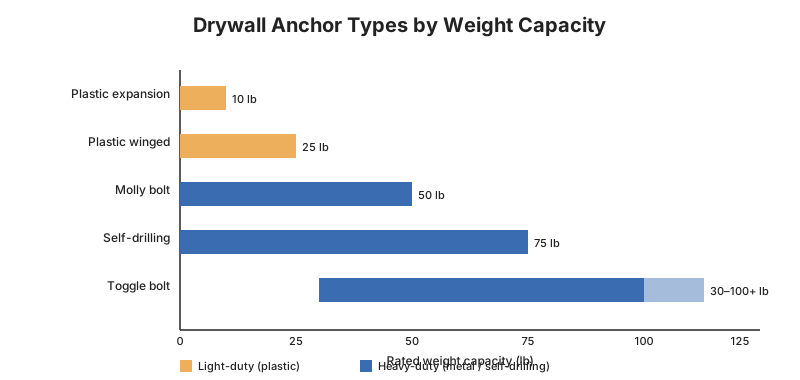
Five anchor families cover nearly every job a facilities or procurement team will face. Each one trades off cost, install speed, and holding power differently. Here is a quick look at all five drywall anchors, with their rated capacity:
- Plastic expansion anchors expand as the screw drives in and hold about 10 pounds. - Best for picture frames and other light decor.
- Plastic winged anchors fold out wings behind the board and hold about 25 pounds. - Best for curtain rods and light shelving.
- Molly bolts use a metal sleeve that collapses behind the board and hold up to 50 pounds. - Best for fixtures removed and reinstalled often.
- Self-drilling anchors cut their own hole with sharp threads and hold up to 75 pounds. - Best for cabinets and larger shelving units.
- Toggle bolts open spring-loaded wings inside the cavity and hold 30 to 100-plus pounds. - Best for TV mounts, grab bars, and anything a person might pull on.
Plastic Expansion Anchors
These plastic drywall anchors are the lightest-duty option on this list. They hold around 10 pounds per pair and install fast, though they fall short for anything that swings.
Self-Drilling Anchors
These self-drilling drywall anchors thread in with no pilot hole needed, which saves time on large jobs. Some models hold up to 75 pounds.
Molly Bolts
These metal drywall anchors pair a sleeve with a bolt; as the bolt tightens, the sleeve collapses behind the board. The largest hold up to roughly 50 pounds, and mollys suit fixtures that come off the wall often.
Toggle Bolts
Toggle bolts pair a bolt with spring-activated wings. The wings snap open once pushed through the cavity. That wingspan gives toggle bolts the highest capacity on this list, generally 30 to 100-plus pounds.
Plastic Winged (Butterfly) Anchors
These winged drywall anchors, sometimes called butterfly anchors, fold flat wings out behind the board. Rated around 25 pounds, they cost less than a molly bolt and hold more than a plain expansion anchor.
| Anchor Type | Typical Weight Capacity | Best For |
|---|---|---|
| Plastic expansion anchor | Up to 10 lb | Picture frames, small decor |
| Plastic winged (butterfly) anchor | Up to 25 lb | Light shelving, curtain rods |
| Molly bolt | Up to 50 lb | Removable fixtures, mirrors |
| Self-drilling anchor | Up to 75 lb | Cabinets, larger shelving |
| Toggle bolt | 30 to 100+ lb | TV mounts, grab bars, heavy fixtures |
How to Find a Stud Before You Reach for an Anchor
A screw driven into a wall stud can carry 100 pounds or more, no anchor needed. That makes stud-finding the first real step before reaching for drywall anchors.
Studs sit about 16 inches apart, center to center, and measure roughly 1.5 inches wide.
Using a Stud Finder
An electronic or magnetic stud finder locates framing fast by sensing density changes or existing fasteners. Run it slowly and mark both edges of the stud, so the screw lands near the center.
Reading Outlet and Switch Box Clues
Outlet and switch boxes almost always sit against a stud, so they double as a free reference point. A drilled test hole confirms the rest:
- Solid resistance right behind the drywall face means a stud sits there. - Move the fastener mark to the center of that stud.
- Hollow feel with no resistance means one of the drywall anchors above is required. - Pick an anchor rated for the load before drilling a full-size hole.
- No luck on the first try: a second test hole 16 inches to either side usually finds the next stud.
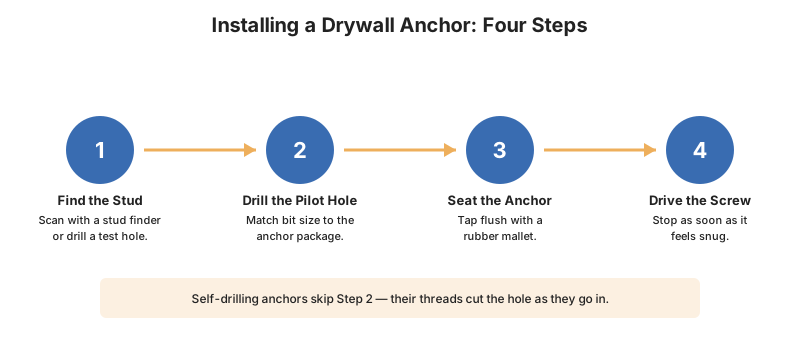
Step-by-Step: Installing a Drywall Anchor
Most drywall anchors fail during installation, not because of a bad product choice. Getting the pilot hole and seating depth right matters as much as the rating on the package.
Before starting, gather a short list of tools:
- A drill with the bit size listed on the anchor packaging.
- A stud finder, or a small nail for test holes.
- A rubber mallet for seating metal anchors.
- A screwdriver or driver bit matched to the anchor's screw.
Drilling the Pilot Hole
Check the packaging for the recommended bit size; the hole should sit slightly smaller than the anchor body, so the threads grip the gypsum instead of spinning loose. Hold the drill straight to keep the hole round, since an angled hole weakens the grip.
Seating the Anchor and Driving the Screw
Tap the anchor into the pilot hole until it sits flush, using a rubber mallet for a snug fit. Drive the screw slowly and stop as soon as it feels snug, since going too far can strip the anchor.
Choosing the Right Anchor for the Job
Two questions settle the choice among drywall anchors every time: how much weight will the fixture carry, and is the wall solid framing or open cavity.
Matching Anchor to Load
Start with the heaviest realistic load a fixture will carry, not its resting weight.
- Under 10 lb: a standard plastic expansion anchor covers most drywall thicknesses.
- 10 to 25 lb: a plastic winged anchor or light self-drilling anchor covers most shelving.
- 25 to 50 lb: a molly bolt is the standard pick for fixtures removed often.
- 50 lb and up: toggle bolts or a stud-mounted fastener are the only options rated that high.
Matching Anchor to Wall Type
Standard gypsum wallboard built to ASTM C1396 accepts every anchor type above, but thinner board and plaster-and-lath walls need anchors rated for those substrates.
- Standard drywall: any anchor in this guide, matched to load.
- Plaster-and-lath walls: anchors rated for plaster, since lath cavities behave differently.
- Hollow-core doors: anchors sized for the door's thin panel, usually a smaller toggle style.
Common Drywall Anchor Mistakes to Avoid
Most failures with drywall anchors come from installation errors, not bad products.
- Drilling a pilot hole larger than the anchor body, leaving nothing for the threads to grip. - Fix: match the bit size to the anchor package, not by eye.
- Ignoring the rated capacity and assuming a bigger-looking anchor holds more weight. - Fix: check the printed rating before buying, every time.
- Driving the screw too far, which strips the anchor or cracks the gypsum face.
- Mounting a heavy load on a single light-duty anchor instead of spreading it across a stud plus drywall anchors.
- Reusing a stripped hole rather than moving the fixture an inch to fresh board.
Frequently Asked Questions
How much weight can drywall anchors hold?
It depends on the type. Plastic expansion anchors hold roughly 10 pounds, winged anchors and molly bolts run 25 to 50 pounds, and toggle bolts top out above 100 pounds.
Do I need a stud finder to use drywall anchors?
Not strictly, but finding studs first is worth the extra minute. A fastener driven into framing outperforms any anchor and needs no special hardware.
Can I reuse a hole drilled for drywall anchors?
A molly bolt or toggle bolt can usually be removed and reinstalled in the same hole. A stripped plastic anchor hole should be abandoned in favor of fresh board nearby.
What size pilot hole do drywall anchors need?
Check the packaging, since sizing varies by brand. The rule of thumb is a bit slightly smaller than the anchor body, so it must be tapped in rather than dropped in loosely.
Are self-drilling drywall anchors as strong as toggle bolts?
No. Self-drilling anchors typically top out around 75 pounds, while toggle bolts reach past 100 pounds because their wings spread the load wider.
Conclusion
Choosing among drywall anchors is a five-minute decision once you know the load and the wall type. Match the fixture's fully loaded weight to the rated capacity, confirm whether a stud sits nearby, and follow the pilot-hole and seating steps closely.
A few habits keep every job on track:
- Stock a mix of plastic, self-drilling, molly, and toggle drywall anchors on the shelf.
- Match bit size to the anchor package every time, not by habit.
- Treat the printed weight rating as a hard limit, not a suggestion.
Stock those four types, and the next job turns into a quick lookup instead of a guess.
Related categories: Drywall & Plaster Anchors · Drywall Panels · Drywall Screws
Related Posts
Sandblasting Sand: Why the Cheapest Abrasive Costs You the Most
Types of Pliers: Jaw Shapes, Grip and What Each Pair Is For