Resistance Bands: How to Choose the Right Type and Tension
By Markus Edvinsson · 17 August 2026
A strip of rubber has become the most widely used strength tool on the planet. Resistance bands cost little, weigh almost nothing, and load a muscle across its whole range.
Yet most buyers still choose by colour, and colour is the least reliable number on the packet.
What Resistance Bands Do That Weights Cannot
Variable resistance in a single strip
Resistance bands load a movement in a way no dumbbell can. Force climbs as the band stretches, so the hardest point sits at the end of the range. That behaviour held for every grade tested in the Journal of Physical Therapy Science.
The portability argument
A full set of resistance bands fits in a jacket pocket. That explains their spread through clinics, hotel gyms and travelling team kits.
What the strength research shows
Elastic training is not a lesser substitute for iron. A review in SAGE Open Medicine pooled trials comparing elastic and conventional resistance training. It found similar strength gains from both, across healthy adults, athletes and patients.
The World Health Organization asks adults to work the major muscle groups on two or more days a week. Resistance bands make that target reachable in a bedroom, a ward or an office.
The Five Types of Resistance Bands
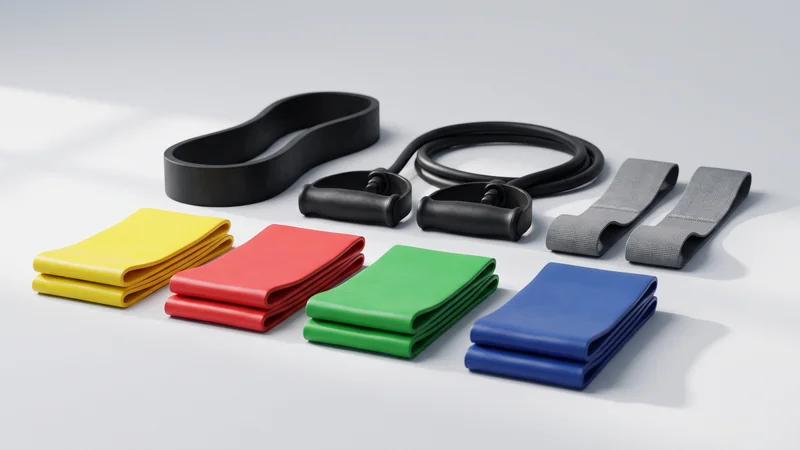
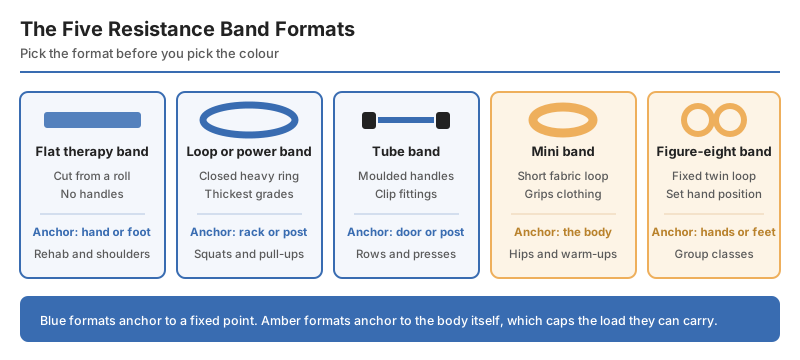
Five formats cover nearly every training job.
- Flat therapy bands cut from a roll.
- Loop or power bands in closed rings.
- Tube bands with moulded handles.
- Mini bands as short fabric loops.
- Figure-eight bands for fixed patterns.
Flat therapy bands
The flat band is the clinical standard and the most forgiving format. With no handles, grip strength never limits the exercise.
- Best for rehabilitation, shoulders and older beginners.
- Sold by the roll, which cuts cost per session.
Loop and power bands
Power bands are thick continuous loops for heavy compound work.
- Best for squats, presses and assisted pull-ups. - Layer two light loops instead of jumping a grade. - Keep the anchor below waist height for presses.
- Watch for snap-back over a sharp edge.
Tube bands with handles
Tubing with handles is the closest thing to a cable machine in a bag. Clip fittings let one handle serve several grades.
- Best for rows, curls and presses. - Check the clip and end fitting before every set.
- Weak point is the joint where tube meets handle.
Mini bands
Mini bands sit around the thighs, knees or ankles. Fabric versions grip skin and clothing far better than rubber.
- Best for hip work, warm-ups and knee rehabilitation.
- Fabric build resists rolling and lasts longer.
Figure-eight bands and ankle cuffs
These fix hand or foot position for you, which helps in a class. The trade-off is a narrow range of usable exercises.
| Band type | Typical form | Best setting | Main limitation |
|---|---|---|---|
| Flat therapy band | Cut length or roll | Clinics and rehabilitation | Grip slips when wet |
| Loop or power band | Closed heavy ring | Racks and assisted pull-ups | Snap-back risk |
| Tube band | Tube with handles | Home training and travel | Handle joint wears |
| Mini band | Short fabric loop | Hips, glutes and warm-ups | Little upper-body use |
| Figure-eight band | Fixed twin loop | Group classes and rehab | Few usable exercises |
What Band Colour Really Tells You
The colour scale is a ranking, not a spec
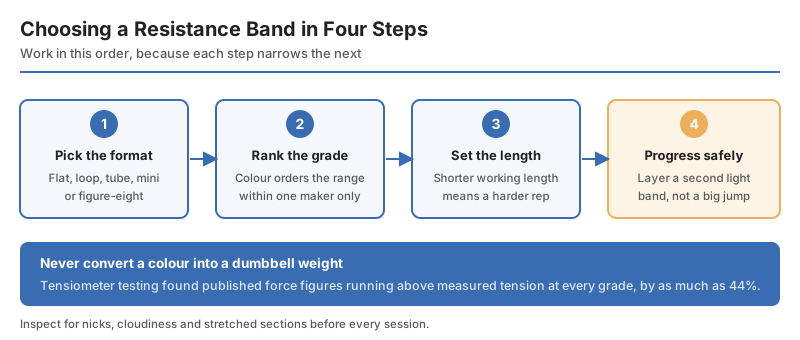
Colour tells you the order of the grades and little else. Makers use their own colour ladders, so a red band from one brand can outpull a green band from another. Treat colour as a position inside that maker's own range.
Published force values run high
This is the finding buyers rarely hear.
Researchers writing in the Journal of Physical Therapy Science measured eight grades on a tensiometer and compared them with published figures. Almost every measured value came in below the published one, and the gap grew wider toward the heavy end. The published number for the heaviest grade overstated real tension by 44%.
Use the published chart to rank resistance bands, never to calculate training load.
Stretch, not colour, sets the load
The same band delivers very different force depending on how far you pull it. Shorten the working length and it gets harder without changing colour.
| Band grade | Force at 100% stretch (kgf) | Force at 200% stretch (kgf) | Published figure at 100% stretch (kgf) |
|---|---|---|---|
| Tan | 1.08 | 1.58 | Not published |
| Yellow | 1.17 | 1.69 | 1.32 |
| Red | 1.60 | 2.26 | 1.77 |
| Green | 1.82 | 2.91 | 2.27 |
| Blue | 2.51 | 3.52 | 3.22 |
| Black | 3.28 | 5.23 | 4.40 |
| Silver | 3.89 | 5.91 | 5.99 |
| Gold | 5.66 | 7.55 | 9.80 |
Those measured values come from one clinical band range. Two grades in it, tan and yellow, proved statistically indistinguishable.
Matching Resistance Bands to the Job
Rehabilitation and clinical work
Start light and progress by grade rather than by stretch.
Flat resistance bands dominate here because they spread pressure over a wide contact area. Clinicians can also cut a fresh length per patient, settling hygiene cleanly.
Strength and hypertrophy training
Heavy loop resistance bands belong in the rack, not the drawer. Pair them with a bar for accommodating resistance, or use them alone for high-rep pressing.
Our strength training equipment range covers the racks and benches these bands anchor to.
Assistance and sticking points
Resistance bands can subtract load as well as add it.
Looped over a bar and under the knee, a band gives most help at the bottom of a pull-up. That is where the lifter is weakest, so the sticking point clears.
Travel and small spaces
- A hotel room needs one tube set and one mini band.
- A home corner needs a door anchor and two loop grades. - Add a mat so knees and elbows stay off hard flooring.
- A field kit needs flat resistance bands, since they cut to length.
Pair any of these with exercise mats and wall padding for floor work.
Latex, Wear and Safe Anchoring
Natural rubber latex and allergy
Many low-cost resistance bands are natural rubber latex. Allergy research has shown that latex sport bands carry clinically relevant allergens.
- Ask the material question before any bulk order.
- Offer a synthetic option in clinics and schools.
Inspect before every session
Rubber fails visibly, and it fails in the same places.
- Nicks and tears along the edge of a flat band.
- Cloudy or sticky patches that signal ozone damage. - Retire the band rather than trimming past it. - Store resistance bands away from sunlight and heat.
- Stretched sections that no longer recover their length.
Anchor points that hold
An anchor failure sends the band back at head height.
- Use a door anchor, never the door edge itself.
- Sleeve rack uprights so powder coat cannot cut rubber.
- Never stretch resistance bands toward a face, including your own.
How to Build a Resistance Bands Set
A starter set for one person
Three grades cover most beginners, plus one anchor.
- One light grade for shoulders and warm-ups.
- One medium grade for rows, presses and squats.
A stock list for a facility
Buying resistance bands for a gym or clinic changes the maths.
- Buy flat bands by the roll and cut per user.
- Double up on medium grades, which wear out first. - Track replacement dates instead of waiting for failures.
- Keep a latex-alternative tray for sensitised members.
Our full resistance bands, resistance tubing and training ropes range covers every format above.
Resistance Bands Questions Answered
Can resistance bands build real muscle?
Yes. The meta-analysis in SAGE Open Medicine found similar strength gains from elastic and conventional training.
How do I match a band to a dumbbell weight?
You cannot convert reliably. Measured tension depends on grade, stretch and anchor length, so match effort by feel and repetitions.
How long do resistance bands last?
There is no fixed expiry date, so replace on condition, not on a calendar. Sunlight, heat and chlorine all shorten a band's working life. Retire any band with nicks, cloudiness or a section that no longer springs back.
Are fabric mini bands better than rubber?
For hip and glute work, usually yes. Fabric grips without rolling, though it costs more per unit.
Do resistance bands suit older users?
They suit them particularly well. Light flat bands start below the weight of any dumbbell. That is exactly where most beginners give up.
Conclusion: Buy Resistance Bands on Tension, Not Colour
Colour ranks a band inside one maker's range. It does not measure force, and published charts overstate load at the heavy end.
Pick the format first, then the grade, then set the anchor length to fine-tune.
Do that, and a pocketful of resistance bands will out-train equipment costing a hundred times more.
Related Posts
Sandblasting Sand: Why the Cheapest Abrasive Costs You the Most

Types of Pliers: Jaw Shapes, Grip and What Each Pair Is For