Steel Plate: How to Choose the Right Grade and Thickness
By Brandon Richter · 17 August 2026
Flat steel looks like one product until you try to buy it. The moment an order goes to a mill, steel plate splits into grades, thickness bands, edge conditions and mill practices. Each of those choices is made before the rolls ever turn.
Get one of those wrong and the material arrives legally correct and completely unusable.
What Counts as a Steel Plate
The dimensional dividing line
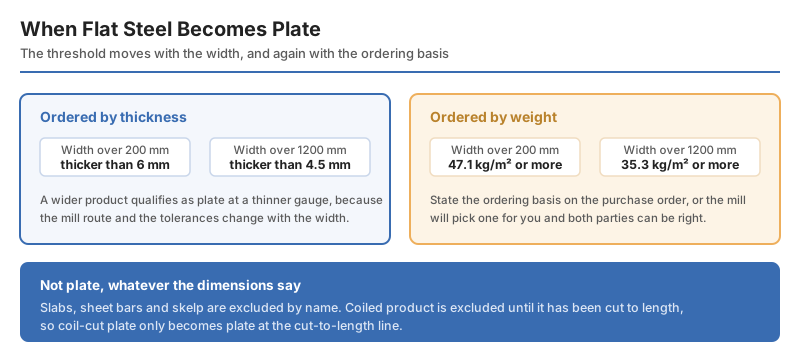
Plate is not simply thick sheet. ASTM International sets width and thickness thresholds that decide which product you have actually bought. The thresholds move with the ordering basis, so the same piece can change name.
| Ordering basis | Width | Threshold |
|---|---|---|
| By thickness | Over 200 mm | Thicker than 6 mm |
| By thickness | Over 1200 mm | Thicker than 4.5 mm |
| By weight | Over 200 mm | 47.1 kg/m² or heavier |
| By weight | Over 1200 mm | 35.3 kg/m² or heavier |
Coil-cut plate against discrete plate
Steel plate reaches you by one of two routes. Both are legitimate, and the paperwork differs.
- Discrete plate rolled as individual flat lengths. - Available in the heaviest thicknesses the mill can roll.
- Coil-cut plate slit and cut from a coil. - Limited to the thickness the coil line can handle.
- A key rule is that coiled material is not plate until it is cut.
Coil-cut steel plate arrives without further heat treatment. Stress relieving does not count as heat treatment for this purpose, so ask the question directly if the job needs a normalised product.
What plate is not
Three products sit close to steel plate without qualifying as it.
- Slabs are semi-finished feedstock for the rolling mill.
- Sheet bars and skelp are intermediate products.
- Coil becomes plate only once cut to length.
Hot-Rolled and Cold-Rolled Steel Plate
How hot rolling shapes the product
Hot rolling happens above the recrystallisation temperature. The steel moves easily, which suits heavy sections and keeps the cost per tonne low. It is the default route for almost all structural work.
- Thickness range runs from a few millimetres to hundreds.
- Surface carries mill scale unless pickled and oiled. - Say so on the order if the plate will be painted.
- Tolerances are looser than any cold-rolled equivalent.
Our hot-rolled steel plate range covers plain, chequered, boiler and wear-resistant products.
Where cold rolling earns its price
Cold rolling takes hot-rolled material and reduces it again at room temperature. That second pass buys precision rather than strength.
- Tighter thickness tolerance across the whole width.
- Brighter surface with no scale to remove.
- Higher hardness from work hardening during reduction.
- Higher cost, since the extra pass is not free.
Reach for cold-rolled steel plate when the finished part is visible or must fit closely.
Choosing between the two
Ask what the plate has to do rather than which sounds better.
A structural gusset does not care about surface finish. A machine guard that will be painted and seen cares a great deal.
Steel Plate Grades That Cover Most Jobs
A36 as the default
A36 is the workhorse of carbon steel plate. It welds and machines easily, and it carries a minimum yield of 36 ksi with tensile strength between 58 and 80 ksi. Most fabrication shops hold it in stock for that reason alone.
A572 Grade 50 for lighter sections
This grade buys strength rather than thickness.
Its minimum yield of 50 ksi runs about 39% above A36, so designers can carry the same load with a lighter section. Minimum tensile strength sits at 65 ksi.
A516 Grade 70 for pressure work
Boiler and vessel plate is a different discipline.
A516 Grade 70 delivers tensile strength of 70 to 90 ksi with a minimum yield of 38 ksi. Toughness at temperature matters more here than headline strength.
Weathering and wear grades
Two more families deserve a place on the shortlist.
| Grade | Minimum yield | Notes | Typical use |
|---|---|---|---|
| A36 | 36 ksi | Tensile 58 to 80 ksi | General structural steel plate |
| A572 Gr 50 | 50 ksi | Tensile 65 ksi minimum | Lighter structural sections |
| A516 Gr 70 | 38 ksi | Tensile 70 to 90 ksi | Boilers and pressure vessels |
| A588 | 50 ksi | Holds to 4 in thickness | Exposed weathering structures |
| A529 | 42,000 psi | Limited to thin sections | Light structural work |
Thickness, Tolerance and Edge Condition
Edge conditions the mill can supply
The edge you specify changes both price and fabrication time. Five conditions are available from the mill.
- Mill edge from horizontal rolls, with no defined contour.
- Universal mill edge from horizontal and vertical rolls. - Often shown as UM on a mill certificate.
- Sheared edge trimmed on every side.
- Gas cut edge from flame cutting.
- Special cut edge with pre-heat or post-heat to cut stress.
Deoxidation practice and quality
How the steel was deoxidised shapes how the plate behaves. The practice is named on the specification, not chosen at the counter.
- Killed steel is fully deoxidised and the most consistent.
- Semi-killed and capped steels sit in the middle.
- Rimmed steel forms an outer rim almost free of voids.
Heat treatment on the mill floor
Heat treatment can be done by the maker, the processor or the fabricator.
Plate given accelerated cooling for toughness must then be tempered between 595°C and 705°C. That step is not optional, so confirm it appears on the certificate.
Specifying Steel Plate Without Surprises
What every order needs
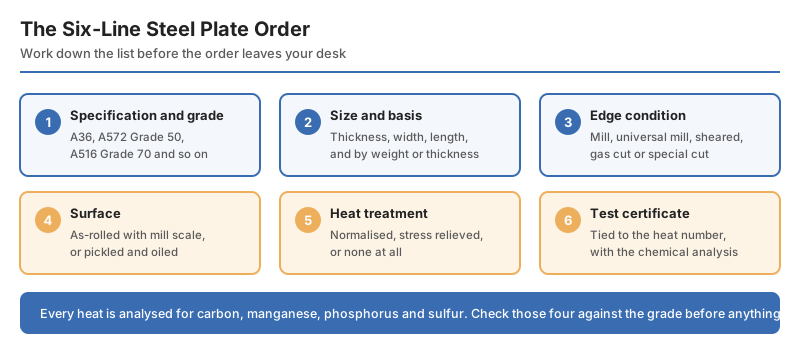
An incomplete order is the most common cause of a rejected delivery. Six lines cover almost every job.
- Specification and grade, such as A36 or A572 Grade 50.
- Thickness, width and length, with the ordering basis stated.
- Edge condition, chosen from the five the mill offers.
- Surface, as-rolled or pickled and oiled.
- Heat treatment, if the design assumes it.
- Test certificate, tied to the heat number.
Reading the mill certificate
Every heat is analysed for carbon, manganese, phosphorus and sulfur, plus anything else the specification restricts. Check those figures against the grade before the plate is cut.
Where fine grain size is required, the standard asks for grain size number 5 or finer with most grains conforming.
Where Each Steel Plate Type Belongs
Structural steelwork
Base plates, gussets, stiffeners and splice plates all start as steel plate. A36 covers most of this work, with A572 Grade 50 taking over when weight matters.
Tanks, boilers and vessels
Pressure work runs on its own grades and its own paperwork.
- A516 Grade 70 for boiler and vessel shells.
- Full traceability back to the heat number.
- Toughness testing where service runs cold.
Floors, ramps and walkways
Raised-pattern steel plate solves the slip problem in one product. Our chequered plate range suits mezzanines, vehicle ramps and plant walkways.
Steel Plate Questions Answered
What is the difference between steel plate and steel sheet?
Width and thickness decide it, not appearance. Flat product over 200 mm wide must exceed 6 mm in thickness to be classed as plate, and the threshold drops for very wide material.
Is cold-rolled steel plate stronger than hot-rolled?
Not in the sense that matters. Cold rolling raises hardness and tightens tolerance, but the grade sets the yield and tensile figures you design to.
Which steel plate grade should I default to?
A36 for general structural work. Move to A572 Grade 50 when a lighter section would save more than the grade costs.
Does chequered plate come in structural grades?
Yes, and it is covered by its own ASTM specification for rolled floor plates. Treat the raised pattern as a surface feature rather than a separate material.
Why did my plate arrive with mill scale?
Because as-rolled is the default on hot-rolled steel plate. Specify pickled and oiled if the surface has to be painted or welded clean.
Conclusion: Buy Steel Plate on the Spec Sheet
Steel plate is the least forgiving product in the flat range, because so much of it is decided before rolling starts.
Fix the grade against the load. Fix the thickness and width against the classification rules. Then name the edge, the surface and the heat treatment in the same breath.
Do that, and every sheet of steel plate that reaches your yard will already be the one you meant to buy.
Related Posts
Sandblasting Sand: Why the Cheapest Abrasive Costs You the Most