Stair Nosing: How to Choose the Right Profile for Every Staircase
By Kasia Olejarczyk · 16 August 2026
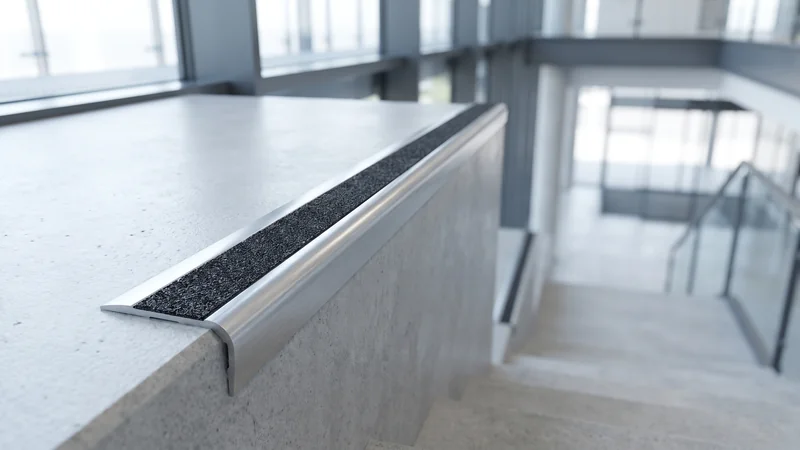
The leading edge of a step takes more punishment than any other part of a staircase. A well chosen stair nosing turns that weak point into the safest surface on the flight.
Get the profile wrong and you build the exact trip hazard you set out to remove.
What a Stair Nosing Actually Does
The three jobs of every strip
A stair nosing works on three fronts at once. It shields the tread, marks the edge for the eye, and holds grip where the sole lands.
- Edge protection so the tread material never chips.
- Visual contrast so the eye reads each step.
- Grip from an abrasive or ribbed face.
- A wear budget, since a strip costs less than a tread.
Why descent matters more than the climb
Most stair falls happen on the way down.
Research on stair negotiation puts most falls in the descent phase. The heel lands close to the front lip, so the leading edge takes the first load. A good strip puts the grippiest material exactly where that contact happens.
Where a stair nosing fails first
Failure almost always starts at the front lip. Bond lines let go, grit polishes smooth, and a lifted edge becomes a toe catcher.
- Lifted edges from adhesive failure or trapped water. - Check the front lip of each strip on every safety walk. - Re-bond or replace before the lip curls.
- Polished grit across the middle of a busy flight. - Test grip with a wet sole twice a year.
- Faded contrast on coloured or glow inserts.
Stair Nosing Profiles and Shapes
Profile choice depends on whether you are building new stairs or rescuing old ones.
- New build suits a square or bullnose profile.
- Chipped risers call for an angle profile.
- Live retrofits need an overlap profile.
Square edge stair nosing
The square profile sits flush against a vertical riser. It suits new concrete or timber stairs with a straight, sound edge.
Bullnose and rounded stair nosing
A rounded lip softens the edge and sheds impact well. Codes cap how tight that curve can be, so the radius is never a free choice.
Angle-fit stair nosing
The L-shaped angle wraps the tread and the top of the riser. Specifiers pick it when the front face already shows chips.
Overlap stair nosing for retrofits
An overlap profile covers a worn edge with no cutting. The strip laps over the existing lip, then bonds or screws down. Fitters like it because the stairs can stay open during the work.
Stair Nosing Materials Compared
Material sets the lifespan, the cost, and the feel underfoot.
| Material | Best setting | Traffic level | Watch out for |
|---|---|---|---|
| Aluminium with grit | Offices, schools, transit | Heavy | Insert wear at the centre |
| Rubber | Gyms, clinics, homes | Light to medium | Faster surface wear |
| Vinyl | Retail and fit-outs | Light to medium | Colour fade in sunlight |
| Photoluminescent | Escape stairwells | Medium | Needs regular light |
| Fibreglass | Plants and outdoor steps | Heavy and wet | Sharper feel underfoot |
Metal and composite options
Aluminium is the default in offices, schools, and transport buildings. Moulded fibreglass takes over where the steps run wet, oily, or outdoors.
- Aluminium carries heavy footfall and never rusts. - Grit inserts refresh grip without a full swap.
- Fibreglass holds coarse grit through wash-down cycles.
- Glow inserts stay visible during a blackout.
Softer indoor options
Rubber and vinyl are quieter and gentler in a fall. They wear faster than metal, so they belong on lighter indoor traffic.
- Rubber suits gyms, clinics, and homes. - Expect a shorter replacement cycle than metal.
- Vinyl suits retail and budget fit-outs.
- Both need a firm, level substrate underneath.
Code Rules That Govern Stair Nosing
Three rule sets shape almost every stair nosing specification worldwide.
Projection, radius and riser slope
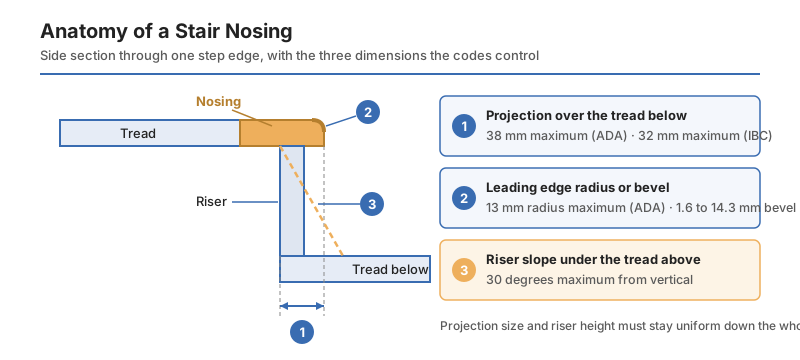
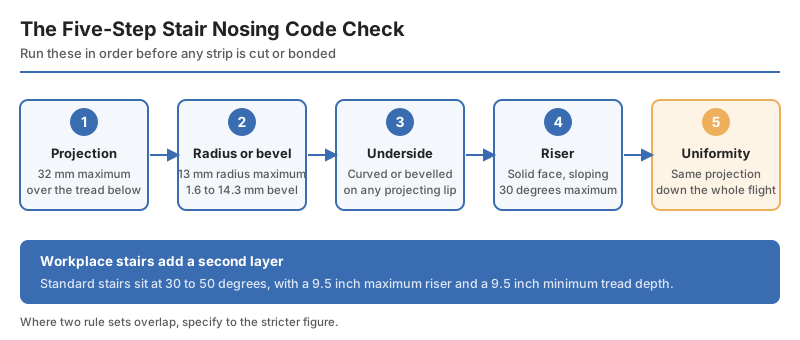
The ADA Standards for Accessible Design cap projection at 1½ inches, or 38 mm, over the tread below. The International Building Code allows no more than 1¼ inches, or 32 mm. Where both apply, the stricter number wins.
Both rule sets also control the leading edge itself. The ADA Standards limit the radius to ½ inch, while the code asks for a curve or bevel between 1/16 inch and 9/16 inch.
- Curved or bevelled undersides on any projecting lip.
- Riser slope of 30 degrees maximum from vertical.
- Uniform projection down the whole flight.
Workplace stairs
OSHA sets its own limits for stairs at work. Standard stairs sit between 30 and 50 degrees from horizontal, with a maximum riser height of 9.5 inches.
- Uniform risers and treads between every pair of landings.
- Minimum tread depth of 9.5 inches on standard stairs.
- Load capacity of five times the anticipated live load.
Slip Ratings Behind a Safe Stair Nosing
DCOF and the 0.42 threshold
ANSI A326.3 measures the dynamic coefficient of friction of hard flooring. Its 2021 revision sorts products into five use classes.
- Interior Dry needs a dry reading of 0.42 or higher.
- Interior Wet needs that figure measured wet, or a declared class.
- Wet Plus, Exterior Wet and Oils are declared by the maker.
R ratings from the ramp test
DIN 51130 uses a tilting ramp and a harnessed walker in cleated boots. The angle at which the walker slips sets the R value.
| R value | Ramp angle | Wet slip risk | Suitable for |
|---|---|---|---|
| R9 | 6 to 10 degrees | High | Dry areas only |
| R10 | 10 to 19 degrees | Moderate | Mostly dry areas |
| R11 | 19 to 27 degrees | Moderate | Occasionally wet areas |
| R12 | 27 to 35 degrees | Low | Wet areas |
| R13 | 35 degrees and above | Low | Very wet areas |
- Read the finish, not the product family. - One collection can span more than one R value.
- Match the rating to the wettest day on site.
How to Specify and Fit Stair Nosing
Measure before you order
- Tread width at the narrowest step in the flight.
- Existing lip depth so the profile sits flat.
- Riser face condition, which decides angle or square.
- Finish thickness of the carpet, vinyl, or tile alongside.
Cut, dry-fit, then fix
Cut each length with a fine-tooth blade and deburr the ends.
Dry-fit the whole flight before any adhesive comes out. A strip that rocks on a high spot will fail early.
- Bonded fixing for thin retrofits on sound substrates. - Clean and prime the tread first.
- Mechanical fixing for heavy traffic or hollow treads.
- Combined fixing where wash-down cycles are constant.
Keep the contrast alive
The ADA Standards advise visual contrast at the leading edge so steps read clearly for people with low vision. That advice only holds if the contrast survives cleaning.
- Inspect quarterly on public flights.
- Replace by section so tread heights stay uniform.
Our antislip stair nosings range covers every profile above.
Stair Nosing Questions Answered
Does every staircase need a stair nosing?
No, but almost every busy one benefits. Where the tread edge is exposed, a stair nosing protects and marks it at the same time.
What is the maximum stair nosing projection?
The ADA Standards allow 1½ inches, and the International Building Code allows 1¼ inches. Plan to the tighter figure on any project that must satisfy both.
Can I fit a stair nosing over a worn edge?
Yes, and that is what overlap and angle profiles exist for. An overlap strip needs no cutting of the existing lip. Full antislip stair treads are the better answer once the whole tread surface has gone.
Which stair nosing suits wet outdoor steps?
Choose a coarse grit face rated R12 or R13 under the ramp test, because fibreglass and gritted aluminium both handle standing water well.
Is anti-slip tape a real substitute?
Only as a short-term fix or on a light-duty flight. Graded antislip tape adds grip, yet it gives the edge no impact protection.
Conclusion: Specify Stair Nosing With Confidence
A stair nosing is a small component with an outsized safety job.
Start from the code limits on projection and radius. Then pick a material that matches the traffic and the moisture. Finish by checking the slip rating of the exact finish you are buying.
Do that, and the right stair nosing will outlast the stairs it protects.
Related Posts
Sandblasting Sand: Why the Cheapest Abrasive Costs You the Most

Types of Pliers: Jaw Shapes, Grip and What Each Pair Is For