Air Compressor Types: How to Choose the Right One for Every Job
By Jess Blachman · 24 July 2026
An air compressor is only as good as its match to the tools it feeds. Buy too little flow and the unit stalls mid-task; buy the wrong design and it overheats or wastes power for years.
This guide compares the main air compressor types, explains CFM and PSI, and covers the safety rule every operator has to follow.
What an Air Compressor Has to Do
An air compressor turns motor power into a steady supply of pressurised air. Doing that at the right flow, pressure, and duty cycle is the whole job.
What every compressor has to deliver:
- Enough flow, in CFM, to keep the tool running without starving it.
- Enough pressure, in PSI, to drive the tool at its rated force.
- A duty cycle that survives how long you run it each hour.
Miss any one of those and the tool underperforms or the compressor fails early.
Flow, Pressure, and Duty Cycle
Flow and pressure are separate specs, and both matter.
Flow is how much air the unit moves, measured in cubic feet per minute. Pressure is how hard it pushes, measured in pounds per square inch, and duty cycle is how much of each hour the machine can run without a rest.
The Main Air Compressor Types
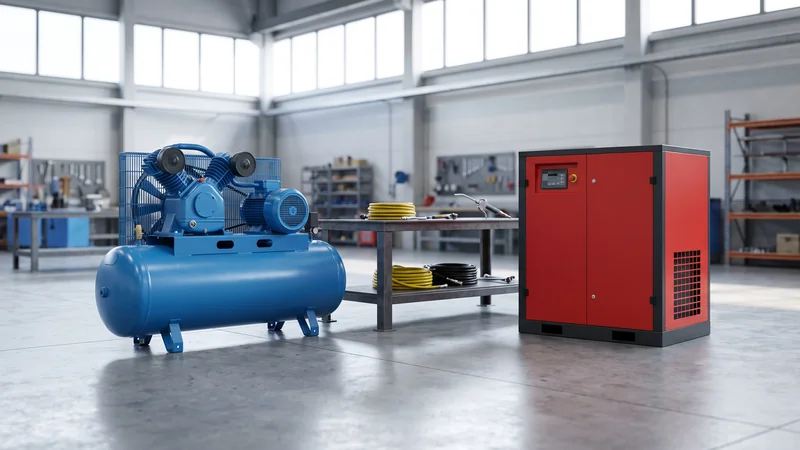
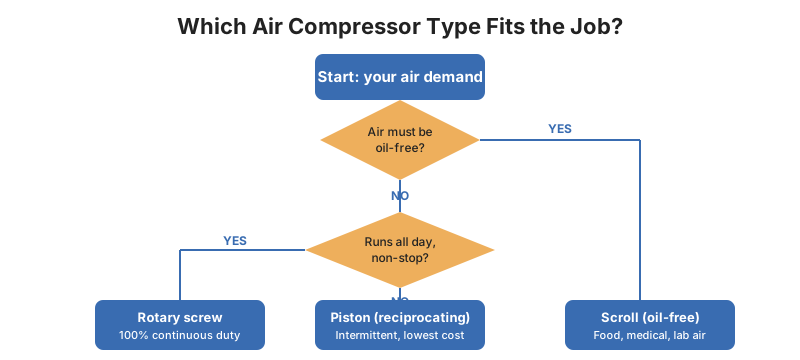
Three designs cover almost every job, from a tyre shop to a production line. Each suits a different balance of run time, air quality, and budget.
The three main air compressor types:
- Piston (reciprocating) — the low-cost, intermittent-duty workhorse. - Best for shops that run tools in short bursts, not all day.
- Rotary screw — built for continuous, all-day supply. - The choice when the line never stops for a cooling break.
- Scroll (oil-free) — quiet, clean-air units for sensitive work. - Suited to food, medical, and laboratory environments.
| Type | Duty cycle | Air quality | Best for |
|---|---|---|---|
| Piston (reciprocating) | Intermittent | Some oil carryover | Shops, sites, intermittent tools |
| Rotary screw | Continuous | Clean with a dryer | All-day production demand |
| Scroll (oil-free) | Continuous | Fully oil-free | Food, medical, and lab air |
Piston (Reciprocating) Air Compressors
The piston air compressor is the most economical unit to buy.
It is simple and robust, which is why you find one in almost every tyre, body, and machine shop. Atlas Copco notes these machines are built for intermittent use, running at roughly a 50 to 60 per cent duty cycle, or about 30 to 35 minutes each hour. They also need cooling time between cycles, and they run loud.
Rotary Screw Air Compressors
A rotary screw air compressor is the answer when the air can never stop.
These machines handle a 100 per cent continuous duty cycle and are built for reliable all-day operation. Many offer variable speed drive or fixed speed, and smaller units come tank-mounted with an integrated dryer for clean, dry air. That endurance makes a rotary screw air compressor the default for a busy production line.
Scroll and Oil-Free Air Compressors
A scroll air compressor compresses air without oil in the chamber. That makes it the natural pick for food, medical, and laboratory work, where any oil carryover is unacceptable. It costs more than a comparable piston air compressor, but the clean-air guarantee earns its price.
Oil-free designs meet the strictest air-quality standards. They run quietly, which suits an occupied workspace.
Sizing an Air Compressor: CFM, PSI, and Tank
Sizing is where most buyers go wrong. Match the unit to the tools, not to the label on the box.
How to read the numbers that matter:
- CFM (flow) — the air volume the tool consumes. - Add up the tools that run at the same time.
- PSI (pressure) — the force the tool needs to work. - Most air tools run near 90 psi.
- Tank size (gallons) — the reserve that smooths demand. - A bigger tank lets the motor cycle less often.
Atlas Copco frames the two core specs simply. Pressure, in PSI, relates to the force it takes to move something, while flow, in CFM, relates to how fast the job gets done.
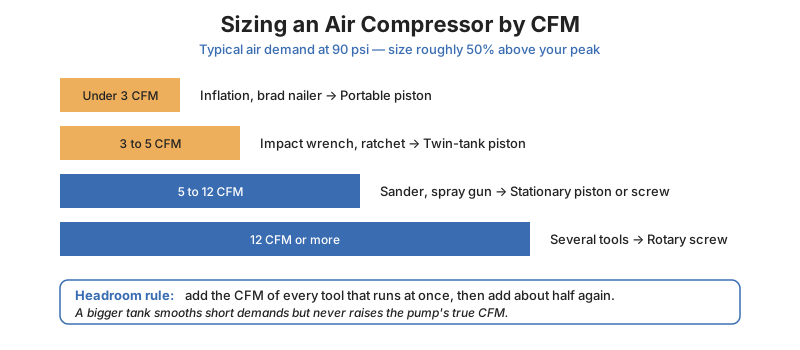
| Job | Typical CFM at 90 psi | Compressor type |
|---|---|---|
| Inflation, brad nailer | Under 3 CFM | Portable piston |
| Impact wrench, air ratchet | 3 to 5 CFM | Twin-tank piston |
| Sander, grinder, spray gun | 5 to 12 CFM | Stationary piston or screw |
| Several tools at once | 12 CFM or more | Rotary screw |
Add Headroom to the Flow
Size the compressor above your peak tool demand, never right at it.
A good rule is to choose roughly 50 per cent more CFM than the tools require, so the unit is not pinned at full output. That headroom protects both the motor and the tool's performance.
Signs an air compressor is undersized:
- The tool slows or stalls partway through a task.
- The motor runs almost non-stop to keep up.
- Pressure sags well below the tool's rated PSI.
Why Tank Size Matters
The tank, or air receiver, stores compressed air so the motor does not restart on every trigger pull.
A larger tank smooths out short, heavy demands. It cannot raise the true flow the pump makes, so read CFM first and treat the tank as a buffer.
Single-Stage, Two-Stage, and Duty Cycle
The number of compression stages sets both the top pressure and how hard the unit can work.
Single-Stage Compressors
A single-stage compressor squeezes the air once before it reaches the tank. It suits lower-pressure jobs and intermittent home or light-shop use.
Two-Stage Compressors
A two-stage compressor squeezes the air twice, with cooling in between.
That extra step reaches a higher pressure and runs cooler under load, which suits heavy, continuous production. Two-stage piston units are the usual step up when a single stage cannot keep pace.
Match the stage count to the work:
- Choose single-stage for intermittent, lower-pressure tasks.
- Choose two-stage for sustained, higher-pressure demand.
Oil-Lubricated Versus Oil-Free
Lubrication decides both the air purity and the maintenance routine.
Oil-lubricated units use oil to cool the pump and cut friction, which leaves slight traces of oil in the air. Oil-free units remove that risk and deliver clean air, at a higher price and often a shorter pump life. Match the choice to the work the air compressor has to do.
Pick the lubrication type by the work:
- Oil-lubricated — durable and quieter under heavy load. - Fine for general shop, site, and workshop tools.
- Oil-free — clean air with no oil carryover. - Required for food, medical, and fine finishing work.
Safety and Maintenance
An air compressor stores real energy, so it earns real respect. Good habits keep both the operator and the machine safe.
The OSHA Cleaning Rule
Never point full line pressure at yourself or a workbench to blow off debris.
OSHA requires that compressed air used for cleaning be reduced to below 30 psi at the nozzle, and then only with effective chip guarding and personal protective equipment. A regulated blow gun meets that rule where an open line does not. The lower pressure and guarding protect eyes and skin from flying debris.
Maintenance That Extends Service Life
Keep any air compressor healthy with a short routine:
- Drain the tank — remove condensate before it rusts the receiver. - Do it after each heavy session.
- Check the intake filter — protect the pump from dust. - A clogged filter starves the unit of air.
- Service the oil — on lubricated pumps only. - Follow the maker's interval to avoid wear.
- Inspect hoses and fittings — catch leaks early. - Leaks waste the power you pay for.
Pair the compressor with the right treatment, and browse compressed air treatment to add the dryer or filter your tools need.
Frequently Asked Questions
What size air compressor do I need?
Add up the CFM of every tool that runs at once, then choose a unit with roughly 50 per cent more flow at your working pressure. Most air tools run near 90 psi, so size the compressor to meet that demand with headroom.
What is the difference between CFM and PSI?
CFM is the volume of air the compressor delivers, and PSI is the pressure behind it. A tool needs both the right flow and the right pressure, so a high PSI alone will not run a hungry tool if the CFM is too low.
Is a piston or rotary screw compressor better?
A piston unit is cheaper and fine for intermittent bursts, while a rotary screw runs all day at a 100 per cent duty cycle. Choose the screw when the air can never stop, and the piston when the work comes in short spells.
Can I use compressed air to clean my workbench?
Only with a regulated nozzle. OSHA requires cleaning air to stay below 30 psi at the tip, with chip guarding and eye protection, because a bare high-pressure jet is dangerous.
Conclusion
Choosing an air compressor comes down to four questions. How much flow do the tools need, at what pressure, how long will it run each hour, and how clean must the air be?
Answer those four and the right unit is clear:
- Size to CFM — meet peak tool flow with headroom. - Add the tools that run at the same time.
- Set the pressure — cover the highest PSI you use. - Most tools want about 90 psi.
- Match the duty cycle — piston for bursts, screw for all day. - Continuous work needs continuous-rated hardware.
- Pick the air quality — oil-free only where it is required. - Food and medical work cannot accept oil carryover.
An air compressor is a long-term purchase disguised as a quick one. Spend the time on the numbers and browse the full air compressor range and matching pneumatic tools to build a system that lasts.
Related Posts


What Bathroom Partitions Have to Survive
Pipe Fittings Explained: Types, Materials and How to Choose

Box Stapler Guide: Types, Staple Sizes and How to Choose One