DC Motor Guide: Types, Torque and How to Choose One
By Jamie Aguilar · 30 August 2026
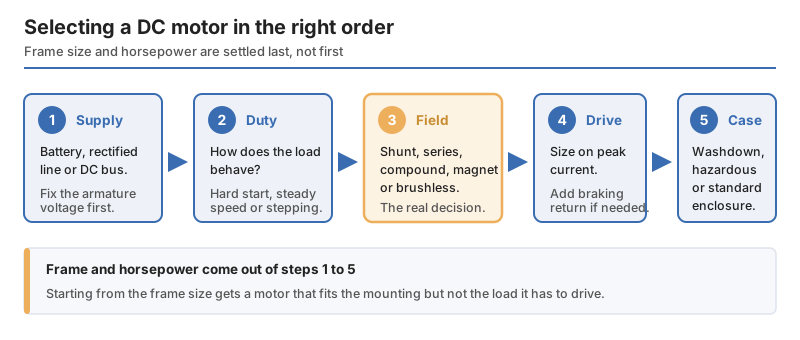
Most catalogue pages list a DC motor by frame and power, and neither number tells you how the machine will act when the load changes.
The behaviour comes from how the field is made.
That one choice separates a motor that holds speed under load from one that runs away when the load drops. It is also the choice most buyers skip. Frame size can wait.
What Makes a DC Motor Different
Speed Follows Voltage
With the field held constant, armature voltage sets the speed of a DC motor. Raise the voltage and it turns faster, with no frequency to change and no drive to set up.
That is why a DC motor is still the simple answer for variable speed on a battery or a rectified supply. Nothing has to convert frequency to make that happen.
- Speed control is a voltage job — a simple chopper or SCR drive covers most of the range.
- No frequency change is needed — there is no volts-per-hertz curve to set. - Battery kit gets variable speed almost for free as a result.
Torque Follows Current
Armature current sets torque on the same terms, and those two rules together make a DC motor unusually easy to work out on paper.
- Read the current to read the load — it tracks shaft torque closely.
- Size the drive on current, not just power — starting and stall currents drive the choice.
- Watch the heat limit — steady torque is capped by heat, not by the magnets.
Where the Standards Sit
NEMA covers DC machines in Part 12 of MG 1. That part reaches direct-current motors up to and including one and a quarter horsepower per rpm in open dripproof frames. IEC sets out its own DC test methods in part 19 of the rotating machines series, for machines rated 1 kW and above on rectifier-fed supplies and DC buses.
One thing worth knowing is what does not apply. The IE efficiency classes are written for line-operated AC motors, so a DC motor carries no IE number at all.
The Brushed DC Motor Families
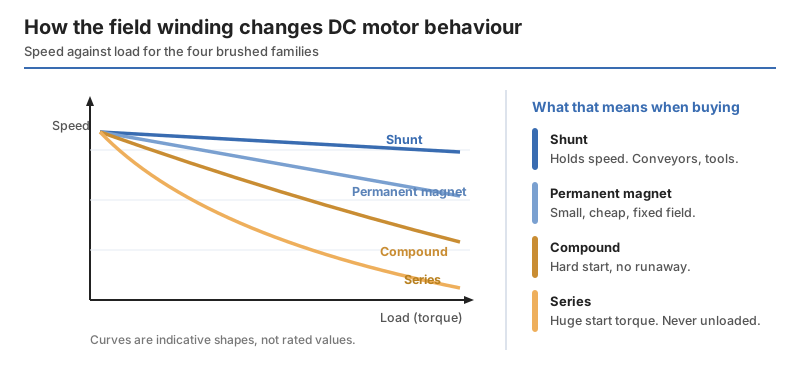
The field winding gives each family its character, and NEMA names every one of them in its own performance clauses.
| Family | Field arrangement | Speed under load | Typical use |
|---|---|---|---|
| Permanent magnet | Magnets, no field coil | Drops steadily | Small drives, vehicles, actuators |
| Shunt-wound | Field across the armature | Nearly constant | Conveyors, machine tools |
| Series-wound | Field in series with armature | Falls sharply | Hoists, starters, traction |
| Compound-wound | Both windings together | Between the two | Presses, shears, cranes |
Permanent Magnet
A permanent magnet DC motor swaps the field coil for magnets. That drops the field losses and makes the machine small and cheap.
- Best for small, low-cost drives — actuators, pumps, wipers and battery kit.
- Field strength is fixed — you cannot weaken the field to reach a higher speed.
Shunt-Wound
The shunt field sits across the armature and stays about the same, so speed holds up well as the load rises.
- Choose it where speed must stay put — conveyors, feeders and machine tool spindles.
- Stabilised types exist — NEMA names straight-shunt and stabilised-shunt windings separately.
Series-Wound
Here the field carries armature current, so torque climbs steeply as current rises. Starting torque is very high.
- Choose it for hard starts — hoists, winches, crane travel and engine starters.
- Never run one unloaded — a series DC motor can overspeed badly with no load on the shaft. - NEMA sets its overspeed limits apart for series and compound machines.
Compound-Wound
A compound motor carries both windings and lands between the other two, so it starts hard but will not run away.
NEMA splits the compound family at 35 percent speed regulation when it sets overspeed limits. That is a useful line to check on a datasheet.
Brushless and Stepper DC Motors
Brushless DC
A brushless DC motor moves the switching into electronics. Windings sit in the stator, magnets sit on the rotor, and a controller fires the phases in turn.
- No brushes means no brush wear — the usual service item goes away for good.
- The controller is not optional — a brushless DC motor cannot run on a plain supply. - Budget for the drive at the same time as the machine, not later.
- Sealed and washdown builds get easier — there is no commutator that needs air.
Stepper
A stepper is a DC motor that moves in fixed steps rather than turning freely. A two-phase hybrid unit with fifty rotor teeth gives a step angle of 1.8 degrees, which works out at 200 full steps per revolution.
Position comes from counting steps, so many machines run without any encoder at all. That saves both cost and wiring on a simple axis.
- Use it to hit an exact position — printers, small CNC axes, valves and feeders.
- Frame numbers are sizes, not power — NEMA 17 means a 1.7 inch faceplate, near enough 42 mm.
- Torque falls as speed rises — check the pull-out curve rather than the holding figure.
Matching a DC Motor to the Duty
General Purpose
General purpose DC motors cover ordinary plant drives in standard enclosures. Start here unless the application rules them out.
HVAC and Vacuum
HVAC and vacuum DC motors are built around their air path, where cooling and blower duty shape the frame more than the raw rating does.
Washdown
Washdown DC motors take sealed enclosures, stainless fasteners and epoxy finishes. Food, beverage and pharmaceutical lines are the usual home for them.
- Match the ingress rating to the hose, not the room — high-pressure washing is a harder test.
- Brushless suits washdown well — sealing a machine with no commutator is far simpler. - Check the shaft seal and drain plug spots before you mount the motor.
Hazardous Location
Hazardous location DC motors are certified for atmospheres where a spark cannot be tolerated. Brushed machines spark as they commutate, so that certification carries real weight. Brushless designs sidestep much of the problem.
- Read the exact class, division and group — a broad rating is no stand-in.
- Check the drive is covered too — certification applies to the complete installed system.
OEM Replacement
OEM replacement DC motors exist to match an original part. Frame, shaft, voltage and mounting all have to line up before performance matters.
Speed Control and Drives
Choosing the Drive
A DC drive rectifies and chops the supply to vary armature voltage. It is simpler than a frequency drive because there is no waveform to build.
- Match the drive to the winding family — shunt machines often need their own field supply.
- Size on peak current — a hoist draws far more at start than its rating suggests.
- Add braking return only if the load drives back — lowering, braking and flywheel duty need it.
Nameplate Checks
The nameplate lists armature and field voltage apart. Both matter, and mixing them up is a common and costly mistake.
- Check base speed and top speed — weakening the field pushes range above base speed.
- Note the duty rating — short-time ratings look roomy until the duty cycle shifts. - NEMA gives DC machines their own heat rise clauses for just this reason.
Maintenance and Commutation
Brush and Commutator Wear
Brushes are the wear part of any brushed DC motor. They are also the best clue, because the commutator face records how the machine has been running.
- Look for even, polished contact — a bright even film is what good commutation looks like.
- Chase sparking early — NEMA gives a whole clause to successful commutation for good reason.
- Replace brushes as a set — mixing worn and new brushes loads them unevenly.
When Brushless Wins
Sealed, hard-to-reach or non-stop duty is where brushless pays back its controller cost. Where nobody can get at the machine easily, brushes become the weak point.
Frequently Asked Questions
What is the main advantage of a DC motor?
Speed follows armature voltage directly, so a DC motor gives smooth variable speed from a battery or a rectified supply with no frequency change.
What is the difference between brushed and brushless?
A brushed DC motor switches through brushes and a commutator, while a brushless DC motor switches in electronics and needs a controller to run.
Which DC motor type has the highest starting torque?
The series-wound DC motor, because its field carries armature current, which is why it is used for hoists, winches and engine starters.
Why should a series DC motor never run unloaded?
With no load on the shaft the field weakens as current falls, and the machine can speed up to a dangerous rate.
Do DC motors have an efficiency class?
No, because the IE efficiency classes are written for line-operated AC motors, so it is rated on its own published efficiency instead.
Is a stepper motor a DC motor?
Yes, a stepper runs on direct current, but it moves in fixed steps rather than turning freely, and it needs a driver to fire the phases.
Conclusion
Frame size and horsepower are the last two things to settle, not the first.
Start with the supply and the duty. The winding family, or the choice of brushless, follows from how the load acts. The drive and the enclosure then follow from that.
Check the field arrangement, then the drive, then the enclosure. A DC motor chosen that way rarely comes back.
Related categories
Related Posts

What Bathroom Partitions Have to Survive
Pipe Fittings Explained: Types, Materials and How to Choose

Box Stapler Guide: Types, Staple Sizes and How to Choose One