How to Choose a Hose Reel: Drive Type, Capacity and Mounting
By Elana Hilaly · 13 August 2026
Most complaints about a hose reel are not really about the reel. They are about a hose that never fitted it in the first place. Bore and length set capacity, and capacity decides almost everything after that.
This guide covers the three drive types, the capacity rule manufacturers actually publish, and the mounting positions that have to be settled before an order goes in. Pressure and temperature come last, because they narrow a shortlist rather than create one.
Why a Hose Reel Pays for Itself
What Loose Hose Costs
Hose left on the floor wears out early. Dixon Valve traces that wear to dragging across floors, contact with sharp edges, and traffic in working aisles. Kinked or flattened hose also cuts flow, which puts avoidable strain on the pump feeding it.
Outdoors the damage turns chemical rather than mechanical. Sunlight, spilled chemicals and standing moisture all shorten hose life. A hose reel removes all three exposures at once by lifting the hose off the ground.
- Abrasion: dragging over concrete and past steel edges.
- Kinking: flattened bore, reduced flow, higher pump load.
- Weathering: UV, chemical contact and moisture outdoors. - Hose on the ground is also a trip hazard in traffic areas. - Damage from all four causes is cumulative and invisible.
Where Hose Reels Earn Their Keep
A hose reel turns up wherever a hose is deployed and recovered many times a day. Dixon lists agriculture, automotive, aviation, construction, fire service, manufacturing and mining among the regular users. The pattern repeats in every one of them.
- Automotive: lubrication, fuelling, air tools and vacuum lines.
- Construction and mining: water supply, dust suppression, hydraulic tools.
- Manufacturing: air, water, coolant, welding gas and general maintenance.
The Three Hose Reel Drive Types
Every hose reel retracts in one of three ways, and the choice is the first real decision in the specification.
Spring-Driven Hose Reels
A spring-driven hose reel rewinds itself with no external power. The operator pulls the hose out, and a short tug releases the ratchet so the spring takes it back.
Coxreels is explicit that the operator still has to guide the hose onto the drum. Letting it whip back unguided is how a spring reel ends up with a tangle instead of a coil.
Reid Supply describes the trade-off built into the mechanism: the further the hose comes out, the more spring tension the operator pulls against.
Hand-Crank Hose Reels
A hand-crank hose reel has the fewest moving parts and the lowest price. It also carries no power dependency at all, which is why it wins on remote sites and vehicle bodies.
The cost simply moves to the operator.
Winding long, large-bore hose by hand is slow, and it gets slower as the drum fills up.
Motor-Driven Hose Reels
A motor-driven hose reel answers the case where hose is too long or too heavy to crank. Coxreels supplies these in AC, DC, air and hydraulic power.
Hose Reels Direct lists pneumatic air motors, 12 V and 24 V DC, and 115 V and 230 V AC among the common builds. The hydraulic version suits mobile plant that already runs a hydraulic circuit. The catch is worth stating plainly: no power, no retraction, unless a manual backup is fitted.
| Drive type | Best suited to | Power source | Operator effort |
|---|---|---|---|
| Spring-driven | Short runs, frequent daily use | None required | Low, guided by hand |
| Hand crank | Long hose, no power on site | None required | High on large bore |
| Motor driven | Long or large-bore hose, heavy cycles | AC, DC, air or hydraulic | Minimal |
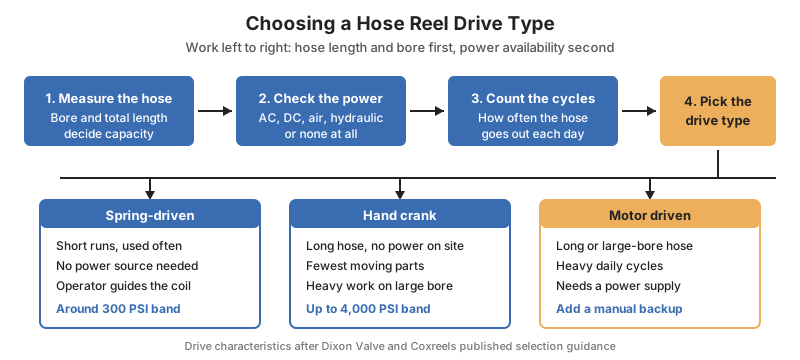
- Spring-driven: short hose runs and high-frequency use.
- Hand crank: no power available, longer hose, tighter budget.
- Motor driven: long or large-bore hose, heavy daily cycles. - Speed controllers and switches are offered on motor drives. - A manual backup rewind covers a power failure.
Sizing a Hose Reel to the Hose
Capacity Is Bore Times Length
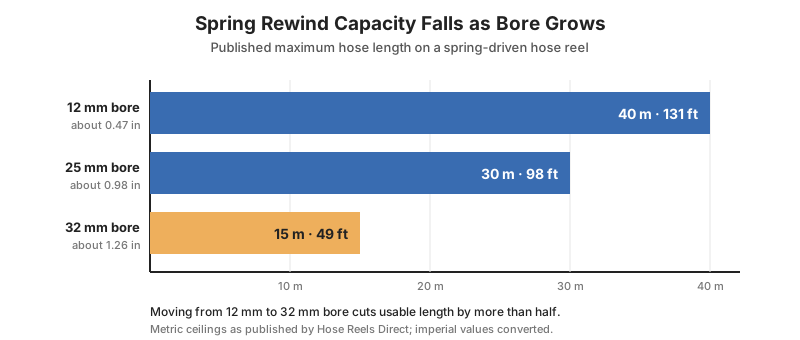
Capacity on a hose reel comes from hose diameter and length together, never from length alone. Move up one bore size and the same drum holds far less.
Hose Reels Direct publishes spring rewind ceilings that show the drop clearly.
Forty metres of small-bore hose becomes fifteen metres once the bore reaches thirty-two millimetres.
| Hose bore (mm) | Hose bore (in, converted) | Max spring rewind length (m) | Max spring rewind length (ft) |
|---|---|---|---|
| 12 | 0.47 | 40 | 131 |
| 25 | 0.98 | 30 | 98 |
| 32 | 1.26 | 15 | 49 |
Buy More Capacity Than You Need
Coxreels advises picking a reel with more capacity than the job requires whenever space allows. The reason is practical rather than theoretical.
A drum with spare room lets the hose be rewound with less care and still sit inside the disc dimension. Uneven coils then stop being a daily annoyance. Reducing the fitting and hose size frees up more capacity again on the same reel.
- Spare capacity: hose stays protected within the discs.
- Smaller fittings: more usable length on the same drum.
- Spool width: check it against the coil, not only the length. - Two reels of different shape can hold identical hose lengths. - That gives room to fit the reel to the space available.
The Hose Quality Trap
Cheap hose costs more on a reel than it does loose. Coxreels warns that poor quality hose expands and contracts under pressure surges. Hose already on the drum then binds, and in extreme cases the reel is distorted beyond use.
Specify a hose rated for the service and the working pressure, then match the hose reel to it.
- Rated hose: sized for the service and the working pressure.
- Pressure surges: the failure mode that binds a full drum.
- Distortion: the end point when the wrong hose is fitted.
Pressure, Temperature and the Swivel
Reading a Pressure Rating
Published hose reel pressure ratings are quoted at a stated temperature, and that temperature is usually close to room temperature. Dixon lists its spring-driven performance reels at 300 PSI and its hand crank series at 4,000 PSI, both measured at 70°F.
A high-pressure hand crank spray reel in the same range is published at 4,500 PSI.
The spread between those figures is the clearest sign that drive type and pressure class travel together.
- Spring-driven band: around 300 PSI on general-purpose reels.
- Hand crank band: up to 4,000 PSI on published steel series.
- High-pressure band: 4,500 PSI on spray and washdown reels. - Every published figure is quoted at a stated temperature. - Read the rating and the temperature as a single number.
Temperature Limits the Assembly
Temperature ratings usually belong to the hose rather than the frame. Dixon rates one spring-driven series to 150°F with the hose fitted, and 210°F without it. The frame outlives the hose, so the assembly rating is the one to design around.
The Swivel and the Inlet
Every hose reel passes fluid through a rotating joint, and that joint is the part that leaks first. Seal material has to suit the medium, not only the pressure.
Coxreels also requires a flexible connector between the inlet pipe and the swivel joint. Hard-plumbing straight into the swivel invalidates the warranty.
- Swivel size: check it against the hose, not the fitting alone.
- Seal material: chosen for the medium being carried.
- Flexible connector: required at the inlet on many reels.
The Safety Device the Rules Require
US construction rules for pneumatic tools set a hard requirement on air lines. Any hose over half an inch inside diameter must have a safety device at the source of supply, or on the branch line, to reduce pressure if the hose fails.
The same rules add three limits worth designing around. Manufacturer safe operating pressures must not be exceeded. Hoses must never be used to hoist or lower tools, and compressed air used for cleaning has to be reduced below 30 PSI with guarding in place.
- Over half-inch bore: fit a pressure-relieving safety device.
- Rated pressure: never exceed the manufacturer's figure.
- No hoisting: a hose is not a lifting sling. - Cleaning air must drop below 30 PSI with chip guarding. - Personal protective equipment applies alongside the guarding.
Mounting a Hose Reel
The Four Mounting Positions
Mounting is an ordering decision, not an installation afterthought. Coxreels ships most reels in a floor-ceiling position and codes the alternatives as bottom-truck, wall-truck and down mount. Getting it wrong means an unbolt-and-reposition job before the hose reel can be hung.
- Floor or ceiling: the default shipping position on most series.
- Wall or truck: the standard for vehicle bodies and workshop walls.
- Bottom or down mount: for overhead runs and underbody installs.
Height Changes the Spring
Height is the part buyers forget. Coxreels instructs customers to consult the factory for reels mounted fifteen feet above the floor, and to specify the correct spring retraction motor on the order.
A standard spring that works at head height will not lift the same hose from a gantry.
- Working height: state it on the order, not on delivery.
- Overhead runs: confirm the spring motor with the maker.
- Drop length: measure from the reel outlet to the work point.
Guides, Rollers and Accessories
A roller guide keeps the hose off the frame edge as it comes and goes. Coxreels lists roller brackets, special mounting brackets, carry handles and carts among the add-ons chosen after the reel itself.
- Roller guides: protect both hose and frame at the exit point.
- Carry handles and carts: turn a fixed reel into a portable one.
- Ratchet locks: hold the hose at a chosen working length. - Brackets are chosen after the reel series, not before it. - A cart converts a workshop reel into a site reel.
Materials and the Working Environment
Choosing the Frame Material
Frame material follows the environment rather than the budget. Hose Reels Direct splits the field three ways.
- UPVC cases: light duty, easy to wash down, chemical resistant.
- Powder-coated steel: the general-purpose heavy duty choice.
- Stainless steel: salt water, aggressive chemicals, food fats.
Under-specify here and the reel corrodes long before the hose wears out.
Matching the Medium
Water and air pass through almost any hose reel. Grease, diesel and hot high-pressure water do not, because each needs its own seal and sometimes a different swivel.
Check medium compatibility before pressure rating. A compatible seal at a lower pressure beats an incompatible one at a higher pressure every time.
Compare spring-return hose reels against hand crank hose reels before deciding, and price the motorised hose reels alongside them if the hose runs long.
Frequently Asked Questions About Hose Reels
What size hose reel do I need?
Start from hose bore and length together, then add spare capacity. Manufacturers advise choosing a reel that holds more than the job needs, so the hose can be rewound quickly and still sit inside the discs.
Is a spring-driven hose reel better than a hand crank?
Only for shorter runs used often. Spring tension climbs the further the hose comes out, so a long run turns into hard work. At that point a hand crank or motor-driven hose reel becomes the better answer.
What pressure rating does a hose reel need?
Match the reel to the highest working pressure in the system, at the temperature it will actually see. Published figures run from around 300 PSI on spring-driven reels to 4,500 PSI on high-pressure hand crank models.
Can a hose reel be mounted on a ceiling?
Yes, and most series ship in a floor-ceiling position by default. Above roughly fifteen feet the manufacturer may need to fit a stronger spring retraction motor. State the mounting height when ordering so the right spring is built in.
Which hose reel suits saltwater or washdown areas?
Stainless steel for salt water, chemicals and food processing. Powder-coated steel handles most other outdoor duty, and UPVC-cased reels suit light washdown work.
Conclusion
A hose reel is specified in three moves. Take the drive type from how often the hose is used, take capacity from bore and length together, then take the frame material from the environment.
Pressure, temperature and seal compatibility narrow whatever is left on the shortlist.
Everything after that is accessories, and reel parts and accessories are easy to add later. Get the first three right and a hose reel quietly outlasts several hoses.
Related Posts
Sandblasting Sand: Why the Cheapest Abrasive Costs You the Most

Types of Pliers: Jaw Shapes, Grip and What Each Pair Is For