What Bollards Are and What They Do

By Jackie Guo · 16 August 2026
A row of short posts looks like the simplest thing on a site plan. Yet bollards decide whether a truck stops at the kerb or ends up in the lobby.
The gap between a pretty post and a tested barrier is huge.
What Bollards Are and What They Do
The core job
Bollards keep vehicles away from people and property. They mark a line and they steer traffic. The tested ones also soak up a crash that a kerb could never take.
- A visible line that a driver reads well before reaching the kerb.
- Traffic control that keeps delivery vehicles on the route you designed.
- Physical cover for doors, shop fronts, fuel pumps, and exposed plant.
- Separation between pedestrian space and service vehicle movement.
Where they earn their keep
Sites with a long, straight run-up need them most.
Any place a van can build speed toward a busy door deserves a hard line. Loading yards, plaza edges, drive-through lanes, and fuel pumps top the list.
Passive against active types
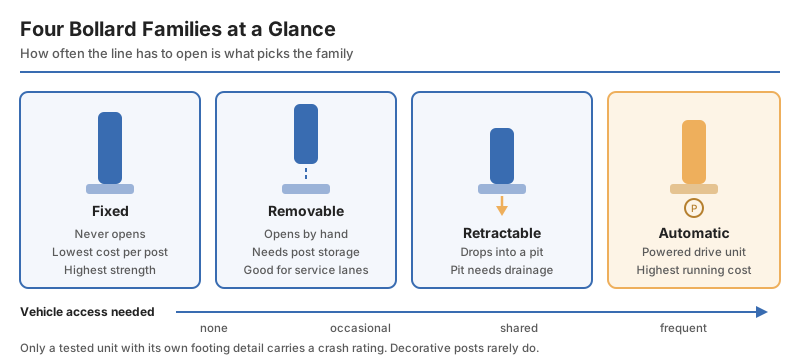
Passive posts stay where you put them. Active ones drop, fold, or sink so that approved vans can pass.
- Passive posts suit a fixed line with no through traffic. - They cost the least and have no moving parts. - They are the wrong pick on a lane that needs van access.
- Active posts suit gated ways in and out. - Plan for power, controls, and a drain in the pit.
Types of Bollards by Function
Function picks the type long before looks do.
| Type | Vehicle access | Typical use | Main trade-off |
|---|---|---|---|
| Fixed | None | Perimeters, shop fronts | No flexibility later |
| Removable | Manual, occasional | Service lanes, markets | Lifting and storage effort |
| Retractable | Manual or powered | Shared entries | Pit drainage and upkeep |
| Automatic | Powered, frequent | Controlled gates | Power and control cost |
| Decorative | None | Plazas, old streets | Rarely crash tested |
Fixed bollards
A fixed post is set in a footing and stays put. It buys the most strength per pound on a line that never has to open.
Removable bollards
A removable post lifts out of a ground socket when a van needs to pass. Staff need a safe, dry spot to keep the loose posts. Skip that step and the posts walk within a month.
Retractable and automatic bollards
Retractable posts drop into a pit and rise again on demand. Automatic versions add a powered drive unit, which buys speed and remote control at the price of a regular service round.
Decorative and planter bollards
Planters and shaped posts soften public space and slow traffic on sight. Treat them as street furniture until a test report says more.
- Planters work well where a hard post would feel harsh.
- Cast shapes suit old streets and listed frontages.
- Lit posts double as low-level path lighting.
Materials and Finishes
- Steel for traffic duty, guard duty, and tested security work.
- Concrete for heavy fixed lines that rarely change.
- Sleeves and covers for looks and for sight value only.
Steel bollards
Steel is the workhorse for traffic duty and for security duty. A tested post draws its strength from the whole build, so the tube, the fill, and the footing all count.
Concrete bollards
Cast concrete suits heavy, fixed lines and public realm work. It is slow to damage. It is also slow to mend, which suits sites that rarely change.
Covers, sleeves and bands
- Plastic sleeves freshen a scuffed post for very little money. - They add colour and sight value, not strength.
- Steel covers suit front doors where looks matter.
- Reflective bands keep posts easy to see at night.
Crash Ratings on Security Bollards
Crash-rated bollards carry a short code, and the code only works if both sides read it the same way.
ASTM F2656 and M ratings
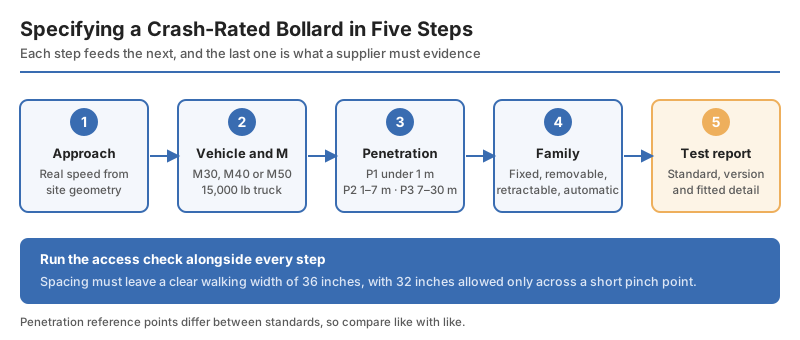
ASTM F2656 is the American test method for crash testing perimeter barriers. Every M rating uses the same 15,000 lb truck, and the number is the crash speed in miles per hour.
| Rating | Test vehicle | Crash speed | Example energy |
|---|---|---|---|
| M30 | 15,000 lb truck | 30 mph | 450,000 ft-lbs |
| M40 | 15,000 lb truck | 40 mph | 800,000 ft-lbs |
| M50 | 15,000 lb truck | 50 mph | 1,250,000 ft-lbs |
P ratings for penetration distance
The P value records how far the vehicle travelled past the barrier line.
- P1 covers penetration under one metre beyond the line.
- P2 covers penetration from one metre up to seven metres.
- P3 covers penetration from seven metres up to thirty metres.
A specification that says only M50 is half a specification. Two posts can share that rating and still behave very differently on impact. Always name the penetration level next to it.
IWA 14-1 and PAS 68
IWA 14-1 is the ISO workshop agreement that grades barriers under a single straight-on impact. Its code reads as test type, vehicle mass in kilograms, vehicle class, speed in km/h, impact angle, then penetration in metres.
- IWA 14-1 measures penetration from the front face of the post. - PAS 68 measures from the back surface instead, so the figures differ.
- The two systems are close relatives rather than exact equivalents.
- Legacy K ratings line up broadly with M30, M40 and M50.
Sizing, Spacing and Access
Standard height
Most trade and civic jobs land between 36 and 48 inches above finished grade. That band keeps a post easy to see without swamping the street.
- Measure above grade, never counting the buried part.
- Check owner rules before you fix the size.
- Test sightlines at doors and crossings.
Keeping the walking route clear
Height is not the access question. The ADA Standards set a clear width of 36 inches on walking surfaces. Spacing and layout are what an inspector will check.
- 36 inches is the general clear width.
- 32 inches is allowed only across a short pinch.
- Wider gaps are needed where the route turns.
Footings and buried services
Crash strength comes from the tested build, not the post on its own.
- Deep footings need room that many town sites cannot give. - Shallow-footing posts exist for ground full of ducts.
- Survey services first so no footing lands on a main.
- Copy the tested detail exactly, or the rating lapses.
How to Specify Bollards
Start with the threat
Work out the real approach speed from the site layout, not from a hunch. A short, twisting run-up rarely earns the top rating, while a long straight one can demand it.
Match the way the line opens
- Daily van access points to powered posts.
- Access now and then points to removable or sinking posts.
- No access at all points to fixed posts every time.
Write it down properly
Our bollards range spans traffic posts, guard posts, and tested security posts.
- Vehicle class and speed, such as M50, not the speed alone.
- The P level, such as P1, set right beside it.
- Standard and version used in the test report.
- Fitted detail copied from the tested layout.
Bollards Questions Answered
What are bollards used for?
They stop or steer vans and shield the people and stock behind them. Plain bollards manage traffic, while rated ones are tested against a set crash.
How tall should bollards be?
Between 36 and 48 inches above finished grade covers most trade jobs. Check local code and owner rules before you fix the size.
Do steel bollards beat concrete bollards?
Neither wins outright. Steel gives more options for lift-out and powered work, while concrete suits heavy fixed lines.
Are decorative bollards crash rated?
Almost never, unless the maker shows a test report. Treat decorative bollards as street furniture until a certificate proves more.
Can I refresh tired posts cheaply?
Yes, when the posts are sound and only look poor. Slip-on bollard covers bring back the colour and the sight value. The footing stays untouched.
Conclusion: Specify Bollards That Actually Hold
Bollards fail on paper long before they fail on site.
Start from the approach speed and the vehicle you expect. Then pick the family that fits how the line has to open. Finish by checking that both halves of the rating code are written down.
Do that, and your bollards will hold on the one day it matters.
Related Posts

Sandblasting Sand: Why the Cheapest Abrasive Costs You the Most


Types of Pliers: Jaw Shapes, Grip and What Each Pair Is For