Saunas: How to Choose Between Traditional, Infrared and Steam

By Elana Hilaly · 5 September 2026
Three products get sold under one word, and they do not feel the same. Buyers tend to learn that only after the tiling is done and the heater is wired in.
A traditional room, an infrared cabin and a steam cabin all sit under Heat Therapy Systems. They run at different heats, need different power and suit different rooms.
Pick by the heat you want. The hardware follows from that, and so does the wiring behind the wall.
What the Research Actually Measured
A review of regular dry sauna bathing gives useful numbers, because it logs the settings each study used. Those settings are the closest thing to a spec this market has.
Two Very Different Heat Profiles
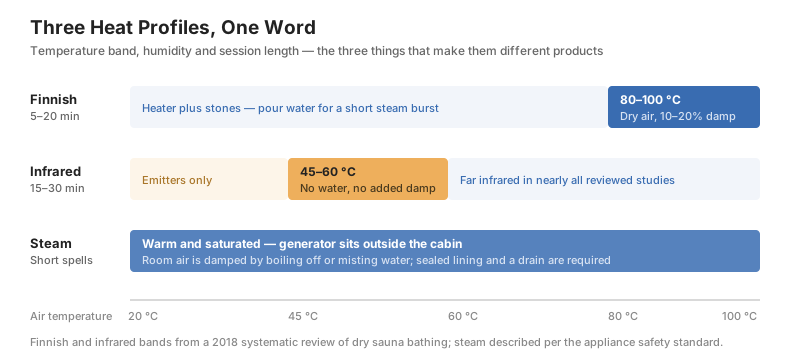
- Traditional Finnish rooms ran short exposures of 5 to 20 minutes.
- Heat sat at 80 to 100 degrees Celsius with dry air throughout the spell.
- Damp air stayed at 10 to 20 percent, broken by bursts of steam. - Those bursts come from throwing water over heated rocks.
Session Length Follows Temperature
Infrared cabins run cooler than a stone-heated room, so the time spent inside the cabin gets longer.
In the studies, infrared runs sat at 60 degrees for 15 to 30 minutes. Two went cooler, at 40 to 45 degrees and at 55 degrees.
The Traditional Finnish Sauna
This is the base product, and the rest of the market is judged against it. It is also the hardest of the three to build well.
Temperature and Humidity
The review puts these rooms at 80 to 100 degrees in dry air, in short spells. The dryness is what makes that band work.
- Dry air is the point, because 10 to 20 percent damp is what makes 90 degrees bearable.
- Water on the stones changes it, lifting the damp for a few seconds.
- The stone mass is the buffer, holding heat between pours.
Heaters, Stones and Controls
The heater is the part of the room that really matters, not the timber lining. Stones and controls come with it as one package.
- Electric sauna heaters rule indoor jobs and small trade rooms.
- Stone volume sets the recovery rate after a scoop of water is poured on.
- Controls decide the duty cycle, and a separate control panel is normal on larger units. - Sunken heaters carry extra rules in the safety standard.
The Infrared Cabin
An infrared cabin is a different machine in much the same box. Nothing in it works the way a Finnish room works.
How Infrared Differs
The review is exact here. Infrared cabins use emitters at mixed wavelengths, with no water and no added damp, and they run cooler than a Finnish sauna at 45 to 60 degrees for much the same time.
- There are no stones in the cabin, so there is no pour and no burst of steam.
- Far infrared was the norm in the reviewed research, with one full-spectrum exception. - Wavelength is a spec, not a sales word.
- Warm-up is quicker than a stone-packed room needs.
Where an Infrared Sauna Fits
The cabin tends to win on building limits rather than on the feel of the heat itself.
- Low ceilings and small rooms suit a cabin better than a built room.
- Single-phase supply is often enough for a home unit.
- Users who dislike high heat usually tolerate the lower band without trouble.
| Type | Temperature | Humidity | Session | Heat source |
|---|---|---|---|---|
| Traditional Finnish | 80–100 °C | 10–20% | 5–20 min | Heater and stones |
| Infrared cabin | 45–60 °C | None added | 15–30 min | Infrared emitters |
| Steam cabin | Warm and wet | Saturated | Short | Steam generator |
Steam Bath Solutions
Steam is the third route, and it is as much a plumbing job as a wiring one. That changes who has to be on site during the fit-out.
The Generator Does the Work
A steam generator sits outside the cabin, in a dry spot with its own drain, and pipes vapour in. The safety standard groups damping units with heaters, and says room air is damped by boiling off or misting water.
- The cabin must be sealed and drained, unlike a dry sauna room.
- Water quality drives upkeep, because scale is the main failure. - Hard-water sites need descaling built into the service plan.
- Controls are remote, since the generator is rarely inside the cabin.
What Steam Demands of the Room
Every surface inside a steam cabin has to be treated as a permanently wet surface.
- Non-absorbent linings are needed on every wall and ceiling.
- Sloped ceilings stop water dripping on users. - Maker guidance puts the pitch at 15 degrees or more.
- Its own drain must be designed in, not added later.
Sizing the Heater and the Supply
This is where jobs stall, and the standard is what sets the limits. Read them before the room is drawn rather than after.
The 20 kW Ceiling
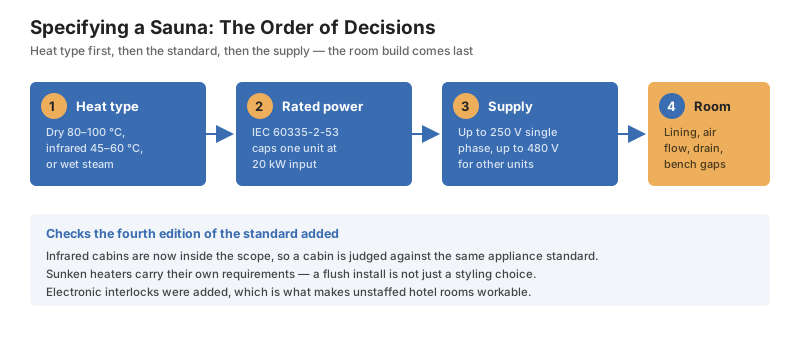
IEC 60335-2-53 covers electric sauna heaters and infrared units with a rated power input of no more than 20 kW.
- That ceiling frames the home and light trade market for a single heater.
- Bigger sauna plant sits outside it, and needs a different route.
- Infrared cabins came into scope in the fourth edition of the standard.
Voltage and Phase
The same standard caps rated voltage at 250 V for single-phase units and 480 V for others.
| Decision | What the standard says | Practical effect |
|---|---|---|
| Rated power input | No more than 20 kW | Caps one unit |
| Single-phase voltage | No more than 250 V | Small cabins and home units |
| Other units | No more than 480 V | Three-phase heaters for big rooms |
| Where it applies | Homes, plus public saunas in flats and hotels | Covers hotel work |
- Confirm the supply before you order, because a three-phase heater will not run on a single-phase circuit.
- Check the local wiring rules next to the product standard.
Interlocks and Recessed Heaters
The fourth edition added rules for electronic interlocks and for sunken sauna heaters. Both matter to trade buyers.
- Interlocks matter in rooms with no staff, which is most hotel work.
- A sunken heater is not a styling choice, and it changes the paperwork.
- Read this standard with IEC 60335-1, which is the general safety text.
Room Build and Cooling Down
Materials and Ventilation
The room itself is far more than a timber box built around a heater.
- Timber choice is about resin and heat, not appearance alone.
- Air has to move, and inlet and outlet spots are part of the design.
- Sauna benches need clearance from the heater guard on every side.
The Cool-Down Half of the Cycle
Heat is only half of a wellness circuit. Cold and water therapy carry the other half, which is why plunge pools and hot tubs sit in the same room plan.
Browse the sauna range for cabins and heaters. Steam projects need steam generator accessories specified alongside the cabin. For the cool-down side, the hydrotherapy systems range covers hot tubs, spa tubs and whirlpool tubs.
Frequently Asked Questions
What temperature is a traditional sauna?
The review puts Finnish rooms at 80 to 100 degrees in dry air, with damp of 10 to 20 percent. Spells in those studies ran 5 to 20 minutes.
Is an infrared cabin the same as a sauna?
Not in use. An infrared sauna uses emitters at mixed wavelengths with no water and no added damp, and it runs at 45 to 60 degrees. The times are much the same.
How much power does a sauna heater need?
It depends on the room, but the standard caps the unit. IEC 60335-2-53 covers heaters and infrared units up to a rated power input of 20 kW.
Can a sauna run on single-phase power?
Smaller ones can. The standard allows up to 250 V for single-phase units and up to 480 V for others, so big heaters are three-phase.
Does the standard cover hotel installations?
Yes. It covers units meant for the home and for public saunas in blocks of flats, hotels and like places, which is why interlock rules were added.
Conclusion
Decide the heat first, because you cannot undo it once the room is built. The rest follows from that one call.
A Finnish sauna gives dry heat near 90 degrees with a steam burst on demand. An infrared cabin gives 45 to 60 degrees with no water at all. A steam cabin gives wet warmth and a drain to plan.
Then size the unit against the standard, confirm the supply with an electrician, and only after that argue about timber.
Related Posts