Fire Brick Guide: How to Match Type, Rating and Mortar to the Heat
By Macy Chen · 21 August 2026
Ordinary brick does not fail in a fire pit straight away. It fails on the third or fourth burn, quietly, from the inside.
Trapped moisture turns to steam. The face flakes off in sheets. The wall you built starts shedding itself.
A fire brick is built to avoid exactly that. Picking the right one is mostly about two numbers and one bag of mortar.
What Makes a Fire Brick Different
A fire brick is a ceramic block made mainly from silica and alumina. It is fired far hotter than a building brick ever is. It is designed to sit against flame without softening, cracking or shedding its face.
Alumina Is the Difference
Alumina is what buys heat resistance. Ordinary building brick carries relatively little of it. Refractory grades carry much more.
- Fireclay grades generally run in the region of 25 to 45 percent alumina.
- High-alumina grades climb well above that band: - More alumina means a higher service temperature. - It also costs more per brick.
- Silica makes up most of the remainder, at roughly 60 percent.
- Trace oxides of magnesium, calcium and potassium fill out the chemistry.
Why Ordinary Brick Fails
Building brick and refractory brick are graded under different standards. Those are ASTM C62 and ASTM C155. The difference is not cosmetic.
- Softening starts far lower on ordinary brick.
- Moisture trapped in the body expands and forces the face off.
- Spalling is the result, and it worsens with every heat cycle: - The face lifts away in flakes. - Each cycle exposes fresh material.
- Ordinary mortar goes first, since regular cement softens well before the brick does.
A fire brick should not spall at all, and its strength should hold through fast temperature swings.
Dense and Insulating Fire Brick
The two families look similar on a pallet and behave nothing alike.
Dense Fire Brick
Dense fire brick is the hard, heavy one. It goes where there is mechanical, chemical or thermal punishment. A wood-fired kiln interior is the classic case.
It takes abrasion from fuel, fluxing from ash and slag, and direct flame. It also stores heat. That is exactly what a pizza oven floor needs.
Insulating Fire Brick
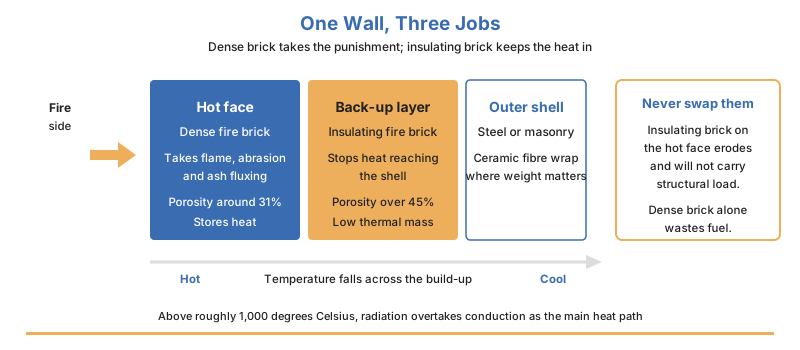
Insulating fire brick is a different animal. It is a soft, highly porous block, with total porosity above 45 percent. Its application temperature starts above roughly 1,000 degrees Celsius.
- Weight is a fraction of the dense equivalent.
- Thermal conductivity is far lower, so less heat escapes.
- Thermal mass is low, which means faster heating and cooling.
- Strength is low, and it falls as density falls.
Which One Goes Where
Insulating grades belong in the insulation layer, not the working face.
- Not for work linings, because erosion and wear strip them.
- Not for heavy load-bearing, because the structure is loose.
- Ideal behind a dense hot face, where they cut the heat loss: - Dense brick takes the flame and the knocks. - Insulating brick stops the heat reaching the shell.
| Point of comparison | Dense fire brick | Insulating fire brick |
|---|---|---|
| Porosity | Around 31% | Over 45% |
| Role | Hot working face | Insulation layer behind it |
| Strength | High | Low, and falls with density |
| Heat storage | High | Low |
| Cutting | Masonry saw | Hacksaw, chisel or drill |
Reading a Fire Brick Temperature Rating
Ratings look cryptic until you know the trick.
The ASTM C155 Group Number
Insulating grades are sorted into groups by classification temperature and density. Groups 23 through 32 are the ones normally stocked.
The group number is a shorthand. Multiply it by one hundred and you have the classification temperature in Fahrenheit. A group 23 brick classifies at 2,300 degrees.
Classification Is Not Working Temperature
This is where most buyers get caught out.
The classification temperature is a test result, not a service rating. The usable maximum sits roughly 100 degrees Celsius below it, so a brick classified at the top of its group should never live there.
Density and Shrinkage Limits
Each group caps both density and shrinkage.
- Density must stay under the group limit.
- Shrinkage must stay below 2 percent after 24 hours of firing.
- Testing happens 30 degrees Celsius under the classification temperature.
- Density alone is a rough guide to insulating power, and it can mislead.
| Group | Classification temperature | Typical use |
|---|---|---|
| 23 | 2,300 F (1,260 C) | Small kilns, ovens, back-up layers |
| 26 | 2,600 F (1,430 C) | General kiln and furnace insulation |
| 28 | 2,800 F (1,540 C) | Higher-temperature furnace linings |
| 30 to 32 | 3,000 to 3,200 F | Specialist high-temperature work |
Sizes, Shapes and Cutting
Fire brick sizing is its own small world.
Standard Straights
The rectangular straight is the workhorse. Two sizes cover most of the market, and splits give you half thicknesses.
- The common straight measures 9 x 4.5 x 2.5 inches.
- The thicker straight measures 9 x 4.5 x 3 inches.
- Splits come in at half those thicknesses: - Useful for backing layers. - Also handy for tight radius work.
- Stock thicknesses in insulating grades are usually the 2.5 and 3 inch sizes.
Arch and Wedge Shapes
Curved work needs shaped brick rather than cut brick.
- Arches and wedges turn a flat course into a vault.
- Keys lock the top of an arch.
- Skews and feathers handle side and end transitions.
Most shaped fire brick is cut to order rather than stocked, so lead time matters more than price.
Cutting on Site
Insulating grades cut easily by hand, which is why they suit custom cavities and curves. Dense grades do not.
- A hacksaw or [masonry chisel](/ae/category/tools/hand-tools/punching-tools-chisels/chisels-sets/chisels-for-brick-concrete-stone/) handles insulating brick.
- A [handheld concrete saw](/ae/category/tools/power-tools/power-saws-blades/masonry-saws-tile-saws-concrete-saws/corded-handheld-concrete-saws/) is the tool for dense brick.
- Dust control matters either way, because refractory dust is respirable.
Mortar and First Firing
The brick rarely fails first. The joint does.
Use Refractory Mortar
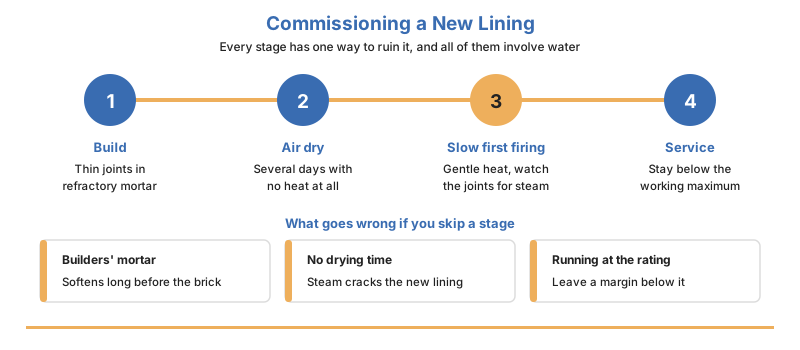
Ordinary cement mortar softens at temperatures a fire pit reaches easily. Furnace cement and high-heat mortar exist for this reason.
Match the mortar rating to the brick rating, not to the fuel. A wood fire and a gas burner can both overshoot what builders' mortar tolerates.
Keep the Joints Thin
Thin joints are what refractory suppliers ask for.
- Thin beds of an eighth of an inch or less are the usual recommendation.
- Full contact matters more than a generous bed.
- Expansion needs somewhere to go on larger builds.
Dry It Before You Fire It
Green refractory work holds water, and water turns to steam.
- Air dry the build for at least a day, and longer on thick work.
- Warm it gently on the first burn rather than going straight to full heat.
- Watch for steam leaving the joints, and slow down if you see it: - Steam under pressure is what cracks a new lining. - A slow first firing costs a day and saves a rebuild.
Common Fire Brick Jobs
Fire Pits and Braziers
This is the biggest search reason and the simplest job. A dense fire brick liner inside an ordinary block or brick outer ring takes the flame and protects the structure.
Pizza Ovens
Ovens want both families at once. Dense fire brick makes the cooking floor because it stores and releases heat, while insulating brick or board underneath stops that heat draining into the base.
Kilns and Furnaces
Industrial linings are layered on purpose.
- Hot face in dense brick or high-alumina brick.
- Back-up layer in insulating fire brick.
- Outer wrap in ceramic fibre insulation where weight matters.
Above roughly 1,000 degrees Celsius, radiation overtakes conduction as the main way heat moves, which is why fine-pored insulating brick outperforms coarse-pored brick at those temperatures.
Frequently Asked Questions
Can I use ordinary brick instead of fire brick?
Not against direct flame. Ordinary brick softens at far lower temperatures and spalls as trapped moisture expands, so it sheds its face after a few heat cycles.
What temperature can a fire brick take?
It depends on the grade. Read the classification figure, then subtract roughly 100 degrees Celsius to get a realistic working maximum.
Dense or insulating fire brick for a pizza oven?
Both, in the right places. Dense fire brick makes the floor because it stores heat. Insulating brick sits underneath to stop that heat escaping downwards.
Do I need special mortar for fire brick?
Yes. Regular cement softens at temperatures a wood fire passes easily, so furnace cement or high-heat refractory mortar is the only sensible choice.
Why did my new lining crack on the first burn?
Almost always trapped water. Fresh refractory work needs proper air drying and a slow, gentle first firing before it sees full heat.
Conclusion
A fire brick is not simply a tougher brick. It is a ceramic chosen for a temperature, a duty and a position in the wall.
- Check the alumina grade against the heat you expect.
- Read the classification number, then take a margin off it.
- Split the job between dense and insulating grades.
- Buy mortar rated to match, never builders' mix.
Get the layering right and the lining lasts years rather than seasons. Browse the full range in brick and fire brick and match the grade to the fire you are actually building.
Related Posts
HEPA Filter Guide: What the Grades Mean and Where One Belongs
Handrail Height: How to Get the Number Right in Every Code
Garage Floor Epoxy Coating: How to Test, Specify and Order It