Ceiling Hooks: Load Limits, Fixings and What Each Ceiling Will Take

By Umer Farouk · 22 August 2026
Almost nobody fails at the hook. They fail at the hole behind it.
Ceiling hooks are cheap, and the thing they screw into is the part that decides whether the load stays up. Pick the fixing for the ceiling you actually have and the rest is straightforward. Get it wrong and the hook comes down with a lump of board attached.
What Ceiling Hooks Have to Carry
A hook is one link in a chain that ends at the building frame. Ceiling hooks fail when that chain is shorter than it looks.
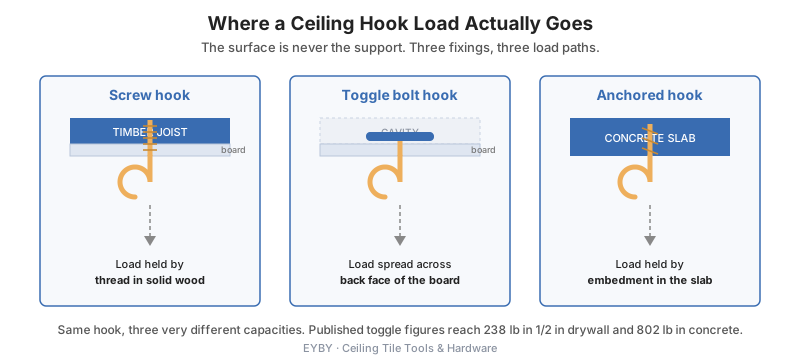
The Load Path Runs Past the Surface
Plasterboard, plaster and ceiling tile are cladding. None of them are structure, and none of them were designed to carry a hanging load. Ceiling hooks fixed to cladding alone are borrowing strength that is not there.
Good ceiling hooks either reach through that cladding into timber, steel or concrete, or they spread the load across the back face of the board with a toggle. Everything else is decoration.
- The surface is only what you see and drill through.
- The fixing is the part that transfers load: - It can bite into solid material. - It can clamp against the back of a hollow sheet.
- The structure is joist, purlin, deck or slab.
- The hook itself is usually the strongest link in that chain.
Static Load Is Not the Whole Story
A hanging basket that swings pulls harder than a hanging basket that sits still.
- Dead load is the weight itself, and it never changes.
- Dynamic load comes from swinging, tugging or wind through an open door.
- Shock load arrives when something is dropped onto the hook.
- Cyclic load loosens threads over months: - Fixings in timber work loose first. - Adhesive pads creep and let go quietly.
Rate ceiling hooks for the worst moment, not the average one.
Ceiling Hooks by Fixing Type
Four fixings cover nearly every ceiling you will meet. Ceiling hooks are sold for all four, and they are not interchangeable.
Screw Hooks into Timber
A screw hook driven into a joist is the strongest common option, because the thread engages solid wood along its whole length.
Drill a pilot hole slightly under the thread diameter. Screw dust coming back out of the hole is the sign you actually found timber rather than the gap between joists. Ceiling hooks that spin freely at the last turn never reached wood at all.
Toggle and Anchor Hooks in Drywall
Where no joist sits above the spot you need, a toggle spreads the load across the back of the board.
Published figures make the point. A heavy-duty toggle bolt from a major anchor manufacturer supports up to 238 pounds in half-inch drywall, using a half-inch drill hole and spanning board thicknesses from three-eighths of an inch up to about three and a half inches.
- Toggle bolts clamp a bar or wing behind the sheet.
- Plastic expansion plugs are wall fixings, not drywall and plaster anchors rated for overhead pull.
- Board thickness must fall inside the anchor's stated range.
- Hole diameter is specified by the maker, not by what your drill index offers: - Oversize holes cut the capacity sharply. - Undersize holes stop the toggle deploying.
Anchored Hooks in Concrete
Concrete gives the highest numbers of the four. The same heavy-duty toggle rises to 802 pounds in concrete, against 238 pounds in drywall. Ceiling hooks anchored into a slab rarely fail on capacity.
Sleeve anchors, wedge anchors and threaded rod with an eye nut all work in slab and deck. Match the embedment depth to the anchor data sheet.
Magnetic and Adhesive Hooks
These have a place, and it is a light one. Treat them as temporary ceiling hooks rather than permanent fixings.
- Magnetic ceiling hooks need exposed steel deck or purlin.
- Adhesive hooks depend on surface prep and temperature.
- Neither type belongs over anything that would hurt on the way down.
- Both types lose grip as the surface ages or dusts over.
| Fixing type | Suits | Indicative capacity | Main limitation |
|---|---|---|---|
| Screw hook | Timber joist or purlin | Manufacturer rating | Must hit solid timber |
| Toggle bolt hook | Drywall, plaster, hollow board | Up to 238 lb in 1/2 in drywall | Needs correct hole size |
| Anchored hook | Concrete slab or deck | Up to 802 lb in concrete | Needs correct embedment |
| Magnetic or adhesive | Exposed steel, smooth finishes | Light duty only | Grip degrades over time |
Ceiling Hooks in a Suspended Ceiling
This is where most people get it wrong, and where the rules are clearest.
The Grid Is Not the Structure
A suspended ceiling grid is sized to carry the panels and nothing else. Ceiling hooks hung from a tee bar transfer load to hanger wire that was never counted for it.
The standards route real loads to the slab or deck above. That is why sign hangers and grid clips are designed to pass loads through the grid rather than into it. Ceiling hooks used this way sit in the grid but hang from the building.
The Weight Thresholds That Govern
ASTM E580 sets the thresholds, and they are worth knowing before you drill anything.
- Under 10 pounds a light fixture takes one 12-gauge wire to the structure above, and that wire may be slack.
- Over 10 and under 56 pounds it takes two 12-gauge wires at opposing corners.
- Over 56 pounds it must hang directly from the structure by approved hangers.
- Pendant fittings get 9-gauge wire straight to the structure, never the suspension system: - The grid carries the panel. - The wire carries the fitting.
| Item hung | Weight band | What the standard requires |
|---|---|---|
| Light fixture | Under 10 lb | One 12-gauge wire to structure, may be slack |
| Light fixture | 10 lb to 56 lb | Two 12-gauge wires at opposing corners |
| Light fixture | Over 56 lb | Direct support from structure by approved hangers |
| Air terminal or service | Under 20 lb | Positively attached to main runners |
| Air terminal or service | 20 lb to 56 lb | Attachment plus two 12-gauge wires |
| Air terminal or service | Over 56 lb | Direct support from structure by approved hangers |
Hanger Wire Rules That Apply to Hooks
The wire rules are prescriptive, and the same discipline applies to anything you hang.
- Twelve-gauge wire at 4 feet on centre is the baseline, or 10-gauge at 5 feet.
- Three tight turns within 3 inches is the required tie.
- One in six is the plumb tolerance for hanger and perimeter wires.
- One hundred pounds is the minimum capacity CISCA expects of the connection device at the supporting construction.
Wires are not allowed to bend around ductwork or pipework in the plenum. Where an obstruction blocks a straight drop, a trapeze carries the load across it. Browse ceiling tile tools and hardware for the clips and hangers made for this.
Reading a Load Rating Properly
Two numbers get confused constantly, and the gap between them is large.
Ultimate Load Versus Safe Working Load
An ultimate load is the point of failure in a laboratory test. A safe working load is what you are allowed to hang from it in service.
Manufacturers publish the first and expect you to derive the second. That 238-pound drywall figure is a test result, not a shopping list. Ceiling hooks sold on a headline number deserve the same suspicion.
Design Factors Used in Practice
Divide the published figure by a design factor and you land somewhere sensible.
- Five to one is the factor OSHA applies to multiple-lift rigging assemblies in steel erection work.
- Two to one is what CISCA applies to seismic splay wires, on a 200-pound design load.
- Site pull tests are used where published values do not exist: - One code interpretation requires 250 pounds held for at least 10 seconds. - Failures trigger testing of neighbouring anchors.
Pick a factor, write it down, and buy ceiling hooks that clear the number with room to spare.
Choosing Ceiling Hooks for Common Jobs
Plants, Lights and Décor
Domestic loads look light until you weigh them properly. Soil and water add real mass to a planted basket, so rate ceiling hooks for the pot at its heaviest rather than the day you bought it.
Signage and Retail Displays
Retail signage is light but visible, and it swings in air movement. Grid-specific sign hangers clip over the tee and spread load along the runner rather than at one point. Ceiling hooks meant for domestic use rarely have that footprint.
Storage, Bikes and Workshop Loads
Garage storage is the heaviest common case. Overhead racks and bike hooks should go into joists every time, using wall and ceiling mounted utility hooks rated for the job.
Installing Ceiling Hooks Without Damage
Find the Structure First
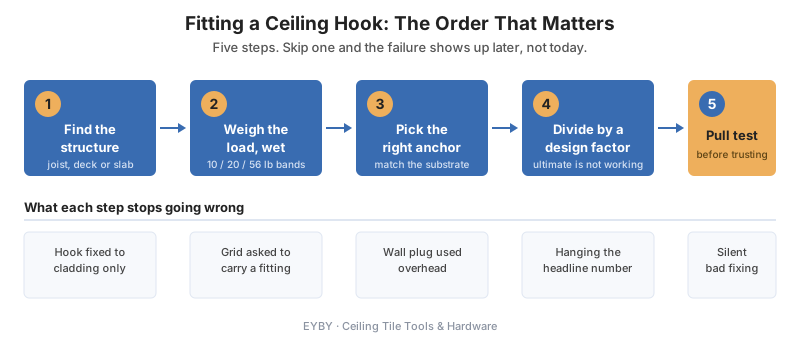
Scan before you drill, then confirm with a fine bit. Ceiling hooks go in last, once you know what is behind the board.
- Stud detectors find joists through board reliably.
- Drill spoil tells you what you are in.
- Existing fixings show the joist line across a room.
- Plenum checks matter above suspended ceilings: - Look for ducts, conduit and sprinkler pipe. - Never drill blind into a plenum.
Drill, Set and Test
Set the anchor fully, then load it gradually rather than all at once. Ceiling hooks tightened past snug can crush the board they depend on.
- Match the bit to the anchor data sheet.
- Seat the toggle until it clamps the back face.
- Tighten to snug, not to crushing.
- Test with a pull at roughly the working load before trusting it.
Frequently Asked Questions
Can I hang things from a suspended ceiling grid?
Not from the grid itself. Loads go to the structure above on hanger wire, and only panels belong on the tee bars.
How much weight can ceiling hooks hold in drywall?
It depends entirely on the anchor. A heavy-duty toggle bolt is rated up to 238 pounds ultimate in half-inch drywall, and your working load should be a fraction of that.
Do I need to hit a joist for ceiling hooks?
Not always. A correctly installed toggle carries far more than most household loads, though a joist remains the strongest option where one is available.
What size hole do toggle-type ceiling hooks need?
Whatever the anchor data sheet says. Common heavy-duty toggles call for a half-inch hole and work in board from three-eighths of an inch up to about three and a half inches thick.
Why did my ceiling hook pull out over time?
Usually movement. Swinging loads and repeated tugging work threads loose, and adhesive fixings creep long before they let go.
Conclusion
Ceiling hooks are a fixings decision dressed up as a hardware decision.
- Identify the ceiling before you choose anything.
- Route the load to timber, concrete or the structure above the grid.
- Read ratings as ultimate values and divide them down.
- Respect the thresholds at 10, 20 and 56 pounds in suspended ceilings.
Get the fixing right and the hook is almost an afterthought. Match the anchor to the substrate, keep a real margin in hand, and the load stays where you put it.
Related Posts

HEPA Filter Guide: What the Grades Mean and Where One Belongs

Handrail Height: How to Get the Number Right in Every Code


Garage Floor Epoxy Coating: How to Test, Specify and Order It