Adhesion Promoter Guide: How Surface Energy Decides Your Bond
By Troy Hasslinger · 21 August 2026
Most failed bonds are not adhesive failures. They are surface failures.
The tape was fine. The panel was fine. The two never wetted out against each other, and hand pressure cannot fix that.
An adhesion promoter is the cheap answer to that problem. It is also the step most often skipped or over-applied.
What an Adhesion Promoter Actually Does
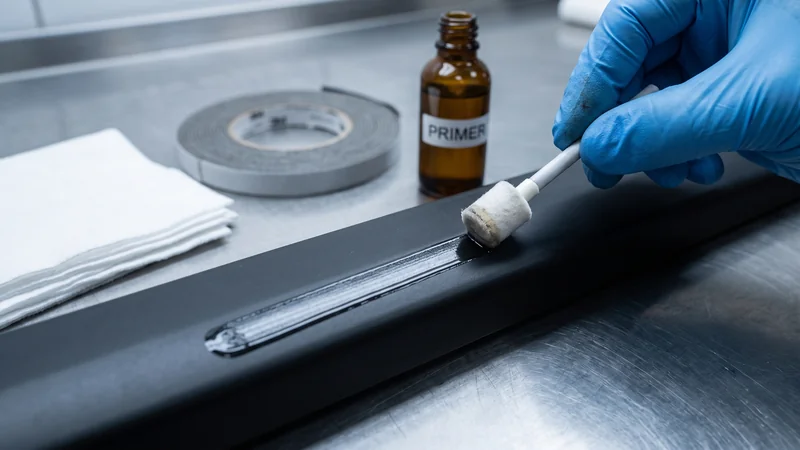
An adhesion promoter is a thin liquid primer wiped onto a surface before the adhesive goes on. It changes how the surface behaves, not the adhesive.
Wetting Is the Whole Problem
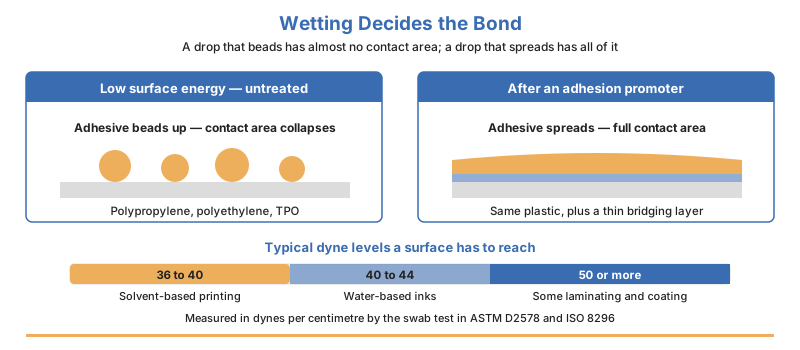
An adhesive has to flow into the microscopic texture of a surface. If it beads instead of spreading, contact area collapses. The bond is weak before it even cures.
- Wetting means the liquid spreads out rather than pulling into droplets.
- Contact area carries the load once the adhesive cures.
- Surface energy decides which of those two you get.
Where the Chemistry Sits
An adhesion promoter leaves a molecular bridging layer behind. One end grips the substrate and the other end suits the adhesive.
The recommended wet film is a fraction of a millimetre. More product does not make a stronger bridge.
Surface Energy in Plain Numbers
Surface energy is the property an adhesion promoter exists to fix.
Dyne Levels Explained
Surface energy is quoted in dynes per centimetre. Higher numbers wet more easily.
The rule is comparative, not absolute. A substrate has to sit clearly above the surface tension of whatever goes onto it. Fall short and wetting is blocked.
- Metals and glass sit high, so wetting is rarely the limiting factor.
- Painted surfaces sit in the middle and vary with the paint.
- Polypropylene, polyethylene and TPO sit low and often need treatment: - These classic low surface energy plastics shed most adhesives untreated.
The Dyne Test
The standard check is a swab test with calibrated fluids. It complies with ASTM D2578 and ISO 8296, using blends of 2-ethoxyethanol and formamide.
- Pick a fluid a few dynes below your expected level.
- Spread it across roughly one square inch.
- Time the beading, because two seconds is the decision point: - No beading within two seconds means step up a fluid. - Beading in under two seconds means drop two to four dynes.
- Never retest the same spot, and never touch the test area.
Why Treated Surfaces Fade
Corona treated film does not hold its level. Surface energy can fall sharply in the short period right after treatment.
That is why elapsed time matters as much as the reading itself. Test late and you measure a surface that no longer exists.
| Job on the surface | Dyne level usually needed |
|---|---|
| Solvent-based printing | 36 to 40 dynes/cm |
| Water-based inks | 40 to 44 dynes/cm |
| Some laminating and coating | 50 dynes/cm or more |
| Untreated polypropylene | Well below all of the above |
Adhesion Promoter Types and What They Suit
Two families cover most industrial work, and they are not interchangeable.
Solvent Promoters for Metals and Paint
This type is usually isopropyl alcohol based, with very low solids. Published data puts the active ingredients under 5% by weight.
This adhesion promoter is aimed at bare metal, galvanized steel and painted surfaces. It raises bond strength. It also speeds the rate at which tape builds adhesion, even in cooler weather.
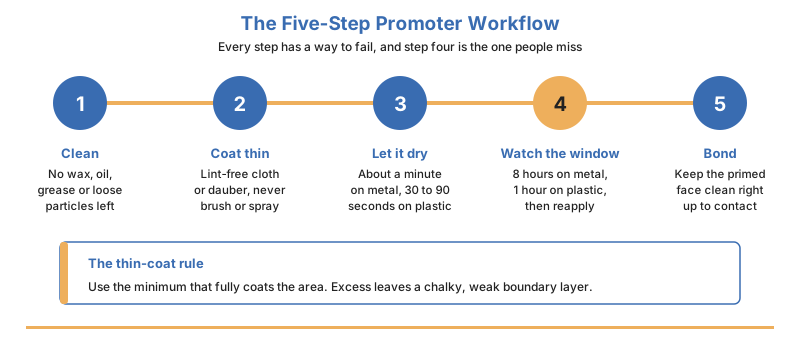
- Dry time is roughly one minute, often one to two.
- Working window is 8 hours before the surface needs redoing.
- Bonus is that it cleans and promotes in one step.
- Catch is that it reacts with airborne moisture, so cap it.
Promoters for Low Surface Energy Plastics
The plastics adhesion promoter is a different formulation. It targets TPO, TPU, polypropylene, EPDM, polycarbonate and acrylic. Automotive trim work depends on it.
- Dry time is 30 to 90 seconds.
- Working window is one hour, not eight.
- Coverage is about 75 square metres per gallon.
- Useful trick is a fluorescent dye in the liquid: - Coverage shows up under UV light, so missed patches stop being guesswork.
Activators, Accelerators and Debonders
Not every bottle on that shelf is a promoter. The neighbouring products solve different problems.
- Activators start the cure on cyanoacrylate joints.
- Accelerators do the same job under a second name.
- Debonders release a cyanoacrylate bond that went on wrong.
How to Apply an Adhesion Promoter
Application errors cause more trouble than product choice does.
Clean First
The surface must be clean and dry. It also has to be free of wax, oil, grease and loose particles. An adhesion promoter is not a substitute for that.
- Contaminated surfaces need a proper cleaner first.
- A half-and-half mix of isopropyl alcohol and water works well.
- Lint matters, so use lint-free dry wipes rather than a shop rag.
- Rough or glossy surfaces may need abrading with sanding sponges before cleaning.
Coat Thin
Use the minimum amount that fully coats the area.
- Wet film thickness should be about 0.002 inch or less.
- A lint-free cloth, pad, felt-tipped dauber or tissue all work.
- Brushes, rollers and spray guns tend to lay down far too much: - Excess shows up as a dull white chalking. - A little chalking does not usually hurt strength. - It wipes off with a dry cloth after the tape is on.
Respect the Open Time
Let the adhesion promoter dry fully before the adhesive touches it. Then work inside the window on the data sheet.
Keep the primed surface clean while you wait. A fingerprint at this stage undoes the whole step.
| Point of comparison | Metal and paint type | Low energy plastic type |
|---|---|---|
| Typical base | Isopropyl alcohol | Solvent carrier |
| Dry time | About 1 minute | 30 to 90 seconds |
| Apply adhesive within | 8 hours | 1 hour |
| Coverage check | Visual only | Fluorescent under UV |
| Minimum application temperature | 10 degrees Celsius | Room temperature |
Mistakes That Kill the Bond
Three failures account for most of the rework.
Using Too Much Adhesion Promoter
More adhesion promoter does not mean more grip. A heavy coat leaves chalky residue and an extra layer the joint never needed.
Contaminating After Coating
The primed film is easy to spoil. Skin oil, dust and overspray all land on it while it dries. None of them announce themselves.
Ignoring Storage Rules
- Shelf life on an alcohol-based adhesion promoter is about one year from shipment.
- Once opened, it is best used within a month.
- Cloudy product or white sediment means it goes in the bin: - Both signal moisture has reacted with the contents, and shaking will not fix it.
- Plastic containers make a poor vapour barrier.
Buying and Storing an Adhesion Promoter
What to Check on the Data Sheet
Match the product to your substrate, not to your supplier's stock list.
- Named substrates on the sheet, in plain words.
- Dry time and the open-time window that follows it.
- Application temperature, which rules out cold workshops.
- Coverage rate, so the bottle size fits the job.
Stock and compare options in adhesive and sealant surface preparation.
Safety and Handling
These products are solvents, and most are flammable.
- Flashpoints can sit as low as 11 degrees Celsius.
- Forced hot air drying is fine, but never near an ignition source.
- Ventilation and the safety data sheet come before the first wipe.
Test every combination before production, because formulations vary even within one plastic family. That holds for any high strength double-sided tape.
Frequently Asked Questions
Do I always need an adhesion promoter?
No. Clean metal and glass wet easily on their own. On those an adhesion promoter buys bond strength and faster build, while on low energy plastics it fixes wetting itself.
How long can I wait before bonding?
It depends on the type. Alcohol-based adhesion promoters for metal give about 8 hours, while plastics promoters typically give one hour before you have to reapply.
Can an adhesion promoter replace cleaning?
Only partly. Some alcohol-based products clean and promote in one step, but only on a surface already free of wax, grease, oil and loose particles.
What is the white haze on my panel?
That is chalking from too much product, and a small amount rarely reduces strength, so it wipes off with a dry cloth once the tape is applied.
Does an adhesion promoter work on polypropylene?
Yes, with the right one. Polypropylene is a low surface energy plastic, so it needs the plastics-grade product rather than the metal-grade one.
Conclusion
An adhesion promoter is not a glue booster. It is a surface fix, and it only pays off when the surface actually needed fixing.
- Know your substrate and roughly where it sits for surface energy.
- Pick the matching type for metal or for low energy plastic.
- Coat thin and let it dry completely.
- Bond inside the window on the data sheet.
Get those four right and the adhesion promoter disappears into the job. Get them wrong and you have added a weak layer to a struggling joint.
Specify the adhesion promoter with the same care you give the adhesive, and the bond stops being a gamble.
Related Posts
HEPA Filter Guide: What the Grades Mean and Where One Belongs
Handrail Height: How to Get the Number Right in Every Code
Garage Floor Epoxy Coating: How to Test, Specify and Order It