Screw Head Types and Standards: A Buyer's Specification Guide
By Evy Du · 23 July 2026
A fastener looks like the simplest line on a purchase order. It is also a common cause of delays, tool mismatches and rework.
The fault is rarely the supplier. It is a line that names a screw head shape and assumes the rest is obvious.
This guide covers what a screw head name leaves out, and how to write a line nobody misreads.
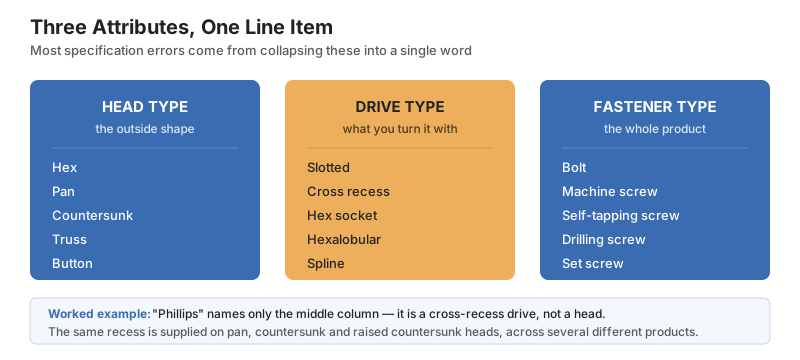
Head Type, Drive Type, and Fastener Type Are Not the Same
Three things get squeezed into one word in most purchase requests. Pulling them apart removes most screw head errors.
The three attributes to keep apart:
- Head type is the outside shape of the screw head. - Hex, pan, countersunk, truss.
- Drive type is the feature you turn it with. - Slotted, cross recess, hex socket, hexalobular.
- Fastener type is the whole product. - Bolt, machine screw, self-tapping screw, set screw.
The Phillips Example
Phillips gets written as a screw head type every day. It is a cross-recess drive, and it comes on pan, countersunk, raised countersunk and other head forms.
Socket screws show the same split. The hex socket is the drive, while the head may be a cap, a button or a countersunk form.
Why the Mix-Up Costs Money
Two screws can look the same in a photo. They can still differ in screw head diameter, head height, recess depth and load capacity. That gap is where substitutions go wrong.
The Two Standards Systems Behind Every Screw Head
A screw head profile only becomes purchasable once it is tied to a document. Two systems cover most industrial buying.
ASME B18 for Inch Products
ASME B18 is a family of American standards for dimensions, terminology and marking. Each document covers a different product family, so there is no single ASME fastener standard.
The B18 documents buyers meet most often:
- B18.2.1 — square, hex, heavy hex and askew head bolts, plus lag screws.
- B18.2.6 — fasteners for structural use.
- B18.3 — socket cap, shoulder and set screws, and hex keys.
- B18.6.3 — machine screws, tapping screws and drive screws.
- B18.12 — the glossary of fastener terms.
- B18.13 — screw and washer assemblies, known as SEMS.
One move inside that family matters most. ASME records that heavy hex structural bolts left the general bolt standard for the structural one. That is why structural heavy hex bolts must never be swapped in for plain hex.
The glossary is the underrated one. ASME built its terminology from more than 230 standards and publications, and it covers head styles.
ISO for Metric Products
An ISO document normally defines one product form. That covers screw head sizes, thread range, tolerances and product grade.
| Standard | What it defines |
|---|---|
| ISO 4014:2022 | Hexagon head bolts, usually part threaded |
| ISO 4017:2022 | Hexagon head screws, threaded to the head |
| ISO 4762 | Hexagon socket head cap screws |
| ISO 7380-1:2022 | Hexagon socket button head screws |
| ISO 10642:2026 | Hexagon socket countersunk head screws |
| ISO 7045:2011 | Pan head screws, type H or type Z cross recess |
ISO 4014 and ISO 4017 both cover steel and stainless in coarse metric threads from M1,6 to M64, product grades A and B. Strength sits elsewhere, in ISO 898-1 for steel and ISO 3506-1 for stainless.
Common Screw Head Types and What Each One Needs
The chart below shows the screw head profiles in use.
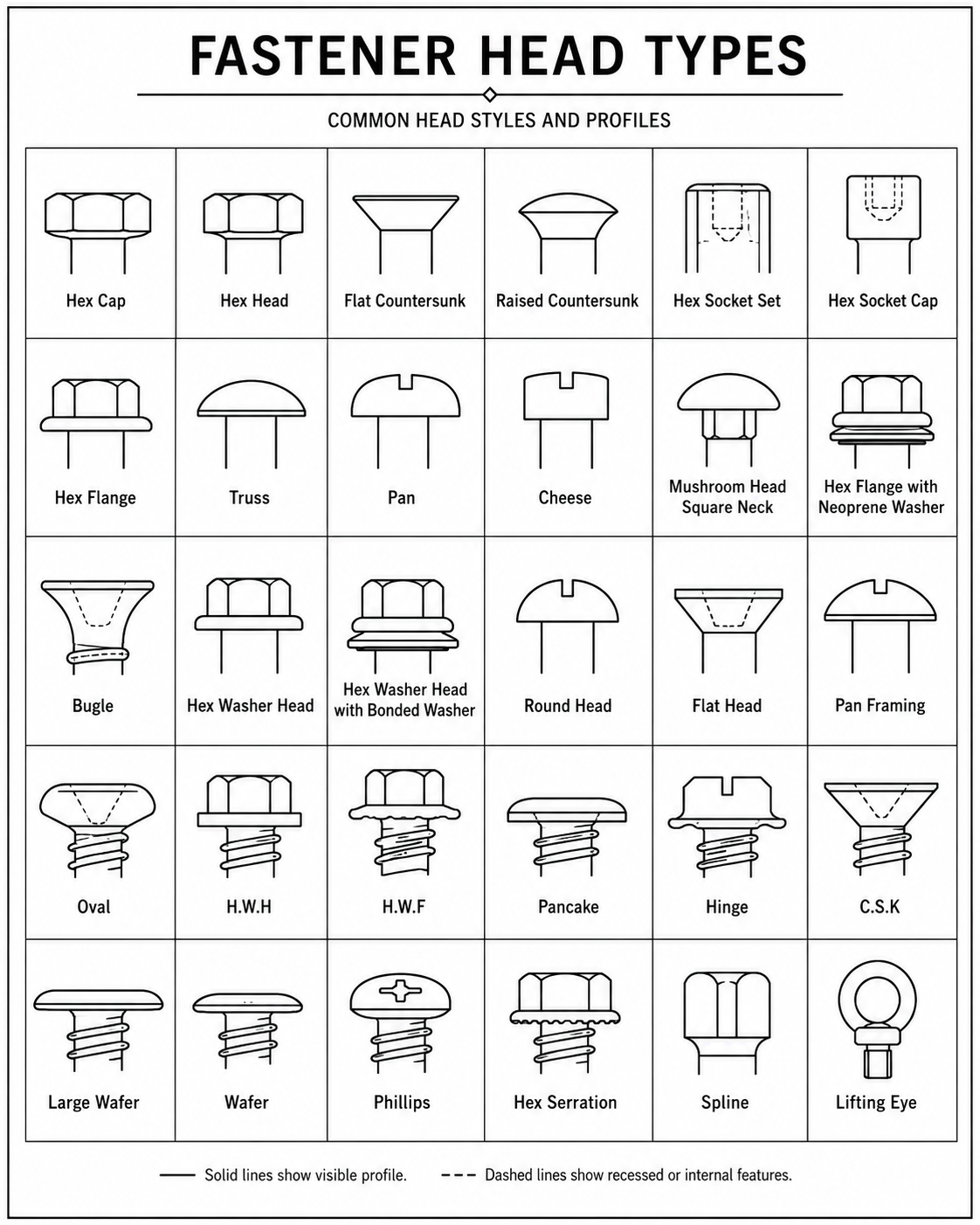
The chart doubles as a worked example: it labels "Phillips" as a head when Phillips is a drive recess, and repeats truss and pan with different geometry.
What a screw head chart cannot tell you:
- Head diameter, head height or recess depth.
- Thread size, property class or material.
- Which standard the profile belongs to.
Hex Head and Hex Cap
Hex screw heads give six outside wrenching faces, and they dominate machinery, steelwork and construction.
For metric buying, settle first whether the product is part threaded to ISO 4014 or fully threaded to ISO 4017. "Hex cap screw" is a North American term, so check thread length and the ASME document behind your hex head bolts before reading it across as "hex bolt".
Socket Cap and Set Screws
A socket cap screw has a round head with an inside hex drive. It suits tight clearances, and metric socket head cap screws sit under ISO 4762.
Set screws have no projecting head at all. They push force through the point, so the point form must be called out separately.
Flange and Sealing Screw Heads
A flange or washer head builds a wide bearing face into the part. It spreads clamping force and can remove a loose washer. A bonded-washer version adds a sealing washer, usually metal bonded to rubber.
Specify these before buying a sealing screw head:
- Washer material and elastomer type.
- Outside diameter and sealing duty.
"Neoprene washer" is not a spec where weathering or chemicals matter.
Screw Heads That Carry Less Load Than You Think
Some screw heads are made by cutting material away. The standards say so in their own titles, and buyers still miss it.
Countersunk Screw Heads
A countersunk screw head sits flush with the surface, which suits smooth finishes and low snag risk. Cutting the taper and recess removes metal, so the head carries less than a cap screw. ISO 10642 names reduced loadability in its own title.
Button Screw Heads
ISO 7380-1 covers button screw heads with reduced loadability. It assumes head loadability of 80 per cent of thread loadability across the sizes it covers.
Check these when a reduced-load screw head is offered:
- Whether the joint was sized on thread strength or head strength.
- Countersink angle, head diameter and head height.
- Material thickness under the head.
Trade Names That No Standard Defines
Bugle, wafer, pancake and framing describe real screw head shapes. They are determined by manufacturer and regional habit, not by one published document.
Bugle heads go with drywall and board fixing, and the curved underside beds into soft material. Wafer, pancake and framing mean a low, wide head for sheet framing.
Ask for this before buying a trade-name screw head:
- A drawing or a named product standard.
- Head diameter, head height and recess depth.
A Lifting Eye Is Not a Screw Head
A lifting eye is a load-handling part, not a decorative head. Its design, material, working load limit and inspection needs are safety critical. The lifting standard, certificate and load rating belong on the order.
Writing a Fastener Line Item Nobody Can Misread
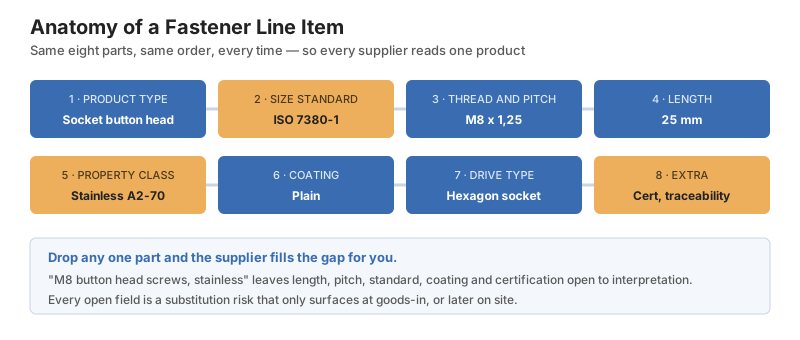
A good description runs in a fixed order, so every supplier reads the same product.
| Element | Example |
|---|---|
| Product type | Hexagon socket button head screw |
| Size standard | ISO 7380-1 |
| Thread size and pitch | M8 x 1,25 |
| Length | 25 mm |
| Material or property class | Stainless A2-70 |
| Coating or finish | Plain |
| Drive type | Hexagon socket |
| Extra requirements | Certificate, batch traceability |
Habits that keep a fastener schedule clean:
- Tie every screw head profile to a current, named standard. - Reject quotes that answer with a product name only.
- Put certificates and batch traceability in the line item.
Machine screws repay this first. One machine screw head name can cover several different products.
Frequently Asked Questions
Is Phillips a screw head type?
No, Phillips is a cross-recess drive that comes on pan, countersunk, raised countersunk and other screw head forms.
What is the difference between ISO 4014 and ISO 4017?
Both cover metric hexagon products in steel and stainless from M1,6 to M64. ISO 4014 covers bolts that are usually part threaded. ISO 4017 covers screws threaded up to the head.
Which screw head types carry less load?
Countersunk and button screw heads. ISO 7380-1 assumes head loadability of 80 per cent of thread loadability, and ISO 10642 names it in its title.
Can I order from a screw head chart?
Use it to identify a shape, never to buy. A chart carries no sizes, tolerances or drive detail, and head names vary between manufacturers.
Conclusion
A screw head image is useful for a first guess.
It is not a purchase specification, and treating it as one is what produces incorrect substitutions.
Four habits that close the gap:
- Tie each screw head profile to a current standard.
- Define thread, strength, material and coating separately.
- Treat reduced-load screw heads as a design decision.
Standardised fastener data lets buyers compare like with like and hold traceability across projects. On Eyby, structured classifications and standard references let teams compare across brands on consistent specs.
Related Posts