Extension Cord Guide: How to Choose the Right Cord for Every Job

By Macy Chen · 14 July 2026
An extension cord looks like the simplest purchase on a job site. Grab any cord, plug in the tool, get to work.
That habit causes roughly 3,300 home fires a year, killing 50 people and injuring 270 more, when the wrong cord overheats quietly. The failure is rarely the plug. It is usually a gauge too thin for the amperage.
This guide covers gauge, length, duty rating, and the code an extension cord has to meet. Each section builds toward the chart electricians use to size a cord by hand.
What an Extension Cord Actually Does
An extension cord is not a neutral length of wire. It is a current-carrying conductor with its own resistance, and that resistance turns into heat under load. Every cord decision comes down to three variables working together:
- Wire gauge sets how much current the copper inside can carry without overheating.
- Cord length adds resistance, so a longer cord carries less current safely than a short one of the same gauge.
- Duty rating tells you whether the cord's insulation and jacket can survive the environment it will sit in.
How Wire Gauge Controls Capacity
Wire gauge uses the American Wire Gauge (AWG) scale, and the numbers run backward from what people expect: a smaller number means a thicker conductor. A 12-gauge cord carries more current than a 16-gauge cord of the same length.
The NEC's ampacity tables show why gauge matters this much. NEC Table 310-15(B)(16) caps overcurrent protection on copper conductors at 15 amps for 14 AWG, 20 amps for 12 AWG, and 30 amps for 10 AWG. That cap holds regardless of higher lab ratings some insulation reaches.
Why Length Changes the Math
An extension cord rated fine at 25 feet is not automatically fine at 100 feet. Resistance rises with length, so a 12-gauge cord good for 20 amps at 50 feet is limited to about 15 amps at 150 feet. Buying by gauge alone, without checking length, is the single most common extension cord mistake.
Extension Cord Types and Duty Ratings
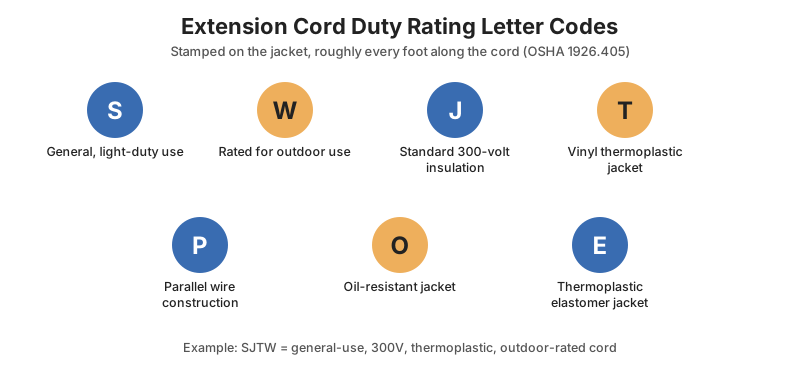
Manufacturers stamp a letter code on every cord jacket, and that code is not decoration. OSHA requires extension cords to carry a durability rating from the National Electrical Code, printed every foot along the cord.
- S cords are rated for general, light-duty use.
- W on a cord means it is rated for outdoor use.
- J marks standard 300-volt insulation, the common residential spec.
- T means a vinyl thermoplastic jacket.
- P marks parallel wire construction, typical of household cords.
- O marks oil-resistant jackets, useful around shop equipment.
- E marks a thermoplastic elastomer jacket, common on newer cords.
Light-Duty vs Medium-Duty vs Heavy-Duty
Three duty classes cover almost every extension cord on the market. Matching the class to the load beats memorizing gauge numbers alone.
- Light-duty cords (typically 16 or 18 AWG) suit lamps, small electronics, and holiday lighting under about 10 amps.
- Medium-duty cords (typically 14 AWG) cover shop tools and appliances up to roughly 15 amps.
- Heavy-duty cords (12 or 10 AWG, marked S, SJ, ST, or SJT) handle job-site power tools and anything drawing 15 to 20 amps.
Indoor-Only vs Outdoor-Rated Cords
Only an extension cord marked with a W is rated for outdoor exposure to moisture and UV. Match the rating to the environment first:
- An indoor-only cord left outside degrades faster under sun and moisture. - It also risks the leakage-to-ground failure OSHA flags for wet connectors.
- An outdoor-rated (W) cord carries a jacket built for temperature swings and direct wetting. - It costs a little more but removes the guesswork on a job site.
Gauge, Length, and Amperage Chart
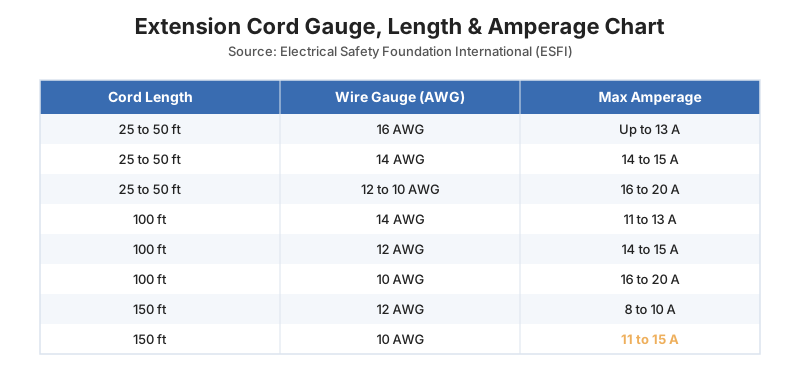
The Electrical Safety Foundation International publishes the reference chart most electricians still use to size a cord by hand:
| Cord Length | Wire Gauge | Maximum Amperage |
|---|---|---|
| 25 to 50 feet | 16 AWG | Up to 13 amps |
| 25 to 50 feet | 14 AWG | 14 to 15 amps |
| 25 to 50 feet | 12 to 10 AWG | 16 to 20 amps |
| 100 feet | 16 AWG | Up to 10 amps |
| 100 feet | 14 AWG | 11 to 13 amps |
| 100 feet | 12 AWG | 14 to 15 amps |
| 100 feet | 10 AWG | 16 to 20 amps |
| 150 feet | 14 AWG | Up to 7 amps |
| 150 feet | 12 AWG | 8 to 10 amps |
| 150 feet | 10 AWG | 11 to 15 amps |
Reading the Chart for Your Tool
Sizing a cord by hand takes three steps:
- Check the tool's nameplate for its amp draw, not its wattage alone.
- Find the row matching the length needed.
- Pick the gauge in that row rated at or above the tool's draw.
Rounding down the gauge to save a few dollars is the shortcut that turns into the overheating cord OSHA and ESFI both warn about. It rarely trips a breaker right away, which is why it goes unnoticed.
Matching an Extension Cord to Your Job
Power Tools and Job Sites
Job-site tools draw more current than most people expect once startup spikes are added in:
- Circular saws, compressors, and mixers typically draw 12 to 15 amps under steady load.
- Startup current spikes well above that steady draw for a fraction of a second.
- A 12-gauge, heavy-duty cord in the 50 to 100-foot range covers most job-site tools with margin to spare.
Household and Holiday Use
Lamps, chargers, and holiday lights draw well under 10 amps, so a 16-gauge light-duty cord is normally correct. That gauge is the one sold in most hardware-store multi-packs.
- Never chain two light-duty cords together to reach further. - Daisy-chaining is one of the most common ways a household extension cord gets overloaded.
- Check holiday light strings for a combined-wattage limit printed on the packaging. - That number caps how many strings one cord and outlet can carry safely.
Long Runs and Job-Site Reels
Runs past 100 feet call for 10-gauge cord to keep voltage drop in check. Longer runs are better handled as permanent wiring than as a cord.
- A self-retracting reel keeps the extra length from becoming a trip hazard.
- Coiled cord under load traps heat, so uncoil a reel fully whenever it runs near its rated amperage.
OSHA and Code Requirements to Meet
Grounding and Strain Relief
Two OSHA rules govern how an extension cord connects to a tool, not just its gauge:
- Three-wire construction lets both the cord and tool be grounded.
- Strain relief at every connection stops tension from loosening a strand against another conductor.
Certification Marks to Look For
Buy only cords carrying an independent testing mark before checking anything else on the label:
- UL (Underwriters Laboratories) is the most common mark on cords sold in North America.
- ETL (Intertek) and CSA (Canadian Standards Association) confirm the same type of independent testing.
That mark confirms the cord's gauge and duty rating were verified, not just claimed by the manufacturer. Skip any extension cord without one, regardless of price.
Common Extension Cord Mistakes to Avoid
- Buying by length alone and ignoring the amp rating that comes with it. - Fix: check the tool's amp draw and the chart above together.
- Using an indoor-only cord outdoors or in wet conditions. - Fix: confirm the W marking before the job starts.
- Running a cord through a doorway, wall, or under a rug. - Fix: trapped heat cannot escape, which raises fire risk.
- Daisy-chaining two or more cords to reach further. - Fix: buy one cord in the correct length instead.
- Leaving a cord coiled while running near its rated amperage. - Fix: uncoil fully before drawing sustained current.
- Treating a damaged cord as still usable. - Fix: retire any cord with cracked insulation or exposed strands immediately.
Frequently Asked Questions
What gauge extension cord do I need for a table saw?
Most table saws draw 12 to 15 amps, so a 12-gauge, heavy-duty cord covers runs up to 100 feet.
Is a thicker extension cord always safer?
A thicker (lower AWG number) cord carries more current with less voltage drop, so it is rarely wrong for heavy loads. It costs and weighs more than light-duty use needs, though.
Can I use an indoor extension cord outside for a short time?
No. OSHA and ESFI both treat the outdoor W rating as a hard requirement, since moisture at a connector can leak current to anyone holding it.
Why does a longer extension cord need a thicker gauge?
Resistance rises with conductor length, so voltage drop increases and safe amperage drops as a cord gets longer. The ESFI chart above shows a 12-gauge cord dropping from 20 amps at 50 feet to about 10 amps at 150 feet. The same gauge never carries the same amperage at every length.
How many extension cords can I safely connect together?
None, as a rule. Daisy-chaining compounds voltage drop and defeats the strain relief and grounding continuity each cord is built around.
Conclusion
Choosing an extension cord is a three-part match: gauge to amperage, length to that gauge, and duty rating to the environment. Skip one variable and the cord becomes the weak point in the circuit.
A few habits keep the decision simple:
- Check the tool's amp draw before shopping for a cord.
- Use the length and gauge chart together, never gauge alone.
- Buy only cords carrying a UL, ETL, or CSA listing.
Get that match right once, and the extension cord stops being the thing that fails first. That habit costs a minute at checkout and saves a repair.
Related categories: Extension Cords · Fuses, Circuit Breakers & Safety Switches · Wire & Cable Management
Related Posts


What Bathroom Partitions Have to Survive

Pipe Fittings Explained: Types, Materials and How to Choose

Box Stapler Guide: Types, Staple Sizes and How to Choose One