Hydraulic Cylinder Repair: How to Diagnose the Leak Before You Reseal
By Sarah Donaker · 27 August 2026
Most hydraulic cylinder repair jobs begin the same way. Oil on the rod, a seal kit ordered, an afternoon lost.
Six weeks later the same rod is wet again. The seal was never the fault, only the part that failed first.
Good hydraulic cylinder repair reverses that order. Read the failure, find what killed the seal, then rebuild.
Why the Seal Is the Symptom, Not the Cause
What Sits Inside a Cylinder
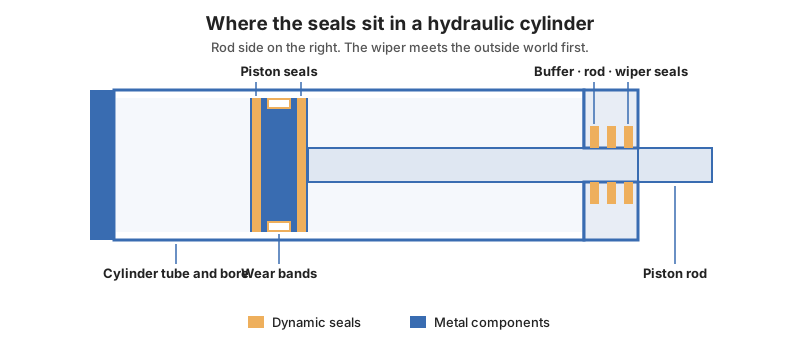
A cylinder carries a small family of seals, and each one has a different job. Knowing which member failed narrows the hydraulic cylinder repair before a spanner is lifted.
- Piston seals keep oil on the work side of the piston.
- Rod seals stop leakage from inside the cylinder to the outside. - This is the most important seal in the stack.
- Buffer seals absorb pressure change under high load. - They sit ahead of the rod seal for that reason.
- Wiper seals stop outside contaminants entering the assembly.
- Wear bands guide the piston and rod, and keep metal off metal. - They carry the transverse force a side load applies.
The Question Every Hydraulic Cylinder Repair Should Answer
A seal is a wear part living in a hostile place. It fails when something else pushes it past what it was designed for.
So the first question is not which seal to buy. It is what changed. Answer that and the hydraulic cylinder repair stops being guesswork.
Read the Failure Before You Start the Hydraulic Cylinder Repair
Peninsular Cylinder's engineering team groups seal failure into five recognisable patterns. Each leaves its own marks, and each points somewhere different.
| Failure mode | What you see | Where the cause sits |
|---|---|---|
| Hardening | Glazed, brittle, cracked seal lips | Heat from high-speed duty or environment |
| Wear | Thinned lips, worn wear bands | Poor lubrication or excessive lateral load |
| Scarring | Cuts and scores on seal and rod | Debris or badly filtered oil |
| Fracture | Broken or missing seal material | Back pressure, pressure spikes and shocks |
| Installation damage | Twisted, nicked, pinched seals | Wrong tools or wrong groove fit |
Hardening Points at Temperature
Glazed lips mean heat, from a fast-cycling duty or from the surroundings. High-temperature materials fix it, and so do shielding, insulation or cylinder cooling. A like-for-like hydraulic cylinder repair here just restarts the clock.
Scarring Points at Contamination
Shop debris, wood splinters and poorly filtered oil score the rod and bore. Those scores then cut every seal that passes over them.
Fracture Points at Pressure Spikes
Broken seal material is the trace a spike leaves behind.
- Direction changes spike pressure even at a correct working pressure.
- Back pressure loads the seal from the side it was not designed for. - Check the return line before blaming the seal.
- Shock loads arrive from the machine, not from the cylinder.
Measure the Rod and Bore Against Real Numbers
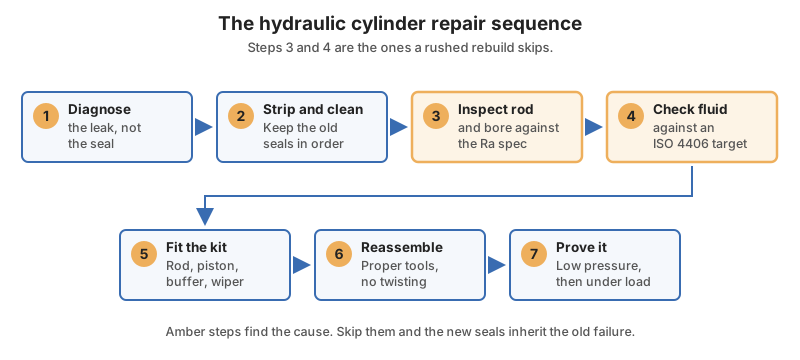
This is the step a rushed hydraulic cylinder repair skips. It is also the one that decides how long the rebuild lasts.
Surface Finish Is a Specification
Hallite's design data treats the dynamic surface as a sealing component in its own right. Too smooth and the surface will not retain lubrication, so the seal wears from frictional heat. Too coarse and the roughness cuts the sealing lip.
| Surface | Target finish | Note |
|---|---|---|
| Piston rod, hard chrome | Ra 0.1 to 0.3 µm | 4 to 12 µin Ra |
| Honed tube bore | Ra 0.1 to 0.4 µm | Best finish for seals |
| Skived and roller-burnished bore | Below Ra 0.1 µm | Rubber elements wear faster |
- Rod hardness should reach at least 67 Rockwell C, or 900 HV/10.
- Finish parameters now sit in ISO 21920, which replaced ISO 4287 and ISO 4288.
- Drawn-over-mandrel tube may or may not be adequate. - The texture actually achieved decides it.
- Smooth-bore tube can still erode a seal through flow.
What to Check on the Bench
Strip, clean and inspect before the hydraulic cylinder repair goes further.
- Run a fingernail along the rod to find scores you cannot see.
- Check the bore for scuffing at the ends of stroke.
- Measure the rod at several points for taper and bending.
- Inspect wear bands for the transverse load story they tell.
- Photograph the old seals in the order they came out.
A scored rod turns a two-hour hydraulic cylinder repair into a re-chroming job. Better to know that on the bench.
Fix the Fluid, or Repeat the Job
Read the Cleanliness Code
Noria's guidance on ISO 4406:99 is the cleanest way to judge the oil. The standard assigns a code number at three particle sizes, greater than 4, 6 and 14 micrometres, from an automatic particle count calibrated to ISO 11171.
The table is a Renard series, so the allowable count roughly doubles at each code step. Particle ingress can climb several-fold while the reported code barely moves.
- Set a target code for the system rather than borrowing someone else's.
- Sample before and after the hydraulic cylinder repair to prove the change.
- Treat the code as a target, not as a root-cause tool. - It answers whether you hit the number. - It will not tell you why you missed it.
Filtration and Ingress
Contaminants that scarred the rod came from somewhere. Filtration is the usual answer, and our range of in-line hydraulic filters catches them before the cylinder does.
Wipers handle the other direction. They are the cheapest part of any hydraulic cylinder repair and the one protecting everything else.
Rebuilding So the Seals Survive
Order the Right Kit
Match the kit to the cylinder, not to the last one you did. A full set of hydraulic cylinder seals covers rod, piston, buffer and wiper together. That avoids the half-rebuild which fails first at the part you reused.
Keeping a kit on the shelf shortens the next hydraulic cylinder repair considerably.
Install Without Damaging Anything
Installation damage is a hydraulic cylinder repair failure in its own right, and entirely self-inflicted.
- Use proper installation tools, not screwdrivers.
- Inspect tools for nicks and burrs before they touch a seal.
- Avoid twisting a seal into its groove.
- Follow the published groove dimensions from the seal maker. - Most publish surface specs alongside them.
- Lubricate lips with clean system fluid on the way in.
Prove the Hydraulic Cylinder Repair Before It Goes Back
Cycle slowly at low pressure first, then work up. No hydraulic cylinder repair is finished until it has run under load.
- Bleed air from both ends before the first full stroke.
- Watch the retract stroke, where a rod seal shows itself soonest.
- Hold under load and look for drift past the piston.
When Hydraulic Cylinder Repair Is the Wrong Answer
Not every cylinder deserves a hydraulic cylinder repair. A bent rod, a scored bore or a corroded tube can cost more to recover than to replace.
- Bent rods rarely straighten back inside tolerance.
- Deep bore scoring needs honing that may exceed the seal range.
- Repeat failures point at sizing or mounting, not at seals.
- A third hydraulic cylinder repair on one unit is a design signal.
At that point a replacement welded hydraulic cylinder is the honest call. The failed unit still earns its keep as a diagnosis.
Frequently Asked Questions
How do I know if it is the rod seal or the piston seal?
External oil on the rod points at the rod seal or wiper. Internal bypass, where the cylinder drifts under load with no external leak, points at the piston seal.
What surface finish does a hydraulic cylinder rod need?
Hallite's data puts a hard chrome plated rod between 4 and 12 microinches Ra, with hardness of at least 67 Rockwell C. Rougher cuts the seal, and smoother starves it of lubrication.
Does hydraulic cylinder repair need the oil changed too?
If contamination scarred the rod, yes. Fitting new seals into dirty fluid restarts the same failure, so sample against an ISO 4406 target first.
Why did my new seals fail within weeks?
Usually the cause was never removed. Check for a scored rod, a heat source, pressure spikes on direction change, or installation damage from the last rebuild.
Should I keep a seal kit in stock?
For any cylinder whose downtime matters, yes. A shelf kit turns an unplanned outage into a scheduled hydraulic cylinder repair.
Conclusion
Hydraulic cylinder repair is a diagnosis wearing the costume of a parts job.
The seal that leaked is evidence. The rod finish, the fluid cleanliness code and the failure pattern together say what actually happened. That is what the rebuild has to answer.
Work in that order and the next hydraulic cylinder repair on that machine is years away, not weeks.
Related Posts
What Bathroom Partitions Have to Survive
Pipe Fittings Explained: Types, Materials and How to Choose
Box Stapler Guide: Types, Staple Sizes and How to Choose One