Fire Extinguisher Types: How to Choose the Right One for Every Fire Class
By Umer Farouk · 26 July 2026
Buying the wrong extinguisher is worse than buying none at all. A unit that looks right on the wall can spread the fire it was meant to stop. Fire extinguisher types are not interchangeable.
That is why fire extinguisher types are defined by what burns, not by brand, size or price. Get the class right and the rest follows. Everything else is detail.
A second trap catches buyers with sites in more than one country. The class letters do not mean the same thing everywhere, and one letter means something quite different in the US and in Europe.
This guide covers the classes, the agents behind the main fire extinguisher types, where each unit goes, and how often it must be checked.
Fire Classes Come Before Fire Extinguisher Types
The class is the fuel
A fire class describes the fuel that is burning. Fire extinguisher types are then rated against the classes they can safely handle.
The rating is printed as a letter, usually with a number in front. A unit marked 13A and 34B is rated for both classes.
What goes wrong when the class is ignored
Water on a live electrical panel conducts current back to whoever is holding the hose. Water on burning cooking oil throws blazing fat across the kitchen. Both are cases of the right fire extinguisher types hanging on the wall and the wrong one being grabbed.
The NFPA is blunt about the cooking case. A unit not rated for cooking oils, used on a cooking oil fire, can produce a much bigger fire or even an explosion.
The Fire Classes Behind the Main Fire Extinguisher Types
Class A: ordinary solids
OSHA defines a Class A fire as one involving ordinary combustible materials such as paper, wood, cloth, and some rubber and plastic. Most fire extinguisher types carry an A rating.
- Found in offices, stores, warehouses and anywhere with stock or waste.
- The most common class in almost every building. - Water and foam both work here. - So does multipurpose dry chemical.
Class B: liquids and gases
OSHA's Class B covers flammable or combustible liquids, flammable gases and greases.
- Fuel stores, plant rooms, paint stores and vehicle workshops.
- Never use plain water, which spreads the burning liquid.
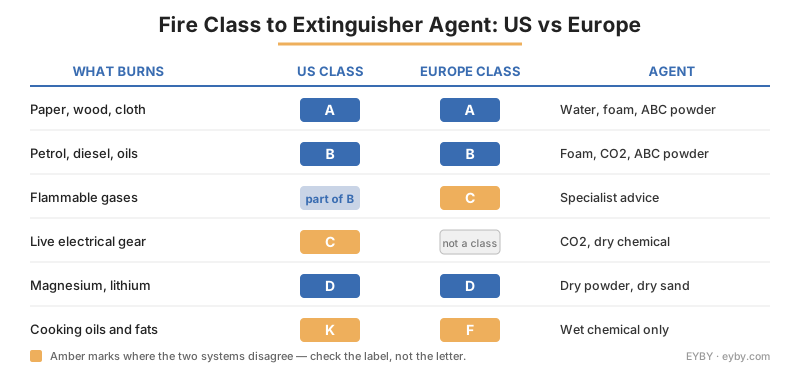
Class C: the letter that changes by country
This is the one to watch on a multi-country site.
- In the US, Class C means a fire in energised electrical equipment, where a non-conductive agent is needed.
- In the UK and Europe, Class C means a fire involving gases. - Electrical fires are not treated as a class of fire at all in that system. - Units suitable for live equipment are marked separately instead.
The same CO2 unit can be bought against a US spec sheet or a European one. The paperwork explaining why will not match.
Class D: burning metals
OSHA's Class D covers combustible metals such as magnesium, titanium, zirconium, sodium, lithium and potassium.
- These need special dry powder, not dry chemical, and the two are not the same.
- Dry sand is an accepted backup in some guidance.
- Take specialist advice before specifying anything here.
Class K and Class F: cooking oils
Both letters describe one hazard: burning vegetable or animal fats in a cooking appliance.
- Class K is the US label, defined by the NFPA for animal fats or cooking oils.
- Class F is the European label, covering cooking appliances with vegetable or animal fats.
| Fire class | What burns | US label | Europe label |
|---|---|---|---|
| Solids | Paper, wood, cloth, plastics | A | A |
| Liquids | Petrol, diesel, oils, greases | B | B |
| Gases | Flammable gases | part of B | C |
| Live electrical | Energised equipment | C | not a class |
| Metals | Magnesium, lithium, sodium | D | D |
| Cooking oils | Vegetable and animal fats | K | F |
Fire Extinguisher Types by Agent
Water and wetting agent
Plain water cools Class A fuel and nothing else. It is cheap, safe to handle and useless on oil or live equipment. Of all the fire extinguisher types, this one has the narrowest range.
Foam and AFFF
Foam blankets a liquid surface and cuts off the air. It covers more ground than water among the water-based fire extinguisher types.
- Rated for: Class A and Class B.
- Common grade: aqueous film forming foam, the workshop standard. - It is still a water-based agent. - Keep it away from live equipment.
- Watch for: foam blankets break down if the surface is disturbed.
Dry chemical
OSHA defines multipurpose dry chemical as a dry chemical approved for Class A, Class B and Class C fires. That is the familiar ABC unit. It is the most widely sold of all the fire extinguisher types.
- Agents include monoammonium phosphate and sodium bicarbonate.
- Coverage is broad, which is why ABC units dominate general use. - The residue is corrosive and messy. - Server rooms and clean areas often choose CO2 instead.
Carbon dioxide
CO2 smothers the fire and leaves nothing behind. Among the fire extinguisher types rated for live equipment, it is the cleanest.
- Best for: live electrical equipment and electronics.
- Upside: no residue, so no clean-up cost after a discharge.
- Watch for: the horn gets very cold, and the agent displaces air in small rooms.
Wet chemical
This is the Class K and Class F agent, and it works by chemistry, not smothering alone.
The agent reacts with the burning oil or fat to make a soapy layer that floats on the fuel and smothers the flame. None of the other fire extinguisher types work that way. Nothing else on the wall does the job.
Dry powder for metals
Dry powder is a separate product from dry chemical. OSHA's own definition of dry chemical explicitly excludes dry powders. It is the only one of the fire extinguisher types rated for burning metals.
| Agent | Rated for | Typical use | Hydrostatic test |
|---|---|---|---|
| Stored pressure water | A | Offices, stores, warehouses | 5 years |
| AFFF foam | A, B | Workshops, fuel handling | 5 years |
| Dry chemical, stainless shell | A, B, C | General purpose | 5 years |
| Dry chemical, mild steel shell | A, B, C | General purpose | 12 years |
| Carbon dioxide | B, C | Electrical, server rooms | 5 years |
| Dry powder, cartridge type | D | Metal working | 12 years |
Placing Fire Extinguisher Types Correctly
Buying the right unit is half the job. OSHA also sets how far a worker may walk to reach one. Spacing rules differ by class, not by which of the fire extinguisher types you picked.
Class A and Class B spacing
- Class A: travel distance must be 75 feet or less.
- Class B: it tightens to 50 feet or less.
- Mounting: units must be mounted, located and identified so they are reachable without risk of injury.
Class C and Class D
- Class C units are distributed on the pattern of the Class A or Class B hazards already present.
- For Class D, travel distance from the metal working area to the agent must be 75 feet or less.
Class K placement
- The 30-foot rule: the NFPA requires Class K units within 30 feet of any area with a Class K risk. - That is a far tighter radius than the general rules. - It reflects how fast a fat fire develops.
Inspection, Maintenance and Testing
Fire extinguisher types differ in service needs, but the base routine is the same.
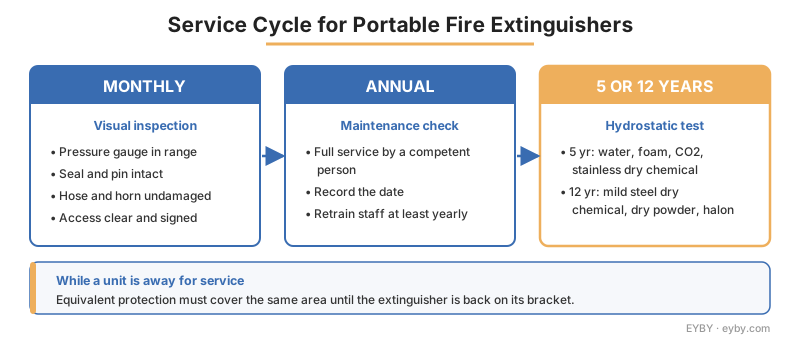
Every month
Every portable unit must be inspected monthly. This is a look, not a strip-down: gauge, seal, hose and clear access.
Every year
Units must go through an annual maintenance check.
- Record it: log the date of that check.
- Keep it: retain the record for one year after the last entry, or the life of the shell, whichever is shorter.
- Train on it: brief staff on first employment and at least once a year after that.
Every five or twelve years
Hydrostatic testing puts the shell itself under pressure.
- Five years: water, foam, CO2 and stainless dry chemical units.
- Twelve years: mild steel dry chemical, dry powder and halon units.
- Hoses: assemblies with a shut-off nozzle follow the same interval as their extinguisher.
When a unit leaves the wall for service, equivalent cover must be provided meanwhile.
Using One Without Making Things Worse
The PASS method
The NFPA teaches four steps, in order.
- Pull the pin.
- Aim low, at the base of the fire.
- Squeeze the lever slowly and evenly.
- Sweep the nozzle from side to side.
When to fight and when to leave
Reach for a unit only when all of these are true.
- The fire is small and contained, and it is not growing.
- Everyone else is out of the building.
- The fire service has been called, or is being called now.
- The room is not full of smoke.
If any one of those fails, leave. No extinguisher is worth a life.
Frequently Asked Questions About Fire Extinguisher Types
Which of the fire extinguisher types covers the most fire classes?
Multipurpose dry chemical, the ABC unit, covers Class A, Class B and Class C. It is the widest single choice of the fire extinguisher types, though its residue is corrosive.
Can I use an ABC extinguisher in a kitchen?
Not on burning cooking oil. That hazard needs a Class K or Class F wet chemical unit, and the wrong type risks a far bigger fire.
What do the numbers before the letters mean?
They are size ratings, not just labels. A unit marked 13A has been tested against a larger Class A test fire than one marked 8A. The same numbering runs across all fire extinguisher types.
How often do fire extinguisher types need checking?
Monthly inspection and an annual maintenance check apply to all of them. Hydrostatic testing follows at five or twelve years, depending on shell and agent.
Do I still need an extinguisher if the building has sprinklers?
Usually yes. Sprinklers and portable fire extinguisher types solve different problems, and the placement rules still apply on their own terms.
Conclusion: Matching Fire Extinguisher Types to Real Risk
Start with the fuel, not the catalogue. Walk the site, name what could burn in each area, and let that list pick the fire extinguisher types.
Watch the class letters across borders. Class C means live electrical in the US and gases in Europe, and cooking oils are Class K in one system and Class F in the other.
Then keep them serviceable. All fire extinguisher types need monthly checks, a yearly service and testing on schedule, and that routine is what turns a wall-mounted object back into working equipment.
Related categories on EYBY:
- Browse fire extinguishers and accessories for units and mounts.
- Compare fire blankets for small cooking fires.
- Review carbon monoxide and smoke detectors to catch a fire early.
Related Posts
Welding Helmet Guide: How to Choose the Right One for Every Job
Torque Wrench Guide: How to Choose the Right One for Every Job
Test Instruments - Sound Meter