Woodruff Key Sizing: How to Read the Number and Cut the Keyseat

By Angela Siniscalo · 12 September 2026
A drawer of half-moon steel slivers looks interchangeable. It is not.
The number printed on the packet of a woodruff key carries the whole geometry of the part. Read it wrong and you seat a loose key in a tight pocket, or grind a keyseat that no stock key will ever fill. Both mistakes cost a shaft.
This guide decodes that number, sets out the keyseat dimensions that go with it, and shows where a woodruff key beats a straight parallel key.
What a Woodruff Key Does on a Shaft
A woodruff key is a semi-circular steel insert. It transmits torque between a shaft and the hub sitting on it.
The Half-Moon Profile
The curved underside drops into a matching pocket milled across the shaft. Because it sits deeper than a rectangular key, it resists lateral movement far better. The exposed top half then carries the hub.
That depth is the whole design idea.
Why It Self-Aligns
Huyett's fastener engineering guidance notes that the semi-circular shape reduces the chance of the key rolling out of its seat. The key can rock slightly in the pocket as the hub goes on. That small freedom is what makes the fit forgiving.
This matters most on tapered shafts, where a rigid straight key would bind before the hub seated.
The Deliberate Weak Link
A woodruff key is also a sacrificial part. Under excessive load it shears, and the gear or pulley it was driving survives. Huyett describes this as a deliberate fail-safe.
Replacing a sheared key costs a few units of stock. Replacing a scored shaft costs a machine rebuild.
How to Read a Woodruff Key Number
Every imperial woodruff key carries a number under ASME B17.2. That number is not a catalogue index, but the dimensions themselves.
Splitting the Number
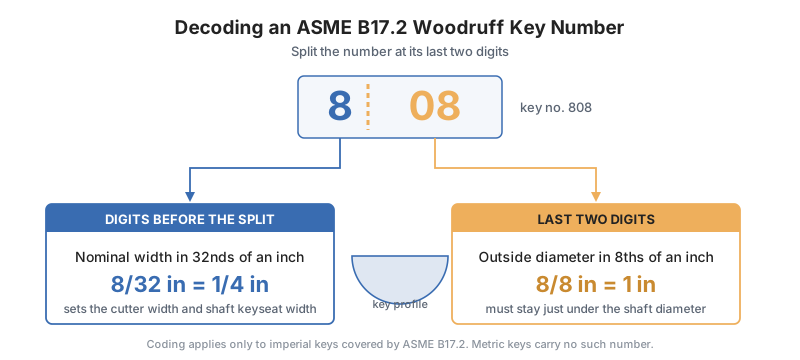
Break the number at its last two digits. What follows is a two-part reading:
- The digits before the split give the nominal width in thirty-seconds of an inch.
- The digits after the split give the outside diameter in eighths of an inch. - A trailing decimal, as in 202.5, marks a half-step in the diameter series. - The diameter figure is the circle that the half-moon is cut from.
- The number tells you nothing about the material, finish or type. - Material and finish are called out separately on the order line.
Worked Example: Key 808
Take key number 808 and split it into 8 and 08.
- Width: 8/32 in, which simplifies to 1/4 in.
- Diameter: 8/8 in, which simplifies to 1 in.
- Result: a quarter-inch wide key on a one-inch outside diameter.
Key 404 decodes the same way. Four thirty-seconds is 1/8 in wide, and four eighths is 1/2 in across.
Where the Code Stops Working
The coding applies only to keys covered by the standard. Two limits catch people out:
- Metric woodruff keys carry no ASME number at all.
- Flat-bottom variants share the number of the full-radius key they derive from.
Woodruff Key Size Chart and Keyseat Dimensions
The key number sets the pocket you have to cut. Engineers Edge publishes the ANSI B17.2 keyseat figures, and the shaft depth is the number that governs your setup.
| Key no. | Nominal size (in) | Shaft keyseat width A, min to max | Shaft keyseat depth B | Key above shaft C | Hub keyseat width D |
|---|---|---|---|---|---|
| 202 | 1/16 x 1/4 | 0.0615 to 0.0630 | 0.0728 | 0.0312 | 0.0635 |
| 203 | 1/16 x 3/8 | 0.0615 to 0.0630 | 0.1358 | 0.0312 | 0.0635 |
| 204 | 1/16 x 1/2 | 0.0615 to 0.0630 | 0.1668 | 0.0312 | 0.0635 |
| 303 | 3/32 x 3/8 | 0.0928 to 0.0943 | 0.1202 | 0.0469 | 0.0948 |
| 404 | 1/8 x 1/2 | 0.1240 to 0.1255 | 0.1355 | 0.0625 | 0.1260 |
| 606 | 3/16 x 3/4 | 0.1863 to 0.1880 | 0.2143 | 0.0937 | 0.1885 |
| 808 | 1/4 x 1 | 0.2487 to 0.2505 | 0.3080 | 0.1250 | 0.2510 |
Reading the Table
Width holds constant across a width family. Every 200-series woodruff key shares the same keyseat width and the same hub pocket, and only the depth of cut and the key diameter change. The 300, 400, 600 and 800 series behave the same way.
That is why the cutter you own dictates which woodruff key sizes you can fit.
Tolerances That Matter
Engineers Edge lists both depth columns with a tolerance of plus five thousandths of an inch and minus nothing. The pocket may run slightly deep, never shallow. Hub width is held tighter still, at plus two thousandths and minus nothing.
The width band on the shaft keyseat is set deliberately, not loosely. Engineers Edge explains that the maximum width admits the key with the greatest looseness that still keeps it seated, while the minimum width caps how much the shaft may distort during assembly.
- A narrow pocket forces the key and burrs the shaft.
- A pocket cut too deep drops the key below the shaft surface. - The hub then rides on the shaft alone and carries no torque.
- A pocket cut too shallow stops the hub from seating. - Check the exposed height with a depth gauge before the hub goes near it.
- Deburr both the shaft slot and the hub slot before assembly.
Metric Woodruff Keys Under DIN 6888 and ISO 3912
Outside North America the same part follows DIN 6888 or ISO 3912. There is no coded number to decode.
How the Metric Designation Works
ISO 3912 designates a metric woodruff key by width, height and diameter in millimetres. A key listed as 4 by 16 mm is four millimetres wide with a sixteen-millimetre diameter. DIN 6888 covers the same family with closely matching sizes.
Product listings often shorten this to width and height, such as M4 x 5.
Common Metric Sizes
The keyway guide published by AIMS Industrial maps the common metric sizes to typical duties:
- 1.5 x 2.6 x 7 mm suits instrument drives and very small motor shafts.
- 2.5 x 3.7 x 10 mm suits small fan and gear shafts.
- 3 x 5.0 x 13 mm is common on European motor shafts.
- 4 x 6.5 x 16 mm suits medium motor shafts and fan hubs.
- 6 x 8.5 x 22 mm suits heavy-duty motor and agricultural drives.
- 8 x 10.5 x 28 mm suits heavy industrial drives. - Above this size most designers drop the woodruff key for a parallel key. - Check the hub bore length before committing to the larger pocket.
Stock both series if you service mixed fleets. A metric hub will not accept an imperial woodruff key of nominally similar size.
Woodruff Key Versus Parallel Key
The two are not rivals so much as answers to different questions. A parallel key is a plain rectangular bar sitting in a slot milled along the shaft.
| Factor | Woodruff key | Parallel key |
|---|---|---|
| Profile | Semi-circular | Rectangular bar |
| Seat in shaft | Deep pocket | Shallow slot |
| Self-aligning | Yes | No |
| Shaft weakening | Higher | Lower |
| Typical duty | Light to medium torque | Medium to heavy torque |
| Suits tapered shafts | Yes | Poorly |
Where the Woodruff Key Wins
Small drives, tapered shaft ends and short hubs favour the half-moon. The key finds its own angle as the hub slides on.
Automotive accessory drives, small pumps and fan hubs are the classic homes for it.
Where It Loses
AIMS Industrial notes that the woodruff key is less common than the parallel key in industrial work. The deep pocket removes more shaft material, so it weakens the shaft more than a parallel keyway does. Long hubs and high torque both push the specification the other way.
On a heavily loaded drive that penalty decides the choice.
Matching the Key to the Shaft
The rule of thumb is short. Keep the key diameter slightly under the shaft diameter, so the pocket never breaks through.
For parallel keys the sizing runs off shaft diameter instead:
- Shafts of 12 to 17 mm take a 5 x 5 mm key.
- Shafts of 17 to 22 mm take a 6 x 6 mm key.
- Shafts of 22 to 30 mm take an 8 x 7 mm key. - Note the step: the key stops being square at this size.
- Shafts of 30 to 38 mm take a 10 x 8 mm key.
Cutting and Fitting the Keyseat
The pocket is cut with a dedicated woodruff cutter on an arbor. A slot drill will not reproduce the radius.
Cutter Selection
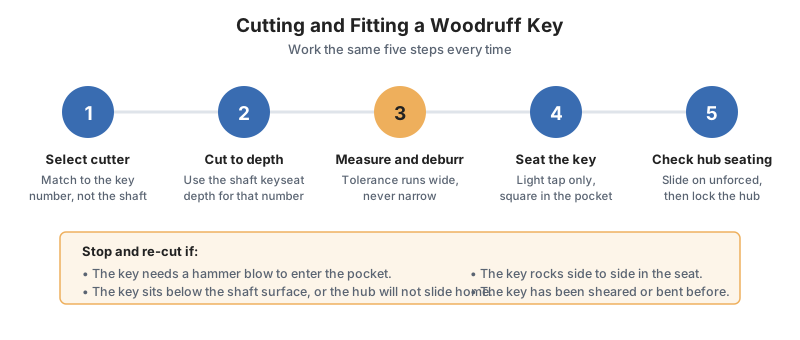
Match the cutter to the key number, not to the shaft. Each cutter produces one width and one radius.
- Confirm the cutter diameter against the key outside diameter.
- Check the cutter width against the shaft keyseat width in the table. - A worn cutter runs undersize and jams the key. - Replace it rather than opening the pocket by hand.
- Run the cutter slowly and clear chips often.
Depth and Fit Checks
Cut to the shaft keyseat depth for that key number, then measure before you go further. Depth is easier to add than to remove.
The key should sit in the pocket with a light tap, not a hammer blow.
Installation Sequence
Work in a fixed order every time:
- Deburr the shaft pocket and the hub slot.
- Seat the key square in the shaft pocket.
- Check that the exposed height clears the hub slot depth.
- Slide the hub on without forcing it.
- Lock the hub with its retaining screw or collar.
Never reuse a key that has been sheared or bent. A deformed woodruff key transmits load through one corner instead of a full face.
Browse the machine keys range for finished keys, or the key stock range if you cut your own. Shaft parts sit under rotary shafts and accessories.
Frequently Asked Questions About Woodruff Keys
What does the number on a woodruff key mean?
It encodes the size. Under ASME B17.2 the digits before the last two give the width in thirty-seconds of an inch, and the last two give the outside diameter in eighths of an inch.
Is a woodruff key stronger than a parallel key?
Generally no. A parallel key carries more torque on a given shaft, because the deep pocket of a woodruff key removes more shaft material. The trade is alignment for strength.
What is the difference between full-radius and flat-bottom types?
A full-radius key is a complete half circle that contacts the whole pocket. A flat-bottom key has its underside shaved flat so it seats fully where a full radius would interfere.
What material should I specify?
Carbon steel covers most general duty. Alloy steel suits higher torque, and stainless steel suits wet or washdown environments. Huyett lists all three as standard woodruff key materials.
Can I cut a keyseat with a normal end mill?
No, the pocket needs the matching radius that only a woodruff cutter on an arbor produces.
Why did my woodruff key shear?
That is often the design working. The key is meant to fail before the gear or pulley does, so check for overload or a seized driven component before fitting a replacement.
Conclusion: Specifying the Right Woodruff Key
Most woodruff key problems start at the order line, not at the bench. Someone reads 404 as a part code rather than as a dimension, and the wrong steel arrives.
Decode the number, cross-check the keyseat depth against the published table, and confirm whether the machine is imperial or metric before ordering. Those three checks remove almost every fitting failure.
Get that right and a woodruff key does exactly what it was designed to do. It holds under load, and lets go before anything expensive breaks.
Related Posts