Fluorescent Light Ballast Guide: Types, Faults and LED Retrofits
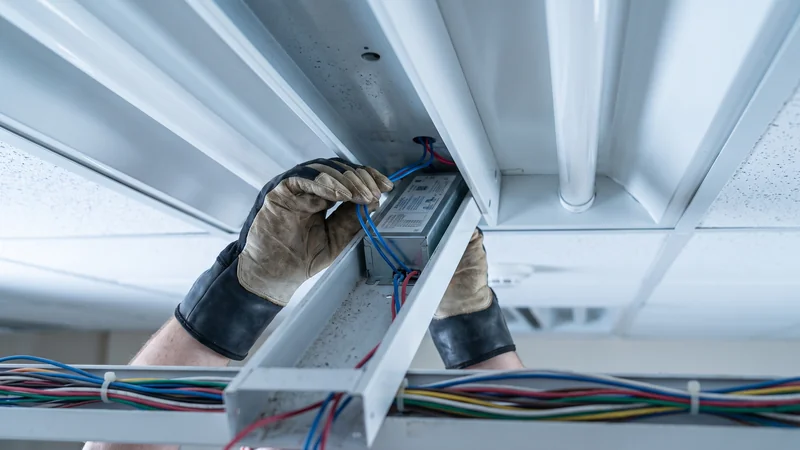
By Jamie Aguilar · 9 August 2026
A fluorescent tube cannot run straight off the mains. Left alone it would pull ever more current until it burned itself out in seconds.
The fluorescent light ballast is the part that stops that happening.
Most people think about it only once the light starts flickering. By then the decision is more than which replacement to buy.
Fluorescent lamps are being phased out of manufacture worldwide, so a ballast bought today is a bridge rather than a permanent fitting. This guide covers what a fluorescent light ballast does, how to read one, and when to retrofit instead. Every figure below traces to a regulator or a national laboratory.
What a Fluorescent Light Ballast Does
Current Limiting, Not Just Power
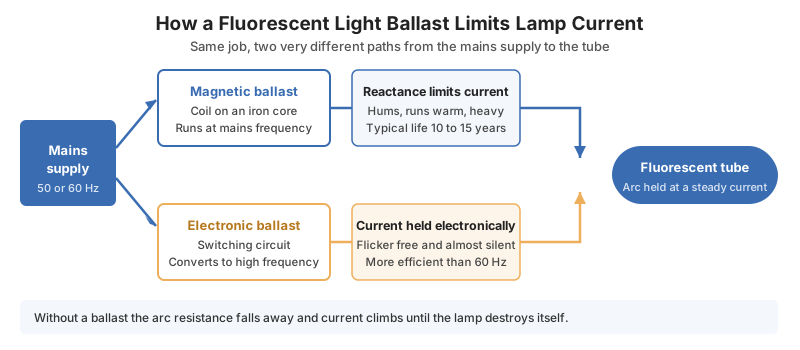
A fluorescent lamp behaves as a negative resistance device. Once the arc strikes its resistance falls, so current climbs without limit unless something holds it back.
Every fluorescent light ballast exists to hold that current at a fixed working value.
A magnetic unit does this with a coil on an iron core. An electronic unit uses a switching circuit at high frequency.
Striking the Arc
Before it can limit anything, the ballast must start the lamp. That takes a brief voltage well above the running voltage.
How that voltage is delivered separates the starting methods below. It also decides how many switching cycles the tube will survive.
Why LED Fixtures Use Drivers Instead
An LED array needs constant current at low voltage, not a mains-frequency arc. That job belongs to an LED driver, a part with its own failure pattern. You cannot swap a fluorescent light ballast for an LED driver.
Fluorescent Light Ballast Types and Starting Methods
Magnetic Ballasts
A magnetic fluorescent light ballast is the older design, built around a core and coil. They hum, run warm, and are heavy for their output.
The US Environmental Protection Agency puts the typical life of a magnetic unit at 10 to 15 years, depending on running hours, temperature and switching cycles. Anything older is on borrowed time. Age alone is a fair reason to plan the swap.
Electronic Ballasts
An electronic fluorescent light ballast converts the mains supply to a high frequency before it reaches the lamp. Lawrence Berkeley National Laboratory's lighting design guide notes that lamps run more efficiently at high frequency than at mains frequency.
They are also flicker free and almost silent, which is why they became the standard.
Instant Start, Rapid Start and Programmed Start
- Instant start: strikes the arc without preheating the cathodes. - Cheapest to buy, and about two watts per lamp cheaper to run. - Hardest on the tube where a light is switched often.
- Rapid start: heats the cathodes and keeps current flowing to them. - Gentler starts, paid for with that extra cathode power. - The only mode advised for very low ballast factor products.
- Programmed start: preheats to a set temperature before it strikes. - The right pick where occupancy sensors switch a light all day.
Berkeley's guide puts instant-start units at 5 to 10 percent cheaper than rapid start. Where lamps run longer than three hours per start, lamp life between the two evens out after about eight hours of continuous running.
Emergency and HID Ballasts
An emergency unit is a second fluorescent light ballast wired alongside the main one, with its own battery.
On a power cut it drives one lamp at low output for the period the building code demands.
HID ballasts are a separate family, built for metal halide and high pressure sodium lamps. Browse the fluorescent ballasts range to see how the families divide.
| Ballast type | Typical use | Strength | Watch out for |
|---|---|---|---|
| Magnetic | Old T12 fixtures | Rugged | Hum, weight, PCBs |
| Instant start | Offices, warehouses | Cheapest to run | Short tube life |
| Rapid start | Rooms switched often | Longer tube life | Higher input power |
| Programmed start | Sensor-lit rooms | Best cycle life | Highest price |
| Emergency | Escape routes | Keeps a lamp lit | Battery testing |
| HID | High bays | Runs HID lamps | Not for tubes |
Reading the Label on a Fluorescent Light Ballast
Lamp Type and Lamp Count
The label names the exact lamp the unit can drive and how many of them. Get either wrong and the pair will run poorly or fail early.
- Lamp code: F32T8 means a 32-watt tubular lamp, one inch across.
- Lamp count: match what the fluorescent light ballast is rated for.
- Tube diameter: the T number counts eighths of an inch.
Input Voltage and Frequency
Mains voltage differs by market, and a fluorescent light ballast is built for a stated range. Many commercial units accept a wide band; low-cost ones rarely do.
- Voltage band: check it against the actual supply, not the nameplate country.
- Supply frequency: a 60 Hz-only unit will not run right on a 50 Hz supply.
The Safety Marks That Matter
- The "P" mark: shows the unit carries thermal overload protection. - Required by the National Electrical Code in the United States. - Units without it have nothing to stop them overheating.
- "No PCBs": required on non-PCB units made between July 1979 and July 1998. - Units made after 1998 carry no such marking by rule.
- Date code: the fastest way to age a ballast in an old fixture.
EPA advises treating an unlabelled unit as a PCB unit unless it is known to post-date 1979. That reading is free to apply. It also keeps the disposal route simple.
Ballast Factor and Light Output
What Ballast Factor Measures
Ballast factor is the light a lamp-ballast pair produces, set against what that lamp gives on an ANSI reference ballast. Berkeley's guide is explicit that the figure belongs to the pair, not the ballast alone. One unit shows a different factor with each lamp it drives.
An ANSI ballast for standard 40-watt F40T12 lamps is required to reach 95 percent. Fit 34-watt energy-saving lamps on that unit and the figure falls to 87 percent.
Choosing a High or Low Factor
Low ballast factor products sit around 70 to 75 percent. They give less light and draw less power in proportion, so the factor is a design choice, not an efficiency rating.
- High factor: fewer fittings needed to hit a target light level.
- Low factor: sensible in corridors, aisles and store rooms.
- Under 70 percent: run rapid start only, or lamp life drops sharply.
| Lamp on the ballast | Ballast factor | What you notice |
|---|---|---|
| 40-watt F40T12 on an ANSI unit | 95 percent | Full rated output |
| 34-watt energy-saving F40T12 | 87 percent | Visibly less light |
| Low factor product | 70 to 75 percent | Deliberate light reduction |
Signs a Fluorescent Light Ballast Is Failing
What You See and Hear
- Flicker or a slow start: the classic first symptom.
- Loud hum or buzz: expected on old magnetic units, a warning on electronic ones.
- Dimming or a colour shift: often the ballast rather than a tired tube.
- Scorch marks or a hot smell: stop and isolate the circuit.
- Dark oily staining: treat it as a leaking capacitor.
Ruling Out the Cheap Causes First
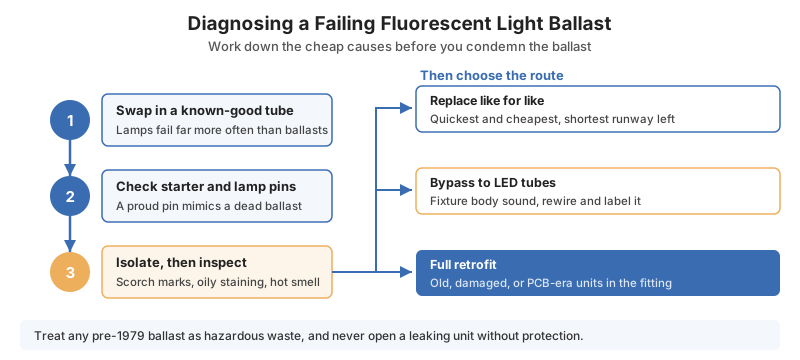
- Swap the tube: fit a known-good lamp before condemning the fluorescent light ballast.
- Check the starter: older fixtures still use one, and starters fail cheaply.
- Reseat the pins: a lamp proud of its holder mimics a dead ballast.
If that fresh tube lights normally in a second fixture, the fault is upstream.
Why Age Changes the Odds
EPA records a failure rate near 10 percent across the working life of the small capacitors in these units.
That risk climbs steeply once a fluorescent light ballast is past its expected life.
Replace, Bypass or Retrofit to LED
Like-for-Like Replacement
Replacing a fluorescent light ballast with the same type is the quickest fix, and today still the cheapest.
It is also the option with the shortest runway left.
Ballast Bypass
A bypass rewires the fixture so LED tubes run straight from the mains. The ballast comes out, the wiring changes, and the fitting must be labelled for whoever opens it next.
Where the fixture body is sound, this is usually better value than a new fluorescent light ballast. Pair it with the right LED drivers if the retrofit uses an array rather than tubes.
The Phase-Out Clock
Under the Minamata Convention on Mercury, parties agreed dates after which most fluorescent lamps may no longer be manufactured, imported or exported. Most compact lamps with an integrated ballast ended in 2025, halophosphate linear tubes in 2026, and triband linear tubes in 2027.
The fluorescent light ballast will outlive the lamps it was bought to run.
- Keep the system: only where tubes are already stockpiled.
- Bypass now: where the fixture body and reflector are still sound.
- Full retrofit: where fittings are old, damaged or hold PCB-era units.
A complete retrofit lifts lighting efficiency by 30 to 50 percent according to EPA, citing ENERGY STAR figures. The same guidance puts payback at under seven years in most buildings.
Frequently Asked Questions About Fluorescent Light Ballasts
How long should a fluorescent light ballast last?
EPA puts magnetic units at 10 to 15 years. Electronic units in cool, lightly switched fixtures often beat that, while hot enclosed ones fall short.
Can I fit an LED tube without changing the ballast?
Only with a tube sold as ballast compatible, and only on the ballast types its maker lists. Anything else needs a proper bypass.
Is a humming fluorescent light ballast dangerous?
A faint hum from an old magnetic unit is normal. A new or rising buzz, especially with heat or a burnt smell, means isolate the circuit now.
What does ballast factor change in practice?
It sets how much light a fluorescent light ballast gets out of the same tube, and how much power the fitting draws.
How do I dispose of an old fluorescent light ballast?
Treat any pre-1979 fluorescent light ballast as hazardous waste and route it through a licensed handler. In the United States a leak must be cleaned up within 24 hours.
Conclusion
A fluorescent light ballast is now a bridging component, not a long-term one. The question is not which unit lasts longest, but how long the fluorescent system must survive.
If the fixtures are sound and tubes are still stocked, a like-for-like electronic unit remains the cheapest move. If either is untrue, spend the money once and retrofit properly.
Read the label on the fluorescent light ballast before touching any wiring. Compare the emergency ballasts for fluorescent or LED retrofit lamps against your escape-route duty before you commit.
Related Posts
Caster Wheels: How to Specify Load, Material and Brakes

Anti-Seize Guide: Types, Torque Effects and Where Not to Use It