Bubble Wrap Guide: How to Choose the Right Type for Every Shipment
By Nikhil Singh · 23 July 2026
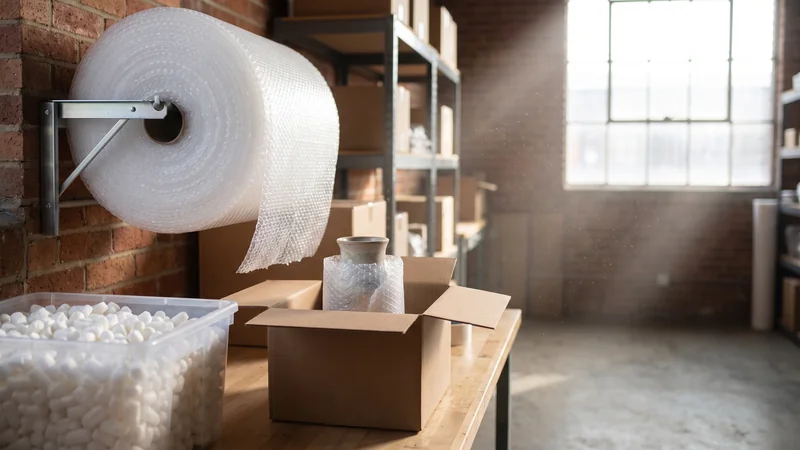
Most packing benches stock exactly one roll of bubble wrap. Everything gets the same treatment, and the damage claims keep arriving anyway.
Bubble height, film grade, and roll width all change how much protection a shipment gets. Picking them on purpose costs nothing extra.
This guide covers bubble sizes, specialty grades, roll specs, packing technique, and disposal.
What Bubble Wrap Actually Does
Bubble wrap is a cushion, not a shield. It absorbs shock by letting trapped air compress, then spreads the remaining force across a wider area.
What actually damages goods in transit:
- Drop impact on a corner or edge.
- Compression from stacked freight above.
- Movement inside a carton that is too large.
The Three-Layer Construction
Bubble wrap is built from three layers of film. Two outer low-density polyethylene layers protect an inner bubble layer, and heat rolling fuses them while forming and sealing the air pockets.
That sealed air is the working part. Once a bubble bursts, the film underneath does almost nothing.
Cushioning Versus Void Fill
These are different jobs, and they call for different bubble wrap.
The four protection roles bubble wrap plays:
- Cushioning wraps the product to absorb impact energy. - Best served by 3/16 inch bubbles and larger.
- Void fill occupies empty space so the product cannot shift. - Best served by 5/16 inch and 1/2 inch bubbles.
- Surface protection stops scuffing between stacked items. - Best served by 1/8 inch bubble or foam sheet.
Bubble Wrap Sizes: Match Bubble Height to the Item
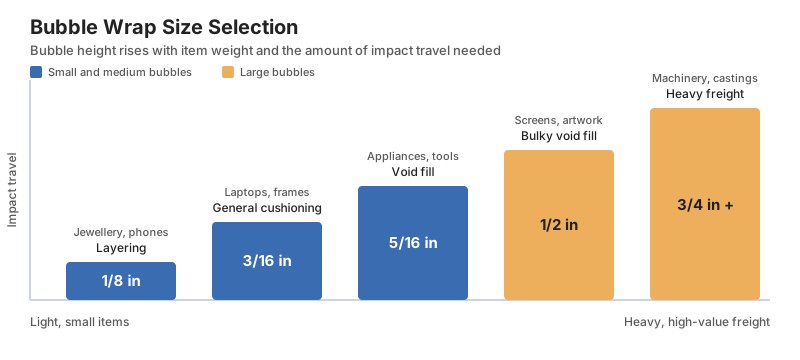
Bubble height is the most useful spec on the box. It measures the depth of an inflated bubble. It scales directly with how much drop energy the material can absorb.
How to read a bubble height quickly:
- Smaller bubbles mean more contact points and finer surface protection.
- Larger bubbles mean more trapped air and more impact travel.
- Heavier items compress small bubbles flat, which ends their usefulness.
1/8 Inch: Layering and Surface Protection
The smallest common bubble wrap. It suits jewellery, cosmetics, and smartphones, where the risk is scratching rather than impact.
3/16 Inch: The General-Purpose Workhorse
Small bubbles that cushion lightweight to medium-weight goods. Laptops, picture frames, and trophies all sit comfortably in this grade.
If a facility stocks only one roll, stock this one.
5/16 Inch and 1/2 Inch: Void Fill and Bulkier Goods
Medium bubbles that fill the gap between product and carton wall. They also cushion light-to-medium items with awkward shapes, such as flat screens and framed artwork. Larger bubbles crush more slowly under a given load.
3/4 Inch and Above: Heavy or High-Value Freight
Sealed Air, which created the BUBBLE WRAP brand, offers inflatable cushioning in large and extra-large bubble grades for this tier. Reserve it for equipment, castings, and anything where one failure is expensive.
| Bubble height | Best used for | Typical items |
|---|---|---|
| 1/8 inch | Layering, surface protection | Jewellery, cosmetics, phones |
| 3/16 inch | General cushioning | Laptops, frames, trophies |
| 5/16 inch | Void fill, medium goods | Small appliances, tools |
| 1/2 inch | Void fill, bulky goods | Flat screens, artwork |
| 3/4 inch and up | Heavy or high-value freight | Machinery, castings |
Specialty Bubble Wrap Types Worth Stocking
Several specialty grades solve problems plain rolls cannot.
Specialty grades that earn their shelf space:
- Anti-static (pink) film for electronics and spares. - Required on any ESD-sensitive packing line.
- Barrier bubble with a nylon layer that holds air longer. - Worth the premium on ocean freight.
- Self-adhering (cling) bubble that grips itself without tape.
- Perforated rolls pre-scored so packers tear rather than cut.
- Bubble bags and pouches sized to a specific product.
- On-demand inflatable film that ships flat and inflates at the bench.
Anti-Static Bubble Wrap
Pink anti-static bubble wrap stops the packaging itself from building up a static charge as it rubs a part. It is antistatic and static-dissipative.
What it does not do is shield. Pink film has no real shielding ability, while a metal-coated bag of the type the ESD Association's packaging standard points to stops about 97 per cent of a 1,000-volt pulse from reaching the contents.
Treat anti-static bubble as the cushioning layer inside a shielding bag, never as a replacement for one.
Barrier and High-Retention Bubble
Standard polyethylene slowly leaks air. A barrier layer keeps bubbles full through long transit legs and under steady pressure in a stack. Ask for it on ocean freight and on goods that sit on pallets for weeks.
Bubble Bags and Bubble Mailers
A pre-made bag beats cut sheets when a product ships in volume at a fixed size. Bubble mailers combine the cushion and the outer envelope in one piece.
How to Spec Bubble Wrap for Your Operation
Bubble height is only the first decision. Several other specs decide whether the material works at the bench.
Specs to confirm before you order:
- Roll width should match your most common product dimension. - Measure your top five shipping profiles first.
- Perforation interval should match your standard sheet length. - Mismatched perforations create offcuts nobody uses.
- Anti-static rating is a must on ESD-sensitive lines.
- Recycled content may be set by a customer packaging policy.
Planning Roll Storage
Pre-inflated bubble wrap is mostly air, so it eats storage space out of proportion to its cost. Sealed Air states that flat-pack inflatable formats cut storage space by up to fifty times against pre-inflated stock. For a small warehouse, that ratio matters more than unit price.
| Format | Storage footprint | Best fit |
|---|---|---|
| Pre-inflated roll | Large | Low volume, no equipment |
| Perforated roll | Large | Mixed product sizes |
| On-demand inflatable | Very small | High volume benches |
Packing Rules That Make Bubble Wrap Work
Good material still fails when it is applied badly.
The bench rules that prevent most damage claims:
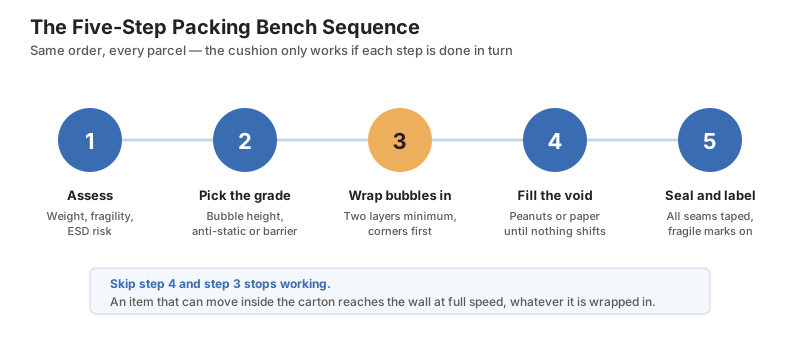
- Turn the bubbles toward the product, flat film facing out.
- Wrap tightly so the item cannot move inside the carton.
- Use at least two layers on anything fragile.
- Give corners and edges an extra pass before flat faces.
- Fill the remaining void with peanuts or paper.
Why Bubbles Face In
The air pockets sit against the item and the flat film faces outward. That is the orientation the cushion was designed for.
Wrap Tight, Then Fill the Void
Movement inside the box turns a small drop into a damage claim.
Wrapping tight removes the movement, and void fill removes what is left.
Order rolls by grade rather than by habit, and keep the bubble roll range split across at least two bubble heights.
Cost, Storage, and Disposal
Recycling and Store Drop-Off
Bubble wrap is polyethylene film, and How2Recycle notes that plastic bags, wraps, and films are not taken by most curbside programs in the United States. They go to store drop-off bins at taking-part retailers instead.
Film must be clean and dry to be accepted. Loose or wet film wraps around sorting gear, which is why most curbside streams reject it.
Disposal points worth briefing the team on:
- Bubble wrap and shipping air pillows are both accepted in film drop-off streams.
- Qualifying films are polyethylene grades, numbers two and four.
- In Canada, the same film is widely accepted in curbside collection.
- Dirty or wet film belongs in general waste.
Recycled-Content Options
Several inflatable bubble lines now carry recycled content, with figures up to ninety-five per cent claimed. Ask for that figure in writing when a customer policy calls for it.
Frequently Asked Questions
What size bubble wrap is best for general shipping?
For most operations, 3/16 inch bubble wrap handles the widest range of goods. It cushions lightweight to medium-weight products such as laptops and picture frames without wasting volume.
Is anti-static bubble wrap enough for electronics?
No, because pink anti-static bubble wrap stops static build-up but gives no real shielding. ESD-sensitive parts still need a metal-coated shielding bag around them.
Can bubble wrap be recycled?
Yes, but usually not at the curb. Clean, dry bubble wrap goes to store drop-off film bins in the United States, and into curbside collection in Canada.
How many layers of bubble wrap should I use?
Two layers is a reasonable minimum for fragile goods. Wrap tightly enough that the item cannot move, then fill the remaining void with peanuts or paper.
Conclusion
Bubble wrap is cheap enough that most buyers never think about it. That is exactly why it is one of the easiest places to cut damage without adding cost.
Start with these four moves:
- Stock two bubble heights instead of one.
- Match roll width to your top shipping profiles.
- Add anti-static or barrier grades only where risk justifies them.
- Brief the bench on orientation, tightness, and void fill.
Match the material to the load, and the claims rate follows.
Related Posts