Treadmills: How to Choose the Right One for Every Space
By Elana Hilaly · 27 July 2026
Most treadmill shopping starts with the console and ends in regret. The screen is the part you look at, and it is the part that matters least. Nobody replaces a machine because the screen aged.
What decides whether a treadmill lasts is duller than any feature list. It is the class the machine was built to, the deck under your feet, and the floor around it.
Those three things also decide whether it is safe.
This guide covers the class ratings, the drive types, how to size a deck and a room, and how the safety rules shape where a treadmill can go.
Start With the Class, Not the Console
Two letters do most of the work
Stationary training equipment is graded by where it is meant to be used. A treadmill carries one of those grades, and it tells you what the frame was designed to survive.
- Class S is studio grade, meant for professional or commercial use.
- Class H is home grade, meant for domestic use.
Why the letter beats the marketing
A machine sold for a hotel gym or a staff wellness room has to hold up to strangers using it all day. A home machine does not. The two frames are built to different duty.
Buy class H for a shared facility and it wears out early. That is the single most expensive mistake in this category.
The accuracy grade sits alongside it
There is a second scale for how truthful the readout is. Accuracy classes run A, B and C, from high precision down to low. The letter tells you how far the numbers may drift.
- Class A is the tightest, so speed and distance readings track closely.
- Class C is the loosest, and the numbers on screen drift further from reality. - This matters for coaching and testing. - It matters much less for a walk before work.
Which standard applies
Treadmills are covered by their own part of the series, alongside the general safety rules. ISO 20957-6 sets additional safety requirements and test methods for treadmills, and it is read together with ISO 20957-1.
| Grade | Meaning | Best fit |
|---|---|---|
| Class S | Studio: professional or commercial use | Gyms, hotels, clinics, staff facilities |
| Class H | Home: domestic use | Single household, light daily use |
| Accuracy A | High precision readout | Coaching, testing, rehab |
| Accuracy B | Medium precision readout | General fitness programmes |
| Accuracy C | Low precision readout | Casual walking and warm-ups |
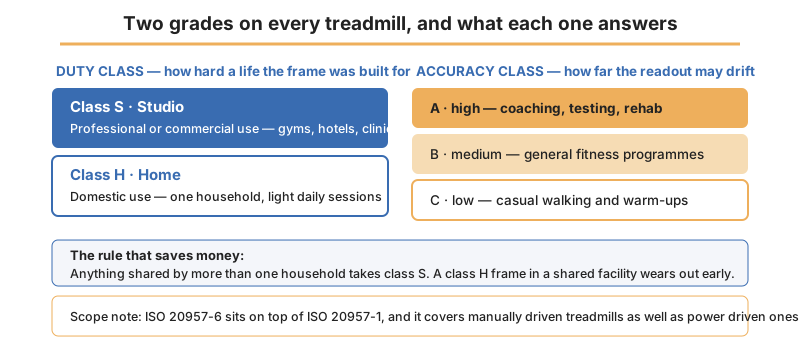
The scope is wider than most buyers expect. The treadmill standard covers manually driven machines as well as power driven ones.
Treadmill Types by Drive and Deck
Motorised treadmills
The belt is driven by a motor and you set the pace. This is what most people picture, and it suits steady programmes where you want to hold a speed. Most gym floors are filled with them.
- Pace: predictable, so intervals are easy to set.
- Incline: powered on most machines. - The motor is the part that fails first under heavy use.
Manual and curved treadmills
There is no motor at all. Your own stride moves the belt, and on a curved deck the shape of the running surface sets the resistance. Speed comes from you, not from a dial.
- Siting: nothing to plug in, so placement is far easier.
- Control: the user sets the speed directly, with no lag. - Harder work at the same apparent pace. - Well suited to sprint and conditioning work.
Folding treadmills
The deck lifts toward the upright and locks, which helps in a small room as long as you are honest about how often you will really fold it.
Walking pads and under-desk units
A flat treadmill with no upright frame, built for walking rather than running. These have grown fast as office equipment, and they are the entry point for many first-time buyers. The trade-off is a much shorter deck.
- Profile: low, so the unit slides under a desk or a bed.
- Limits: slower top speed and a shorter deck than a full machine.
Sizing the Deck and the Frame
Match the deck to the stride
Walking needs less deck than running, running needs less than sprinting, so buy for the fastest thing anyone will actually do on the machine.
A deck that is too short forces a shortened stride. That is how a treadmill turns into a source of injury rather than fitness.
Weigh the users, not the buyer
Every machine carries a maximum user weight, so check it against the heaviest likely user rather than the person signing off the purchase.
Incline and its cost
Powered incline widens what a treadmill can do without raising the speed. It also adds a second motor, a second control system and a second thing to service.
- Upside: hill work, and intensity without the impact.
- Cost: adds height, weight and price to the frame.
The Floor Space a Treadmill Really Needs
This is the part that gets skipped, and it is the part safety turns on.
Clearance behind is not optional
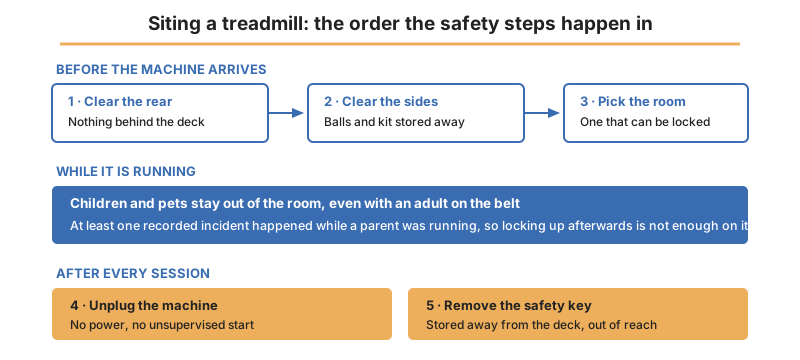
A treadmill needs clear floor behind it, because that is the direction anything gets carried. The rear roller is where the recorded harm happens. Nothing at all should sit in that zone.
CPSC has been blunt on the hazard. Adult users, children, pets and objects can be pulled underneath the rear of a treadmill, posing a risk of injury or death.
Keep the surrounding floor clear
The same guidance says to keep all objects away from the machine, including exercise balls and other equipment. Anything on the floor near the belt is a candidate to be dragged under it.
What the numbers looked like
One recall in May 2021 covered about 125,000 machines. A 6-year-old child died after being pulled under the rear of a treadmill.
That recall also logged 72 reports of adults, children, pets or objects being pulled underneath. Among them were 29 reports of injuries to children, including second- and third-degree abrasions, broken bones and lacerations.
| Risk | What CPSC advises | Applies when |
|---|---|---|
| Children or pets reaching the belt | Use the machine only in a locked room | While the treadmill is in use |
| Objects dragged under the roller | Keep all objects, including exercise balls, away | While in use |
| Unsupervised start-up | Unplug the machine after every session | When not in use |
| Key left in the console | Store the safety key away from the device, out of reach of children | When not in use |
The trap in that advice
Locking the room when the machine is idle is not enough on its own. CPSC noted that at least one incident happened while a parent was running, which means the hazard is live during use, not only after it.
Safety Features Worth Paying For
The safety key
A clip and a tether cut the power when the user leaves the belt, which makes this the oldest feature on the machine and still the most valuable one.
Side rails and handrails
Rails give you somewhere to go when balance fails, and longer rails suit older users and anyone coming back from injury.
Guarding at the rear
Look at how the deck meets the floor at the back. A treadmill with a tight, well guarded rear roller gives less room for anything to be drawn in.
Matching a Treadmill to Real Weekly Use
Start from the target, not the machine
The World Health Organization puts the adult baseline at least 150 minutes of moderate-intensity activity through the week. The alternative is at least 75 minutes of vigorous activity, or an equivalent mix of the two. Both routes count the same.
For more benefit, that moderate figure rises to 300 minutes a week. A treadmill only has to cover the share of it you will do indoors.
Turn minutes into a duty cycle
- Three short walks a week is a class H workload.
- Several users, every day, is a class S workload. - Shared facilities should assume the higher figure. - So should any machine in a staff gym or a rented flat.
Frequently Asked Questions About Treadmills
What is the difference between a class S and a class H treadmill?
Class S is studio grade, built for professional or commercial use, and class H is home grade for domestic use. The grade describes the duty the frame was designed for, not the feature list.
Does a manual treadmill count under the same standard?
Yes. The treadmill standard covers manually driven machines as well as power driven ones.
How much space does a treadmill need behind it?
Enough clear floor that nothing and nobody can be caught at the rear roller. CPSC frames this as keeping children, pets and objects away from the machine rather than as a fixed measurement.
Is a walking pad a real treadmill?
It is a treadmill with a shorter deck and a lower top speed. That suits walking and desk work, and it rules out running for most users.
How many minutes a week should the treadmill cover?
Use the WHO baseline of 150 minutes of moderate activity, or 75 minutes of vigorous activity, as the weekly target. Then decide how much of that will happen indoors.
Conclusion: Buy the Class, the Deck and the Clearance
Pick the class first. Class S for anything shared, class H for a single household, and let that decision come before any comparison of screens.
Then size the deck for the fastest user rather than the average one. A short deck shortens the stride, and a shortened stride is how a treadmill causes injuries instead of preventing them.
Finally, measure the room before you buy the machine. The floor behind a treadmill is a safety feature, and it is the only one that cannot be retrofitted later.
Related categories on EYBY:
- Browse treadmills for motorised, manual and folding machines.
- Compare exercise bikes where floor space is tight.
- Review exercise mats and wall padding to protect the surrounding area.
Related Posts