Hose Clamp Guide: How to Choose the Right Type for Every Job
By Miguel Duarte · 23 July 2026
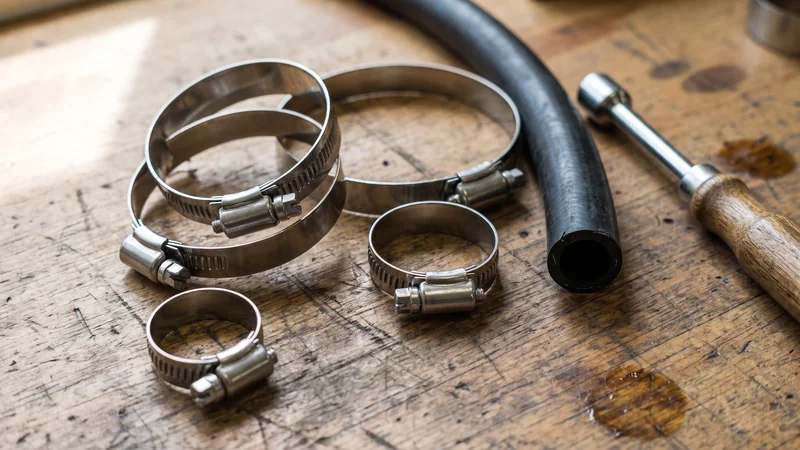
A hose clamp is the cheapest part in the assembly and the most common reason it leaks. Most failures trace back to the wrong type, the wrong size band, or a screw driven far past its rating.
None of those mistakes cost more to avoid than to make. This guide covers clamp types, SAE sizing, material grades, torque limits, and which clamp belongs on which joint.
What a Hose Clamp Has to Do
A hose clamp squeezes a flexible hose onto a rigid barb or fitting hard enough to seal it, without cutting the hose. That balance is the entire requirement.
The three things a joint asks of the clamp:
- Enough radial force to seal against internal pressure.
- Even pressure around the circumference, not just under the screw.
- Retained force after the hose relaxes, heats, or deteriorates with age.
In practice, most leaks are a failure of that third requirement.
Why Hoses Loosen Over Time
Rubber and polymer hoses cold-flow. Under sustained clamping pressure the wall thins slightly, the outside diameter shrinks, and the clamping force drops away with it.
Heat cycling accelerates the loss. A joint that sealed on the bench can weep after a week in service, and nothing about the clamp looks wrong when it does.
Hose Clamp Types and Where Each One Belongs
Hose clamp types are classified under SAE J1508, which also sets the SAE size designations you see stamped on the housing.
The main hose clamp families:
- Worm drive (SAE Type F) — the general-purpose default. - The most widely used hose clamp, with a 1/2 inch band.
- Miniature worm drive (SAE Type M) — small-diameter lines and confined spaces. - Narrower 5/16 inch band with a 1/4 inch hex head screw.
- Full-size worm drive — heavier duty, wider bearing surface. - A 9/16 inch band spreads load across more hose wall.
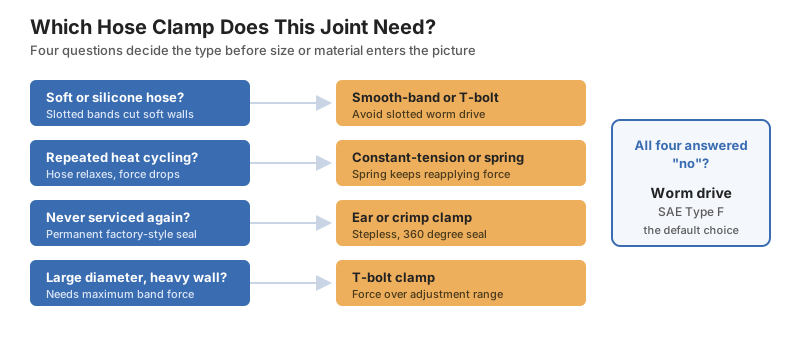
- Constant-tension — spring-loaded, maintaining force through temperature cycles.
- T-bolt — maximum clamping force on large diameters and heavy-wall hose.
- Ear or crimp clamps — permanent, uniform, factory-style seal.
- Spring band clamps — self-adjusting, typical on coolant circuits.
Worm-Drive Clamps
The standard worm-drive clamp is the most commonly used hose clamp, built around a slotted band and a screw that pulls the band through a housing.
It carries one notable limitation, because worm-drive hose clamps are not recommended for soft or silicone hoses and tubes, where the slotted band progressively bites into the softer wall material, although extended-band versions exist to protect soft hose compounds.
Type F clamps are made to the ANSI/SAE J1670 standard, which covers Type F clamps for plumbing applications. Browse the worm-gear clamp range when you need a general-purpose fit.
Constant-Tension and Spring Clamps
These carry a spring element that keeps pushing the band inward as the hose relaxes. They are the answer to the cold-flow problem described above. The spring does the work the installer cannot repeat later.
Specify them wherever the joint experiences repeated heating and cooling. Spring-tension clamps hold their grip long after a plain worm drive has gone slack.
Ear and Crimp Clamps
Ear clamps are permanently closed with a dedicated pincer and never reopened. Oetiker, which developed the stepless design, describes it as giving uniform compression and a 360 degree seal.
The closed ear also works as a spring. Oetiker notes that the low ear geometry raises clamping force and creates a spring effect as the hose expands or contracts under temperature and vibration.
Use ear clamps where the joint will not be serviced and the seal has to be permanent.
T-Bolt Clamps
A T-bolt hose clamp trades adjustment range for clamping force. Large-diameter charge-air and heavy industrial hose usually gets one.
Sizing: Reading SAE Numbers and Band Widths
The SAE number is not the hose diameter. It is a size designation for the maximum inner diameter the clamp will close to, defined under SAE J1508 for worm-drive clamps. Constant-tension and high-torque styles sit outside that numbering entirely.
| Clamp style | Band width | SAE size range | Diameter covered |
|---|---|---|---|
| Miniature worm drive (Type M) | 5/16 inch | 4 to 10 | 1/4 inch to 1-1/16 inch |
| Standard worm drive (Type F) | 1/2 inch | 6 to 104 | 3/8 inch to 7 inch |
Land in the Middle of the Range
Every hose clamp has a working range, not a single size. A hose clamp used at the very end of its range has few threads engaged and little band left in the housing. Select the size that positions your hose near the middle of that range.
Band Width Is a Real Spec
A wider band spreads the same force across more hose wall, which lowers the risk of cutting into it. The full-size 9/16 inch band exists for exactly that reason. Narrow bands belong on small lines, not on large soft hose.
Sizing mistakes worth designing out:
- Using a hose clamp at the extreme end of its adjustment range.
- Fitting a narrow band to a thick, soft hose wall.
Material Grades and Corrosion
The band, the housing, and the screw are often three different materials, and the weakest one sets the service life.
Common hose clamp constructions, least to most corrosion resistant:
- 201 or 301 stainless band and housing with a zinc-plated screw.
- 201 or 301 stainless band and housing with a 410 stainless screw.
- All 300-grade stainless throughout, sold as marine grade.
- All 316-grade stainless throughout, for superior corrosion resistance.
Why the Screw Fails First
A plated screw in a salt or washdown environment corrodes considerably earlier than the stainless band around it. The hose clamp then cannot be adjusted or removed without cutting it off.
Torque: The Spec Most People Skip
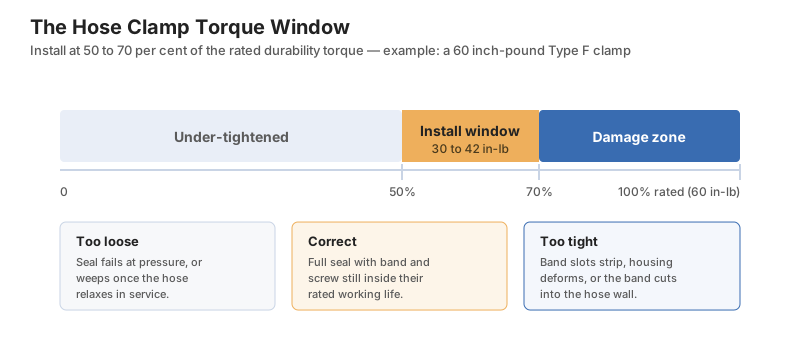
Hose clamp makers publish a durability torque for each construction, and the installation figure is deliberately lower.
| Type F construction | Durability torque | Install at 50 to 70 per cent |
|---|---|---|
| 201 or 301 band, zinc-plated screw | 50 inch-pounds | 25 to 35 inch-pounds |
| 201 or 301 band, 410 stainless screw | 60 inch-pounds | 30 to 42 inch-pounds |
| All 300-grade, marine | 60 inch-pounds | 30 to 42 inch-pounds |
| All 316-grade | 60 inch-pounds | 30 to 42 inch-pounds |
Install at 50 to 70 per cent of the rated durability torque, never at the rating itself. Miniature Type M clamps are rated considerably lower, at 16 to 20 inch-pounds.
What Over-Tightening Does
Driving past the rating strips the band slots, deforms the housing, or cuts into the hose wall. A cut hose does not leak immediately, which is why the failure often surfaces several weeks later. Use a calibrated torque driver on any application that matters.
Signs a hose clamp was over-tightened:
- Band slots deformed or stripped at the housing.
- A visible ridge cut into the hose outer wall.
Fitting and Inspection Habits
Even a correctly specified hose clamp will leak if the installation is careless.
A repeatable fitting sequence:
- Cut the hose square and clean the barb before assembly.
- Sit the band behind the barb ridge, never over the ridge itself.
- Torque to spec, then re-check after the first heat cycle.
What to Look for at Inspection
Replace the hose clamp when you find:
- Corrosion bleeding from the screw or housing.
- Any weeping or discolouration at the joint.
Frequently Asked Questions
What does the SAE number on a hose clamp mean?
It is a size designation under SAE J1508 for the maximum inner diameter a worm-drive clamp closes to. It is not the hose diameter, and constant-tension styles are numbered differently.
Can I use a worm-drive clamp on silicone hose?
It is not recommended. The slotted band digs into soft silicone walls, so a smooth-band, T-bolt, or constant-tension clamp is the better choice.
How tight should a hose clamp be?
Install at 50 to 70 per cent of the clamp's rated durability torque. For a 60 inch-pound Type F clamp that lands around 30 to 42 inch-pounds.
Which hose clamp is best for coolant lines?
A constant-tension or spring clamp, because it keeps applying force as the hose heats, cools, and relaxes over time.
Conclusion
Clamp selection comes down to four questions: how soft the hose is, whether the joint heat-cycles, whether it will ever be serviced, and how much force the diameter needs.
Get these four right and the joint holds:
- Match the clamp type to the hose material and duty cycle.
- Size so the hose sits mid-range, not at the limit.
- Specify the stainless grade the operating environment demands.
- Torque to specification instead of to operator feel.
A hose clamp is an inexpensive component. Treating it as an engineered one is what eliminates the callback.
Related Posts

What Bathroom Partitions Have to Survive
Pipe Fittings Explained: Types, Materials and How to Choose
Box Stapler Guide: Types, Staple Sizes and How to Choose One