AC Motor Types Explained: How to Choose the Right AC Motor
By Evy Du · 11 August 2026
Almost every pump, fan and conveyor on a plant floor turns because an AC motor is turning it. The International Energy Agency puts electric motor driven systems at 53 percent of global electricity use.
That single figure explains why regulators around the world now police what an AC motor is allowed to waste.
Buyers still get the choice wrong. They match horsepower, ignore the design letter, and discover on install day that the frame does not fit the base.
What an AC Motor Actually Is
The Rotating Field
An AC motor turns alternating current into a magnetic field that rotates inside the stator. The rotor chases that field, and the chase makes torque.
Induction and Synchronous Families
NEMA MG 1 sorts polyphase AC motors into three electrical types. Each behaves differently once load is applied.
- Squirrel-cage induction: rotor bars are shorted by end rings, with no brushes or slip rings.
- Wound-rotor induction: rotor windings are brought out to external resistance for start control.
- Synchronous: the rotor locks to the rotating field and holds speed regardless of load. - Field poles may be excited by direct current. - Permanent-magnet and reluctance variants exist.
Why the Squirrel Cage Won
The squirrel-cage AC motor has no contacting parts in the rotor circuit at all. That removes the brushes, the commutator and most of the maintenance.
- Gives you: rugged construction and a long service interval.
- Costs you: a fixed speed unless a drive is added.
- Watch for: a heavy inrush current at the moment of starting.
Single-Phase and Three-Phase AC Motors
Where Single-Phase Makes Sense
A single-phase supply cannot produce a rotating field on its own. Every single-phase AC motor therefore needs a starting trick built into the winding. The trick is what separates one single-phase type from another.
- Shaded pole: an auxiliary shorted winding is displaced from the main winding.
- Split-phase: a second winding with different impedance creates the phase shift.
- Capacitor-start: a capacitor gives a much stronger starting torque.
- Permanent split capacitor: the capacitor stays in circuit while running.
Why Three-Phase Wins on Larger Loads
Three-phase power creates the rotating field without help. A three-phase AC motor is smaller, quieter and markedly more efficient than a single-phase machine of the same rating. Nothing has to be switched in or out to get it turning.
NEMA and IEC both put a typical three-phase induction AC motor at Premium Efficiency. Shaded-pole, split-phase and capacitor-start units all sit on the bottom Standard step.
- Efficiency: three-phase reaches IE3, single-phase types are IE1.
- Size: less iron and copper for the same shaft power.
- Starting: no capacitors, switches or start windings to fail.
Speed, Slip and the NEMA Design Letters
Synchronous Speed Is Set by the Supply
You do not choose the speed of an AC motor directly. You choose the pole count, and the supply frequency does the rest.
Synchronous speed equals 120 multiplied by the supply frequency, divided by the number of poles.
| Poles | Synchronous speed at 60 Hz | Synchronous speed at 50 Hz |
|---|---|---|
| 2 | 3,600 rpm | 3,000 rpm |
| 4 | 1,800 rpm | 1,500 rpm |
| 6 | 1,200 rpm | 1,000 rpm |
| 8 | 900 rpm | 750 rpm |
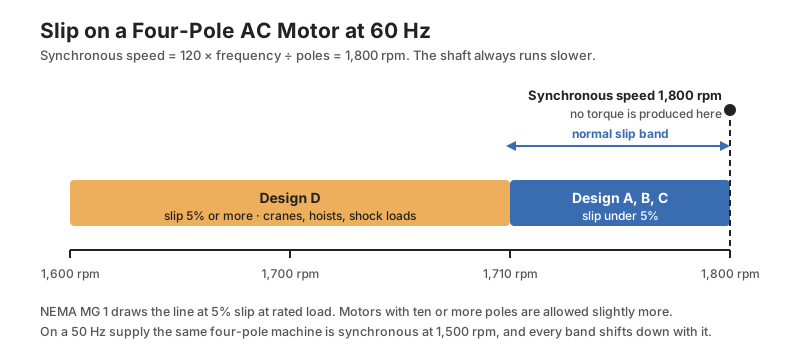
That table is why a 60 Hz nameplate cannot simply be dropped onto a 50 Hz supply. The same AC motor runs about a sixth slower, and the driven load feels it immediately.
Slip Is the Working Difference
An induction AC motor never quite reaches synchronous speed. The gap between the two is slip, and slip is what allows torque to be produced at all. Without slip there is no relative motion, and without relative motion there is no rotor current.
NEMA MG 1 uses slip to draw the line between design families.
- Under 5 percent: normal slip, covering Design A, B and C machines.
- 5 percent or more: high slip, which defines Design D.
- Ten poles or more: MG 1 permits slip slightly above 5 percent.
Design A, B, C and D
The design letter tells you the shape of the torque curve.
- Design A: normal locked-rotor torque with a higher starting current draw.
- Design B: the general purpose default, used for fans, blowers and centrifugal pumps.
- Design C: high locked-rotor torque for conveyors and positive-displacement pumps.
- Design D: high locked-rotor torque with high slip, used on cranes, hoists and shock loads. - Slip in service typically runs from about 5 to 13 percent. - The soft curve lets the machine absorb shock loads.
Efficiency Classes and Minimum Standards
The IE Ladder
IEC 60034-30-1 sorts line-fed AC motors into four International Efficiency classes. IEC TS 60034-30-2 covers motors that only run on an inverter, and it reaches IE5.
| Class | Name | Typical motor type |
|---|---|---|
| IE1 | Standard Efficiency | Shaded pole, split-phase, capacitor-start |
| IE2 | High Efficiency | Older three-phase stock |
| IE3 | Premium Efficiency | Three-phase induction, equal to NEMA Premium |
| IE4 | Super Premium Efficiency | Synchronous reluctance, electronically commutated |
| IE5 | Ultra-Premium Efficiency | Inverter-only machines under IEC TS 60034-30-2 |
Efficiency is measured, not claimed. IEC 60034-2-1 is the international test standard, while the United States accepts IEEE 112B and Canada's CSA 390.
What the Law Requires
Minimum energy performance standards now decide which AC motor may legally be sold in a given market. The dates below come straight from the regulators.
- European Union: regulation 2019/1781 covers motors from 120 watts to 1000 kW.
- EU IE3 date: since 1 July 2021, motors from 750 watts to 1000 kW must reach IE3.
- EU IE4 date: since 1 July 2023, motors between 75 kW and 200 kW must reach IE4.
- United States: the first country to set motor standards, at the IE2 equivalent in 1997 and the IE3 equivalent in 2007. - A 2015 widening pulled small polyphase motors up to IE3. - Single-phase machines were brought in at IE2.
- Australia and New Zealand: IE2 from 750 watts to 185 kW, in force since 2001.
- India: a comparative efficiency label since 2009 and a voluntary IE2 standard since 2012.
By 2020 the countries responsible for 76 percent of motor-system electricity use had set standards at IE2 or IE3.
Frames, Mounts and Enclosures
Reading a NEMA Frame Number
A NEMA T-frame number encodes the mounting size. Take the first two digits and divide by four, and you have the shaft centre height in inches. That one rule decodes most of the catalogue.
- Two-digit frames: small machines such as 48 and 56.
- Three-digit T frames: 143T upwards, so frame 256T sits at 6.25 inches.
IEC Metric Frames
The IEC system uses millimetres and quotes the shaft height directly. An IEC 80 frame has an 80 mm shaft height.
The two systems are not interchangeable. Bolt patterns and flange dimensions differ, so a swap needs an adapter.
- Check first: shaft height, shaft diameter and keyway.
- Check second: bolt circle and mounting hole spacing.
- Check third: overall length and conduit box position.
Enclosure and Environment
The enclosure decides where an AC motor can live.
- Clean and dry: an open, ventilated housing is enough.
- Dusty or damp: a totally enclosed housing keeps the winding clean.
- Wash-down: sealed shafts, drains and a coated finish. - Seals and paint finish are what repeated cleaning attacks first. - Our washdown AC motors range is built for this duty.
- Hazardous area: a certified machine for the gas or dust group present.
Choosing an AC Motor for the Job
A Six-Step Sequence
Work through the decisions in this order and the specification writes itself.
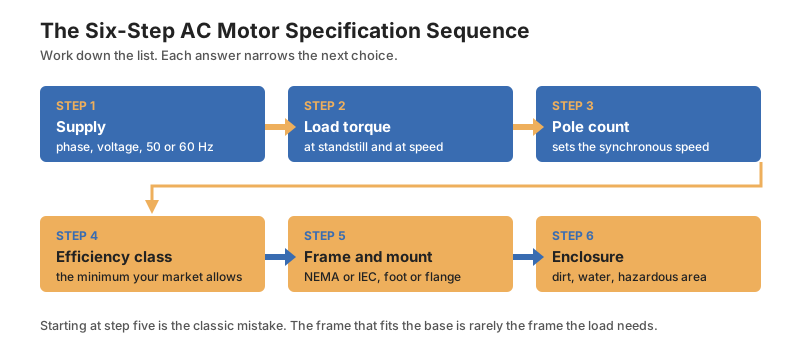
- Step 1: confirm the supply, its voltage and its frequency.
- Step 2: define the load torque at standstill and at full speed.
- Step 3: pick the pole count that gives the speed you need.
- Step 4: set the minimum efficiency class your market allows.
- Step 5: choose the frame and mounting to match the base.
- Step 6: choose the enclosure for the environment.
Common Specification Mistakes
Oversizing is the most expensive habit in the trade. A lightly loaded AC motor drifts below its rated efficiency. It drags the power factor down too.
- Oversizing: paying for shaft power that never gets used.
- Ignoring the design letter: a Design B machine stalling on a loaded conveyor.
- Frequency mismatch: fitting a 60 Hz AC motor to a 50 Hz supply.
- Wrong enclosure: an open machine in a wash-down bay. - Water finds the windings within weeks. - The replacement usually costs more than the upgrade would have.
Most general duty lands on a Design B machine from the general purpose AC motors range. Air handlers and condensers draw on HVAC AC motors built for that job.
Frequently Asked Questions About AC Motors
What is the difference between an AC motor and a DC motor?
An AC motor is driven by a rotating magnetic field created by alternating current. A DC motor needs a commutator or electronic switching to reverse current in the rotor circuit.
Can I run a 60 Hz AC motor on a 50 Hz supply?
Not without checking. Synchronous speed falls by a sixth, the available shaft power falls with it, and the voltage usually has to change too.
Which AC motor design letter should I specify?
Design B covers most fans, blowers and centrifugal pumps. Move to Design C for conveyors and positive-displacement pumps, and Design D for hoists and shock loads.
Is a NEMA Premium motor the same as IE3?
They are close. NEMA Premium Efficiency corresponds roughly to the IEC IE3 class, though the test conditions behind the two labels are not identical.
Will a NEMA frame motor bolt into an IEC base?
No. Mounting hole patterns and flange dimensions differ between the systems, so an adapter or a new base is required.
Conclusion
Specifying an AC motor is four questions in sequence: the supply, the load torque at standstill, the speed the driven machine needs, and the environment around the housing.
Answer those and the frame, the design letter and the efficiency class follow.
Check the design letter before the horsepower. It is the single cheapest way to avoid a stalled AC motor on commissioning day.
Related Posts

Paper Bags: How to Choose Construction, Basis Weight and Handles


3 Ring Binder Sizes and Ring Types: A Buyer's Guide