Walkie Talkie Guide: Choosing UHF, VHF and the Right Licence
By Kasia Olejarczyk · 23 August 2026
Two teams buy the same walkie talkie and get completely different results.
One team is out on open ground and hears every word. The other is three floors inside a concrete building and hears nothing at all.
The radio did not fail. The band, the power and the licence class were wrong for the site.
What a Walkie Talkie Really Is
A walkie talkie is a handheld two-way radio that transmits and receives on the same channel. Press the button to talk, release it to listen. Nothing else in the chain has to exist for the pair to work.
That single detail shapes everything else. Only one person on a channel can speak at a time, so channel discipline matters more than any specification printed on the box.
One Channel, One Talker
- Simplex working means both sets use one frequency, with no network in between.
- Push to talk gives instant group calling, which a phone call cannot match.
- No infrastructure has to exist for a basic walkie talkie pair to work: - That is the whole appeal on a site with no coverage. - It also caps how far the pair will ever reach.
Analogue or Digital
- Analogue sets are simpler, cheaper and talk to almost anything on the same channel.
- Digital sets hold audio quality further out and carry text or GPS data.
- Mixed fleets need care, because the two modes cannot hear each other: - A digital walkie talkie and an analogue one share air but not conversation. - Migrating a fleet usually means dual-mode sets for a season.
UHF or VHF: The First Real Decision
Regulators split mobile radio across two bands, and the choice between them decides whether your fleet works.
How Far Each Band Reaches
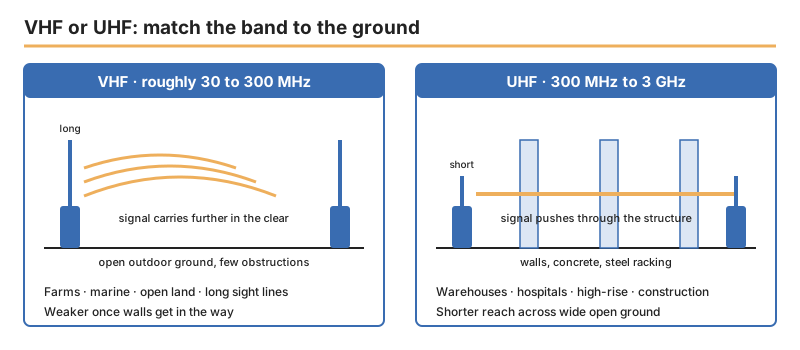
VHF covers roughly 30 to 300 MHz, and UHF picks up from there and runs to 3 GHz. Manufacturer guidance is consistent about what that difference means on the ground.
VHF signals typically travel farther than UHF across open outdoor country with few obstructions.
Where UHF Wins Indoors
UHF has better obstacle penetration through walls and concrete. That is why a warehouse, a hospital, a high-rise or a busy construction site is usually UHF territory. Steel racking and reinforced floors punish the lower band badly.
A walkie talkie on the wrong band inside a building is not weak. Its signal is simply being absorbed by the structure.
What the Antenna Tells You
- Longer antennas point to VHF, since the wavelength itself is longer.
- Short stubby antennas point to UHF.
- Swapping antennas between bands does not work and hurts the walkie talkie.
| Question | VHF | UHF |
|---|---|---|
| Band | Roughly 30 to 300 MHz | 300 MHz to 3 GHz |
| Best ground | Open, outdoor, few obstructions | Buildings, concrete, steel |
| Through walls | Weaker | Stronger |
| Antenna | Longer | Shorter |
| Typical users | Farms, marine, open land | Warehouses, hospitals, high-rise sites |
Licence-Free or Licensed
This is where most buyers get caught. A licence-free walkie talkie is legal to use straight from the box, and the trade-off for that convenience is power.
FRS in the United States
The FCC authorises 22 channels for the Family Radio Service in the 462 and 467 MHz range. The service runs under a licence by rule, so nobody needs an individual licence to use a walkie talkie on it.
- Anyone may operate an FRS walkie talkie, at any age, for personal or business use.
- Power sits at 2 watts on most channels and half a watt on channels 8 to 14.
- The radio must stay unmodified and must carry FCC certification.
- Telephone interconnection stays off limits.
GMRS and the Licence It Needs
The same channels are shared with the General Mobile Radio Service, which does require a licence.
- An individual licence covers the holder and their family members.
- Ten years is the licence term.
- Up to 50 watts applies, which is a different class of coverage entirely.
- Repeaters become legal, which is the real reason fleets move up to GMRS.
PMR446 in the UK and Europe
Ofcom treats PMR446 as licence-exempt, and describes it as a short-range, simplex, peer-to-peer system suited to office buildings, factories and building sites. A walkie talkie handset is the example the regulator itself gives.
- 446 MHz is the band, and both analogue and digital modes are fine.
- Half a watt of radiated power is the ceiling.
- No relays, gateways or fixed stations belong on the service.
| Service | Licence | Power ceiling | Where |
|---|---|---|---|
| FRS | None, licensed by rule | 2 W on most channels | United States |
| GMRS | Individual licence, ten-year term | Up to 50 W | United States |
| PMR446 | Licence-exempt | Half a watt | UK and much of Europe |
What Range Really Means
The Numbers on the Box
Advertised range figures come from unobstructed line of sight, often across water or from a hilltop. No working site ever looks like that.
Treat the box figure as a ceiling that nobody will reach.
What the Regulator Says
The FCC is refreshingly blunt about it. Usual range on the half-watt FRS channels runs to under half a mile, with the 2 watt channels doing better depending on conditions. That gap between the marketing and the regulator is the most useful fact in this guide.
Plan a walkie talkie fleet around the second number, never the first.
Repeaters Change the Answer
- A repeater receives on one frequency and retransmits on another, from a high point.
- Licensed services allow them, and licence-exempt ones generally do not.
- Site coverage stops being a walkie talkie question and becomes a system question: - One repeater can cover a campus that handhelds never will. - It also brings a licence, a mast site and a power supply with it.
Specifying a Walkie Talkie for Work
Channels and Groups
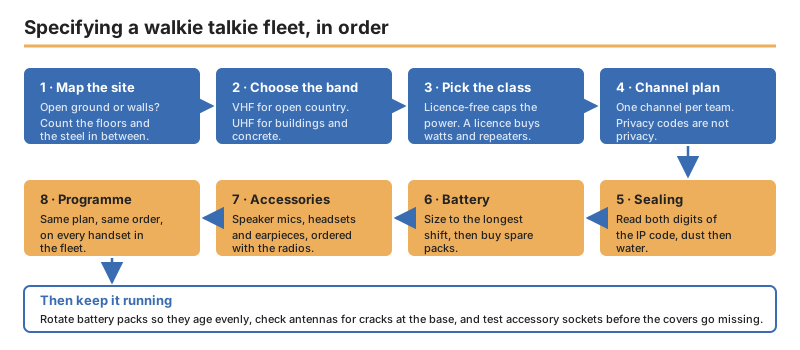
Count the teams before counting the channels. Separate groups need separate channels, and privacy codes do not create any privacy at all.
Sealing and Drop Rating
The IEC ingress-protection code is two digits: dust first, water second. A second digit of five or six means jets of water, not merely rain. Read both digits before you buy a walkie talkie for outdoor work.
- Dust and rain are the everyday enemies on a working site.
- A sealed microphone port matters more than the headline rating.
- Drop-test figures are worth reading, because concrete is unforgiving.
Battery and Shift Length
- Match the battery to the longest shift, not the average one.
- Spare packs beat fast chargers when a team runs two shifts back to back.
- Multi-way chargers keep a walkie talkie fleet tidy and stop packs going missing.
Audio Accessories
- Remote speaker microphones keep the walkie talkie on the belt and the audio at the shoulder.
- Headsets are the answer in high noise, rather than more volume.
- Earpieces suit front-of-house work where the radio should stay discreet.
Keeping a Fleet Working
Programming and Fleet Discipline
Every walkie talkie in a fleet should carry the same channel plan in the same order. A mismatched handset is the usual cause of a team that cannot hear each other. Label the radios, and lock the programming if the set allows it.
The Checks That Prevent Downtime
- Rotate the batteries so that packs age evenly across the fleet.
- Check the antennas for cracks at the base, which is where they fail.
- Test the accessory sockets, since covers go missing and let water in.
Frequently Asked Questions
Do I need a licence for a walkie talkie?
It depends on the service. FRS in the United States and PMR446 in the UK need no individual licence, while GMRS needs an FCC licence with a ten-year term.
Is UHF or VHF better for a walkie talkie?
UHF is better inside buildings because it penetrates walls and concrete more effectively. VHF reaches farther across open outdoor ground with few obstructions.
How far will a walkie talkie actually reach?
Far less than the box claims. The FCC puts usual range on the half-watt FRS channels at under half a mile, with the 2 watt channels reaching farther depending on conditions.
Can I use a walkie talkie for business?
Yes. The FCC allows FRS use for personal or business purposes, and Ofcom describes PMR446 as suiting business and non-business users alike.
Do privacy codes make a walkie talkie channel private?
No. They only stop your radio hearing other traffic on the channel, and anyone scanning that frequency can still hear every word you say.
Conclusion
Choosing a walkie talkie is a site question before it is a product question.
- Map the site first, because concrete and open ground want different bands.
- Pick the licence class you can actually live with, since power follows it.
- Ignore the box range and plan around the regulator's figures instead.
- Buy the accessories with the radios, not six months later.
Get the band and the licence right and the rest is detail. Compare handheld two-way radios, kit them out with earpieces and headsets, and look at repeaters when a single site outgrows a walkie talkie fleet.
Related Posts
HEPA Filter Guide: What the Grades Mean and Where One Belongs
Handrail Height: How to Get the Number Right in Every Code

Garage Floor Epoxy Coating: How to Test, Specify and Order It