Air Purifier Guide: CADR, Room Size and the Features Worth Paying For

By Troy Hasslinger · 14 September 2026
An air purifier can make a real difference to the air in a room, but only when it is the right size and uses the right technology. Price and styling are easy to compare. The numbers that decide performance sit in smaller print on the box.
This guide explains what an air purifier can do, how to size one with CADR and which features to avoid.
What an Air Purifier Can and Cannot Do
The US Environmental Protection Agency (EPA) notes that portable air cleaners, also called air purifiers, are designed to filter the air in a single room or area. Central HVAC filters, by contrast, treat air throughout a home.
Particles and Gases Need Different Filters
Indoor air carries two broad kinds of pollutant, and most filters are built for only one of them.
- Particles include dust, pollen, smoke and the fine particles known as PM2.5.
- Gases include chemical vapours, known as VOCs, and many odours. - A particle filter will not remove gases on its own. - An air purifier with both filter types can handle particles and gases together.
What No Air Purifier Can Fix
The EPA is clear that the most effective ways to improve indoor air are to remove pollutant sources and to ventilate with clean outdoor air. Filtration is a supplement to those steps, not a replacement. Deal with the source first, then filter what remains.
Mould is the classic example, because an air purifier may capture some mould particles, but it cannot stop the moisture problem that lets mould grow.
What the Health Research Shows
According to the EPA, several studies with portable HEPA air cleaners have found small improvements in heart and lung health. Studies have also found improvements in some allergy and asthma symptoms, although not in every symptom.
How Air Purifier Filters Work
The filter decides what an air purifier removes, so read the spec sheet first.
Mechanical Filters
A mechanical air purifier relies on physical filters alone. Public health guidance recommends this type, with a true HEPA filter as the main stage.
- HEPA filters capture at least 99.97% of particles at 0.3 micrometres, and smaller and larger particles even more efficiently.
- Pre-filters trap large dust and extend the life of the main filter.
- Activated carbon filters remove some gases, and the EPA notes that thicker carbon beds work better.
Labels to Treat With Caution
Public health guidance lists several warning signs on the box:
- "HEPA-like" or "HEPA-style" filters are not true HEPA filters.
- "99% HEPA" claims are another label to avoid.
- Washable HEPA or carbon filters are a red flag, because washing makes them ineffective.
Air Purifier Sizing With CADR
Room size is the most important detail when choosing an air purifier. The Clean Air Delivery Rate (CADR) links the unit to the room.
What CADR Measures
CADR shows how much filtered air an air purifier delivers, in cubic feet per minute, at its highest fan speed. The Association of Home Appliance Manufacturers (AHAM) tests three pollutants: tobacco smoke, dust and pollen.
Each rating stands for a different particle size:
- Smoke CADR covers the smallest particles, so it is the figure to compare.
- Dust CADR covers medium-sized particles.
- Pollen CADR covers the largest particles. - Be cautious with any model that lists only a room area. - Ask the maker for the smoke CADR if the box leaves it out.
The Two-Thirds Rule
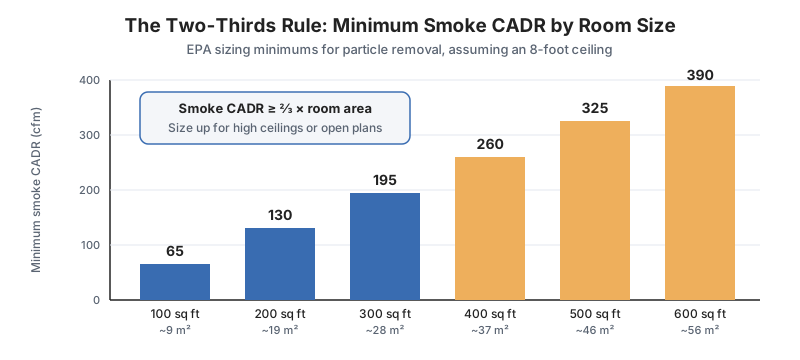
AHAM's rule of thumb is to choose an air purifier whose smoke CADR is at least two-thirds of the room's floor area in square feet.
| Room area (sq ft) | Room area (approx. m²) | Minimum smoke CADR (cfm) |
|---|---|---|
| 100 | 9 | 65 |
| 200 | 19 | 130 |
| 300 | 28 | 195 |
| 400 | 37 | 260 |
| 500 | 46 | 325 |
| 600 | 56 | 390 |
The EPA publishes these minimums, based on an 8-foot ceiling. Measure the room's length and width, multiply them and compare the result with the table.
High Ceilings and Open-Plan Spaces
The two-thirds rule assumes a standard ceiling height, so some rooms need more capacity.
- Ceilings above 8 feet call for a model sized for a larger area.
- Open floor plans should be measured as the whole connected space.
- Very large areas may need two or more units running together. - Several units at lower speed can be quieter than one unit at full speed. - Public health guidance suggests a higher smoke CADR where wildfire smoke is frequent.
Ozone: The Air Purifier Feature to Avoid
Some devices sold as air cleaners add a pollutant of their own.
Ozone Generators
The California Air Resources Board (CARB) warns that some products advertised as purifiers deliberately emit large amounts of ozone. Ozone irritates the lungs and can worsen asthma. CARB strongly advises against using ozone generators in spaces occupied by people or animals.
Watch for sales terms that hide what the device really does:
- "Activated oxygen" is a marketing name for ozone.
- "Super oxygenated" and "energized oxygen" mean the same thing.
Other Technologies That Can Emit Ozone
According to the EPA, electrostatic precipitators, ionisers, some UV lights and plasma cleaners may also emit ozone. CARB adds that ionisers and precipitators release ozone as a by-product. They usually emit far less than ozone generators do.
How to Check a Model
Before you buy, confirm that the air purifier has been tested for ozone.
- Check the CARB list of certified air cleaning devices. - CARB certification is based on low ozone emissions and electrical safety.
- Check the AHAM directory of certified room air cleaners and their CADR ratings.
- Look for "mechanical" rather than "electronic" in the product listing.
Noise, Energy and Running Costs
A loud air purifier is more likely to be switched off.
Noise Ratings
Noise depends mainly on fan speed. The EPA notes that a rating around 50 decibels is roughly as loud as a modern refrigerator. Check the figure at the highest speed, because CADR is usually measured there.
Energy Labels
An ENERGY STAR label means the unit meets energy efficiency guidelines. It says nothing about how well the air purifier cleans the air. Treat it as a guide to running costs only.
Filter Replacement
All filters need regular replacement, because a dirty, overloaded filter works poorly. Public health guidance suggests HEPA replacements are often due every 3 to 12 months, and sooner after heavy smoke events.
- Check the price of replacement filters before buying the unit.
- Replace carbon filters as directed, because they generally need replacing more often.
- Clean washable pre-filters on the schedule in the manual.
Where to Put an Air Purifier
Choose the Right Room
Put the unit where you spend the most time, such as a bedroom or home office. AHAM suggests placing it nearer the centre of the room rather than in a corner, depending on the design.
- Bedrooms benefit from a display that can be switched off at night.
- Rooms with open doors share air with the next space, so size for the larger area.
Keep the Airflow Clear
Keep the air purifier away from curtains and anything blocking the intake or outlet. Many units sit on the floor, while some are made for tabletops. If the airflow creates a draft, turn the outlet away from where people sit.
Run It Longer and Faster
The EPA explains that higher fan speeds and longer run times increase the amount of air filtered. A unit set to a low speed filters less air. An automatic mode linked to a particle sensor can raise the speed only when the air needs it.
Frequently Asked Questions About Air Purifiers
What size air purifier do I need?
Choose a smoke CADR of at least two-thirds of the room's area in square feet. A 300 square foot room needs a smoke CADR of about 195 cfm.
Do air purifiers remove odours?
Models with activated carbon or another gas filter are built for odours. A HEPA filter on its own targets particles.
Can an air purifier fix a mould problem?
No. It may capture some mould particles, but you still need to fix the moisture source and clean up the mould.
Are ioniser air purifiers safe?
Ionisers can emit ozone as a by-product. Choose a filter-only model that appears on the CARB certified list.
Should an air purifier run all day?
Longer run times filter more air, so running it whenever the room is in use gives the most filtration.
Conclusion: Size the Air Purifier First
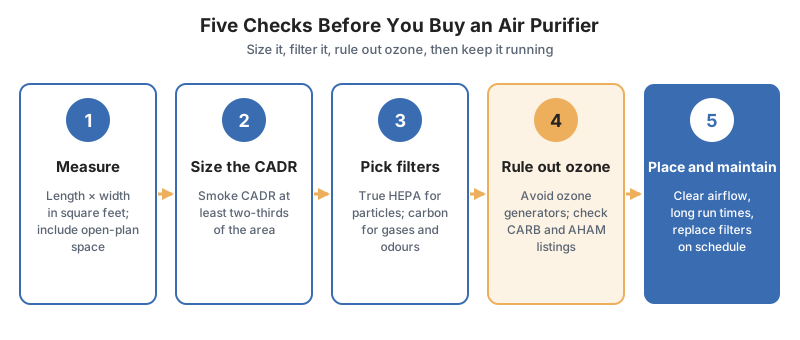
Start with the room, not the price tag. Measure the floor area, choose a smoke CADR of at least two-thirds of that figure and favour a mechanical HEPA design.
Rule out ozone, check the noise rating and budget for replacement filters. Compare portable air cleaners, air cleaner filters and dehumidifiers to build the right air purifier setup for every room.
Related Posts