Busbar Guide: Materials, Current Ratings and How to Specify One
By Mohamed Azam · 3 August 2026
A busbar looks like the simplest part in the whole switchroom.
It is a bar of metal. That bar carries more current than anything else on the site.
What a Busbar Does
A busbar distributes power from one supply point to many output circuits. The Copper Development Association design guide puts it in almost those words.
Think of the busbar as a junction in solid form. It takes the place of the cable bundle that would fan out from the incomer. The bar is the connection.
Scale is what sets it apart from wiring.
Where you find them
- Vertical risers carrying current to each floor of a tall building.
- Distribution panels where one bar feeds a row of breakers. - Inside the box the bar is often bare, insulated only at the joints.
- Process equipment running heavy steady current at low voltage.
- Switchgear and generator links where cable would be far too bulky.
Different jobs, one part. The busbar does the same thing in each of them.
Five questions every design must answer
- Temperature rise caused by energy losses in the conductor.
- Running cost of that lost energy over the life of the job.
- Short-circuit stress and how the system is guarded against it.
- Joint method and the resistance each joint adds.
- Maintenance access once the room is full.
Those five come straight from the copper guide. Skip one and the busbar still works on day one.
Copper or Aluminum
Nearly every busbar is copper or aluminum.
The two metals are not close. The table shows why.
What the numbers say
| Property at 20 C | Copper C101 | Aluminum 1350 |
|---|---|---|
| Conductivity, annealed | 101 %IACS | 61 %IACS |
| Thermal conductivity | 397 W/m·K | 230 W/m·K |
| Tensile strength, annealed | 200 to 250 N/mm² | 50 to 60 N/mm² |
| Elastic modulus | 116 to 130 kN/mm² | 70 kN/mm² |
| Expansion coefficient | 17 per K (×10⁻⁶) | 23 per K (×10⁻⁶) |
| Density | 8910 kg/m³ | 2700 kg/m³ |
| Melting point | 1083 C | 660 C |
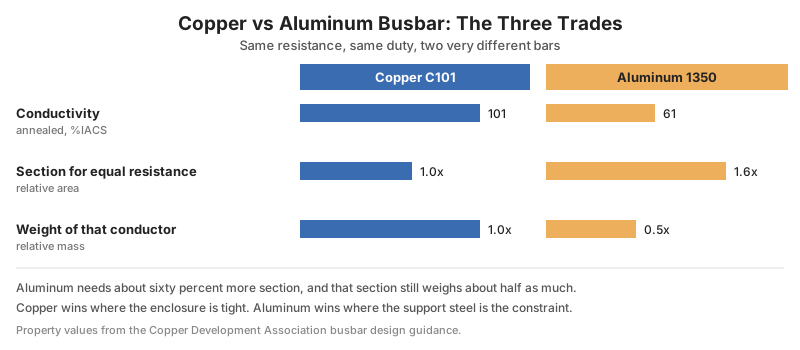
Copper is the yardstick here. It sits at one hundred percent on the IACS scale. Good modern copper often beats that mark.
Why cross-section is the real trade
Aluminum sits at sixty-one percent. An equal-resistance busbar in aluminum needs about sixty percent more cross-section.
All that metal has to fit the same cubicle. Where space is tight, copper wins the argument before price comes up.
Weight runs the other way.
Where aluminum still earns a place
- Long flat runs where half the weight eases the whole support design.
- Tight budgets where the cubicle has room for the bigger section.
- Busway housings, where aluminum is the norm for the casing itself. - Siemens busway uses that housing as the ground path.
Copper has one real drawback, and it is weight. Every other line in the table favours it.
What Sets a Busbar Current Rating
A busbar rating is really a temperature limit wearing an ampere label.
Heat is the true limit
Maximum working current is set by the highest temperature the bar may reach. That ceiling comes from safety, from the strength the metal must keep, and from what the mounts and cables around it can take. The amps on the drawing follow from there.
What quietly steals capacity
- Enclosure that blocks air flow across the bar face.
- Grouping, where each bar warms the ones beside it. - Close phase spacing also drives up the working resistance.
- Frequency, since skin effect pushes current out to the surface.
- Harmonics that load the neutral well past its share.
None of these show up on a nameplate. All of them shrink the busbar rating you thought you bought.
The long-run question
High conductivity copper begins softening above 150 C. Continuous operation therefore has to sit comfortably below that figure.
The copper guide cites bars running at 105 C for twenty to twenty-five years. A short circuit is a different case. Copper takes 250 C for a few seconds with no lasting harm.
Aluminum starts creeping at far lower temperatures.
Busbar or Busway
A busbar is a conductor. A busway is a made-up housing with the bars already fitted inside it.
Ratings and standards
| Attribute | Typical busway system |
|---|---|
| Amp range | 100 to 6500 A |
| Voltage | 600 V or less |
| Copper bars | about 98 percent conductivity |
| Aluminum bars | about 58 percent conductivity |
| Main standards | UL 857 and NEMA BU1 |
| Insulation | Class B, rated 130 C |
Those figures come from Siemens busway data. Other big makers land in the same band.
What a busway buys you
- Speed, since it goes up in about half the time of cable and conduit.
- Cost, with savings of twenty to thirty percent installed.
- Flexibility, because plug-in units tap power along the run. - Good plug-in openings are finger-safe to IP2X.
Loose bars still win in panels.
Busway wins once the run leaves the cubicle. Speed on site is the reason.
Joints Decide Whether the Run Lasts
Bars rarely fail. Joints do, and each joint sits in series with the load.
A good joint beats plain bar
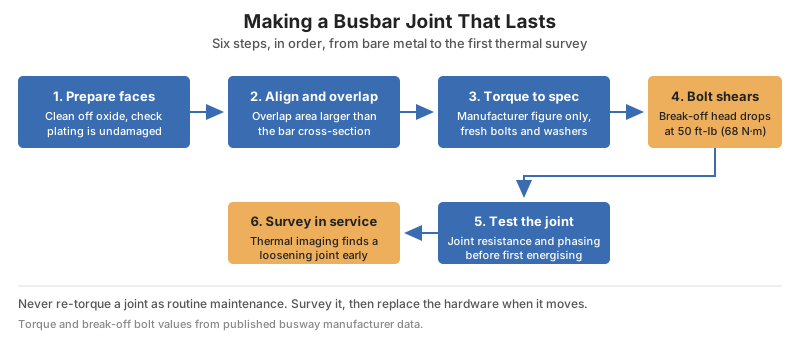
This reads oddly at first. A well made busbar joint can show less resistance than the same length of plain bar. The overlap area is simply bigger than the bar section.
Getting the clamping right
- Torque to the figure the maker lists, never a generic table.
- Break-off bolts on busway shear their top head at the rated torque. - Siemens sets that at 50 ft-lb, or 68 N·m, so no wrench is needed.
- Fresh hardware each time, since busway makers rule out reused bolts.
Contact resistance drops as pressure rises. That is the job of the bolt.
Too little torque and too much both end in heat.
What ages a joint
- Oxide building on the contact faces.
- Corrosion where two unlike metals meet.
- Fretting from vibration and heat cycling.
- Creep that lets the clamping force bleed away.
Tin plating on busway bars slows the first two.
Specifying and Supporting the Run
Support and thermal movement decide the job on site. Both are easy to get wrong.
Support intervals
The National Electrical Code sets the default in Article 368. Busways must be held at intervals of five feet or less unless designed and marked otherwise. Makers often list systems for ten-foot spacing, and that marking is what allows the wider span.
Vertical runs need spring hangers rather than rigid ones. They also need extra support where the floor-to-floor height passes sixteen feet.
Thermal movement
Copper expands considerably less than aluminum, but neither material stays still.
Busway makers call for one expansion section every two hundred feet of straight run. Another goes at each turn into a vertical run. Another goes at each building expansion joint.
Wall and floor flanges cover the hole around the busbar. They must never carry its weight.
Ordering the parts
Start with the straight busbar elements sized for the ampere rating and the enclosure you actually have.
Then pick the busbar support hardware against the listed spacing, not the handy one. Finish with the busway connection hardware and tools, since the joint is what the whole run rests on.
Frequently Asked Questions About Busbars
What is a busbar?
A busbar is a metal bar, copper or aluminum, that feeds power from a supply point to several circuits. It takes the place of a cable bundle.
Is copper or aluminum better for a busbar?
Copper leads on conductivity, strength, heat flow and creep. Aluminum leads on weight and cost. It also needs about sixty percent more section for the same resistance.
What temperature can a copper busbar run at?
Copper softens above 150 C, so steady ratings sit under that. It has run at 105 C for more than twenty years and takes 250 C for a few seconds in a fault.
How far apart do busway supports go?
Five feet is the code default, and wider spans need the busway to be marked for them.
Does a busbar need plating?
Not always, though busway bars are usually tin plated to guard the contact faces. Silver plating is offered where joint duty has to go further.
Conclusion: Specify the Busbar, Not Just the Amps
An amp figure on its own tells a supplier very little. The same busbar rating means different metal and different support once you name the duty.
- Name the material and the conductivity you expect from it.
- State the working temperature the rating is based upon.
- Give the support spacing and the joint torque specification.
Get those three onto the order and the busbar arrives right. Leave them off, and a heat scan finds the problem for you later.
Related Posts
Drywall Anchor Guide: Types, Load Ratings and Safe Fixing