Commercial Refrigerator Guide: How to Choose Type, Size and Efficiency
By Pete Hodges · 6 August 2026
Most kitchens buy a commercial refrigerator twice. The first is bought on price. The second is bought on experience.
The gap between them is a few unread lines on a spec sheet. Door type, volume and condenser position decide most of what happens later.
What a Commercial Refrigerator Has to Survive
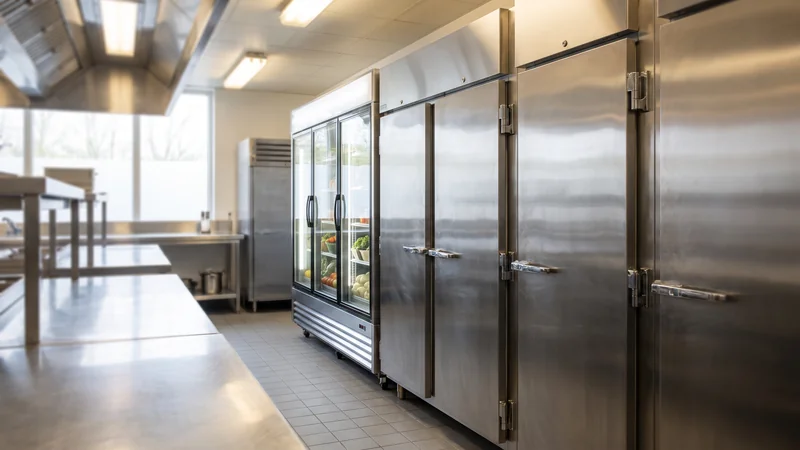
A home fridge sits in a cool room and is opened a few times an hour. A commercial refrigerator lives elsewhere. ENERGY STAR sets out the brief plainly: this gear must hold food at set temperatures in hot kitchens, through frequent door openings.
Heat, doors and duty
Every door opening dumps warm damp air into the cabinet.
The compressor then pulls that heat back out. In a busy kitchen that happens hundreds of times a shift. Duty cycle, not the badge, splits the two machines.
What the food safety standard covers
NSF publishes NSF/ANSI 7, the rule book for commercial refrigerators and freezers. It sets minimum food protection and clean design rules for how these units are built and perform. Its scope is wide.
- Storage units cover reach-in, under counter, walk-in and roll-in.
- Display units cover glass front cases and drink coolers.
- Service units cover buffet, transport and prep cabinets. - Ice cream cabinets sit inside it too.
What the standard leaves to you
NSF/ANSI 7 does not cover fitting the unit. That part stays with the buyer.
- The mark covers the cabinet and how it is built.
- The mark does not cover where you put it.
- Local health rules still apply on top of it.
The Commercial Refrigerator Formats Worth Knowing
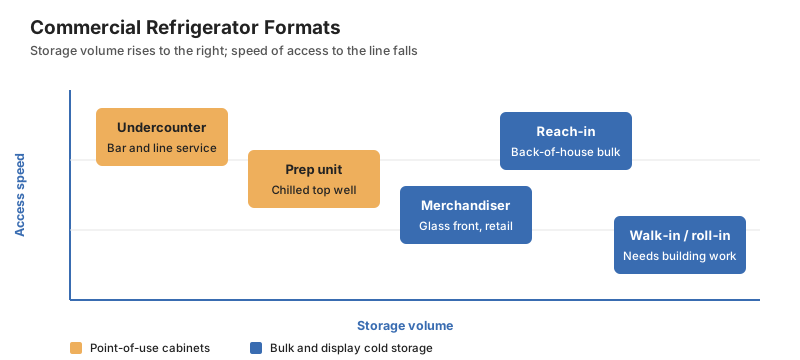
Format is the first real choice, and hard to undo.
Reach-in cabinets
The upright reach-in is the default back-of-house commercial refrigerator. It gives the most volume per square metre of floor.
- Solid doors hold cold better and cost less to run.
- Glass doors let staff find stock without opening anything.
- Half doors cut the cold air lost per trip. - Two half doors give the same opening as one full door.
Undercounter and prep units
These trade volume for reach.
A cook on the line saves steps per order. Prep units add a chilled top well for ingredients. That comfort carries an energy cost.
Display cases
A refrigerated display case sells the product as well as chilling it.
Glass, lighting and open fronts all add heat load. Expect a higher bill than a solid door commercial refrigerator of the same size.
Walk-in and roll-in rooms
Past a certain volume, a room beats a cabinet. Roll-in models take loaded trolleys straight from prep. They need building work, so lead times run longer.
| Format | Typical use | Strength | Trade-off |
|---|---|---|---|
| Reach-in | Bulk back-of-house | Most volume per floor | Far from the line |
| Undercounter | Line and bar | Fast access | Small capacity |
| Prep unit | Assembly stations | Ingredients at hand | Higher energy use |
| Display case | Retail and self-service | Drives sales | Heat from glass and light |
| Walk-in or roll-in | High volume sites | Scales past cabinets | Needs building work |
How to Size a Commercial Refrigerator
Sizing errors cost more than any other spec mistake.
Start with covers, not cubic feet
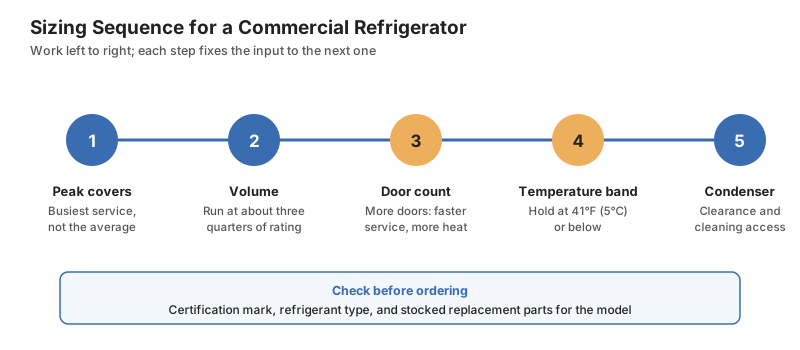
Count the meals served at the busiest service. A commercial refrigerator sized for a quiet Tuesday will fail on a Saturday.
Match door count to traffic
Each door is an access point and a heat leak.
- One door suits a single station.
- Two doors suit a shared prep area.
- Three doors suit a full production line. - Split cold storage across units where layout allows.
Leave headroom for deliveries
Stock arrives in surges. A cabinet that runs full has no room for a delivery day.
Aim to run at about three quarters of rated volume. That gap keeps air moving around the food.
The Temperature Rules Behind the Spec
Food safety law sets the target the gear has to hit.
The cold holding limit
The FDA Food Code holds cold time and temperature control foods at 41°F (5°C) or below. Most national codes follow the same line.
That figure is a limit, not advice. Your commercial refrigerator must reach it while the kitchen is hot and the doors keep moving.
The danger zone
Between 41°F and 135°F (5°C and 57°C), bugs multiply fast.
Time in that band must be controlled at every stage. Cooked food gets two hours to fall from 135°F to 70°F. It then gets six hours in total to reach 41°F.
Rapid pull-down units
Some units chill hot food fast rather than hold cold food. Under NSF/ANSI 7 these carry a fixed label. It states the unit can take contents from 135°F (57°C) to 40°F (4°C) in four hours.
- Storage units hold food that is already cold.
- Pull-down units chill food that is still warm.
- The wrong choice parks stock in the danger zone.
Where the Running Cost of a Commercial Refrigerator Comes From
Purchase price is a small part of lifetime cost. Power is the rest.
What the label is worth
ENERGY STAR labelled commercial refrigerators and freezers are on average twenty percent more efficient than standard models. That gain comes from hardware, not tuning.
- ECM fan motors on both the evaporator and the condenser.
- Hot gas anti-sweat heaters in place of electric ones.
- Better compressors matched to the duty. - All three are named in the ENERGY STAR criteria.
| Labelled unit | Energy saved a year | Bill saved a year | Lifetime saving |
|---|---|---|---|
| Solid door refrigerator | 325 kWh | More than $40 | $350 |
| Glass door refrigerator | 370 kWh | Nearly $50 | $430 |
| Solid door freezer | 80 kWh | More than $10 | $80 |
| Glass door freezer | 900 kWh | More than $110 | $980 |
Where the label stops
Not every commercial refrigerator can carry it, and the excluded list is useful.
- Prep tables and chef bases are out of scope.
- Service over counter and open air units are excluded.
- Convertible temperature units are out of scope. - Remote condensing gear is excluded as well.
Refrigerant choice
Refrigerant is now part of the buying choice. ENERGY STAR points buyers to lower global warming options. Named ones include R-600a, R-290, R-450A, R-513A and R-744, which is carbon dioxide.
- Ask for the refrigerant by name on every quote.
- Compare it against the carbon dioxide baseline of one.
- Check local rules on older blends before you order. - Some older blends warm the planet thousands of times harder.
Fitting, Airflow and Service Access
A good commercial refrigerator can still be ruined by where it lands.
Give the condenser air
An air-cooled unit throws heat into the room it stands in. Boxing it against a wall raises head pressure. That shortens compressor life, in a slow, quiet failure.
Plan the cleaning
NSF/ANSI 7 asks for cooling parts to be easy to clean. A blocked condenser coil is the top cause of a warm cabinet.
- Clean the condenser at a set interval.
- Check door seals for splits and flat spots.
- Log cabinet temperature daily and keep the record. - Inspectors ask for that log more than anything else.
Keep parts on hand
Downtime is measured in spoiled stock. Check that replacement parts for the model are stocked before you order.
Frequently Asked Questions About Commercial Refrigerators
What temperature should a commercial refrigerator hold?
Cold food under time and temperature control must sit at 41°F (5°C) or below under the FDA Food Code. Many operators set the cabinet a little lower. Door openings then cannot push stock over the limit.
Is a glass door commercial refrigerator less efficient?
Not always. A labelled glass door model saves 370 kWh a year, which beats the solid door saving.
Can a commercial refrigerator cool hot food?
Only if it is built for it. Rapid pull-down units are labelled for that job and take food from 135°F to 40°F in four hours.
Does the NSF mark cover fitting?
No, because NSF/ANSI 7 covers how the unit is made and how it performs, while fitting stays with the buyer.
How much spare volume should I allow?
About a quarter. Running a commercial refrigerator full blocks airflow and leaves nothing for delivery days.
Conclusion: Specify the Duty, Then the Cabinet
A commercial refrigerator is a duty spec wearing a price tag.
Write down the peak covers, the temperature band, the door count and the condenser clearance. Then go shopping. A commercial refrigerator chosen that way outlives the fit-out around it.
- Size for the busiest service, never the average one.
- Check the label and the refrigerant together.
- Confirm clearance and parts before the order goes out.
Skip those three lines and the cabinet will make the point itself, during service.
Related Posts
Dent Puller Guide: How to Choose the Right Dent Puller