How to Choose a Compressed Air Dryer: Types, Dew Point and Sizing
By Pete Hodges · 2 September 2026
Every air compressor makes water. Squeezing air wrings the moisture out, and that water travels straight down the pipe.
A compressed air dryer is what stops it. Skip one and the water finds your tools, valves and paint finish. The repair bill always beats the dryer.
The choice comes down to three questions. How dry must the air be, how much of it is there, and what does energy cost?
Why Wet Air Costs More Than a Compressed Air Dryer
Moisture in an air line is not a nuisance. It is a slow, expensive fault that hides behind other symptoms.
What Water Actually Does Downstream
Water rarely announces itself, so it gets blamed on something else.
- Corrosion inside the pipework, which then sheds rust into the air.
- Clogged valves and shorter tool life, which is where the cost usually lands. - Spray finishes blister and get rejected. - Food and pharmaceutical batches fail their air checks.
Fix the air and most of those symptoms clear at once. That is why a compressed air dryer counts as core plant. Nobody treats it as an accessory twice.
Pressure Dew Point Decides Everything
Pressure dew point is the one number that matters. It is the temperature at which water vapour starts to condense at your working pressure.
Why It Is Measured Under Pressure
Atmospheric dew point and pressure dew point are not the same figure. Compressed air holds moisture differently, so the number only means something at system pressure.
Ask any supplier for the pressure dew point, not just the model name.
Setting a Target Dew Point
Take the dew point from the coldest place the air travels, not from the compressor room.
- General workshop air: a dew point of about 3 degrees C is plenty.
- Any pipe run outdoors or through a chiller: you need a figure below freezing. - A pipe at 0 degrees C drops water out of 3 degrees C air. - Laboratories and coating lines often call for minus 40 degrees C.
Set that target before you look at a price. Every compressed air dryer decision follows from it.
The Main Compressed Air Dryer Types
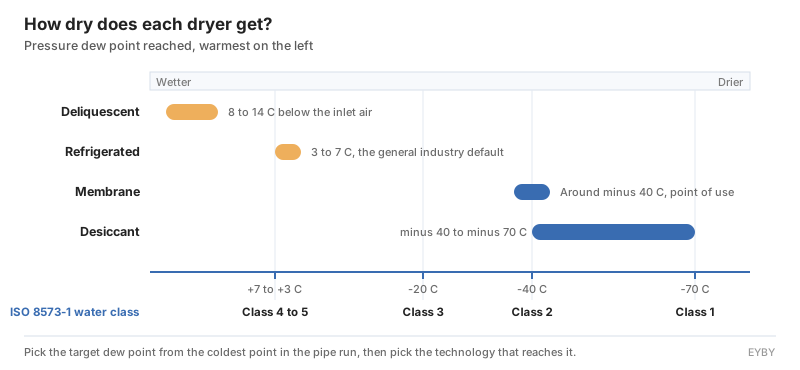
Four technologies cover almost every job. The table sets out what each one delivers.
| Dryer type | Typical dew point | Power needed | Best fit |
|---|---|---|---|
| Refrigerated | 3 to 7 degrees C | Yes | General industry, indoor pipework |
| Desiccant, heatless | minus 40 to minus 70 degrees C | Little | Labs, pharma, food, cold lines |
| Desiccant, heated or blower | minus 40 to minus 70 degrees C | Yes | Same duties, lower running cost |
| Membrane | Around minus 40 degrees C | No | Point of use, remote kit |
Refrigerated Compressed Air Dryers
This is the default across general industry, and it covers most factories.
- How it works: the air is chilled until moisture condenses, then drains away.
- Control style: non-cycling units run flat out, while cycling and variable speed units follow demand.
Non-cycling models are the cheapest to buy. They are also the dearest to run. Over a ten year life that energy gap can exceed the original purchase price of the compressed air dryer.
Desiccant Compressed Air Dryers
Desiccant is the answer whenever the dew point has to sit below zero.
- How it works: beads adsorb moisture, and two towers alternate so one dries while the other recovers.
- Watch the purge: heatless designs spend 16 to 25 per cent of your treated air on regeneration.
That purge air is real compressor capacity. Size the compressor to cover it, or the system runs short at peak.
Heated and Blower Purge Options
Heat does the regeneration work that purge air would otherwise do. Both options cost more up front.
- Heated purge cuts the purge loss below 10 per cent.
- Blower purge removes almost all of the compressed air loss.
On a plant that runs long hours, the payback usually arrives within a few years. Judge any compressed air dryer on total cost of ownership, not on the invoice.
Membrane and Deliquescent Dryers
Neither needs electricity, which makes both useful in awkward corners.
- Membrane: hollow fibres let water vapour pass out while the dry air carries on.
- Deliquescent: a consumable medium absorbs water and slowly dissolves as it works.
Membrane units suit a single machine or an outdoor cabinet. Deliquescent units only pull the dew point down by roughly 8 to 14 degrees C below the incoming air. Treat that as a rough guard, not a specification.
Reading ISO 8573-1 Air Purity Classes
ISO 8573-1 is the standard your customers will quote at you. It was first published in 1991 and revised in 2010.
The Three Numbers
Air quality is written as three class numbers in a fixed order. Lower numbers mean cleaner air.
| Position | Contaminant | Limit at Class 1 |
|---|---|---|
| First | Solid particles | 0.1 micron maximum |
| Second | Water | Dew point at or below minus 70 degrees C |
| Third | Oil | 0.01 mg per cubic metre |
So Class 1:2:1 means the strictest particle limit, a dew point around minus 40 degrees C, and the strictest oil limit.
What Each Water Class Means
The water class is the one your compressed air dryer has to hit.
- Class 1: dew point at or below minus 70 degrees C.
- Class 2 and Class 3: between minus 40 and minus 20 degrees C. - Class 4 and Class 5 sit between 3 and 7 degrees C. - That upper band is where refrigerated units live.
Food, beverage and pharmaceutical work is commonly specified at Class 1:2:1. General pneumatic tools usually run happily on Class 3:4:4.
Sizing a Compressed Air Dryer
Sizing errors are common and costly. An undersized unit lets water through, while an oversized one wastes capital and energy.
The Five Steps
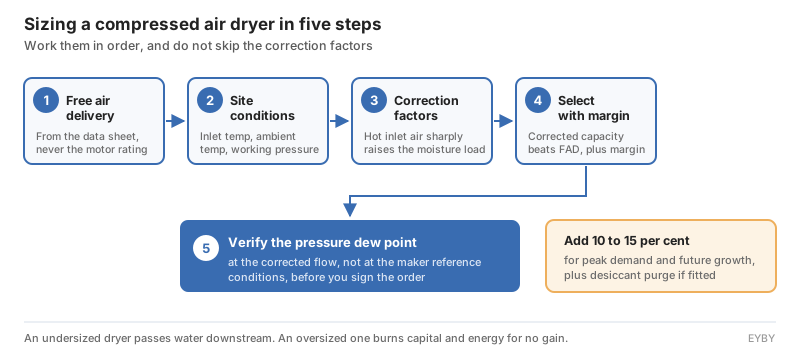
Work the sequence in order and the answer falls out.
- Take the free air delivery from the compressor data sheet, never the motor rating.
- Record site conditions: inlet air temperature, ambient temperature and working pressure. - Hot inlet air sharply raises the moisture load. - Working pressure changes the correction factor applied.
Then apply the maker's correction factors. Pick a compressed air dryer whose corrected capacity beats your free air delivery. Add 10 to 15 per cent for peaks and future growth.
Verify at the Corrected Flow
A published dew point is measured at the maker's reference conditions. Yours will differ on almost every site.
Confirm the figure at your corrected flow before you sign the order.
Filters and Drains Around a Compressed Air Dryer
A compressed air dryer only works properly if the kit around it does its job first.
Order of Equipment
Treatment runs in a sequence that rarely changes.
- Aftercooler and separator first, to drop out bulk liquid water.
- Coalescing filter next, to catch oil aerosol before it reaches the dryer.
- Dust filter after a desiccant unit, to catch any carried-over beads.
Drains and Condensate
Every drain point is a leak waiting to happen. Timed drains dump air on every cycle. Zero-loss drains open only when there is liquid to release.
Oil-bearing condensate cannot go to the sewer untreated in most places. An oil and water separator on the condensate line handles that.
Compare complete units in compressed air dryers, narrow the shortlist under refrigerated compressed air dryers, and match the upstream kit from compressed air filters.
Frequently Asked Questions
Do I need a compressed air dryer for a small workshop?
If the air only drives hand tools, a receiver and good drain may cope. Add a compressed air dryer as soon as you spray, blast or run anything sensitive to water.
Can a refrigerated dryer reach a dew point below zero?
No. Refrigerated units work by condensing water, so they stop just above freezing, and anything colder calls for desiccant or membrane drying.
How often does desiccant need replacing?
Media life depends on inlet conditions and on how well upstream filters work. Check it against the maker's schedule. Check it again after any oil carry-over event.
Where should the compressed air dryer sit in the system?
Downstream of the aftercooler and the water separator in most layouts. Always follow the maker's piping drawing for the specific unit you buy.
Conclusion
Choosing a compressed air dryer is a dew point decision first and a budget decision second.
Set the target from the coldest point in the pipe run. Match a technology to that target rather than to the sticker price. Then size the unit on real site conditions, with a margin for growth.
Get the filters and drains right around it too.
Do that and the air stays dry, the tools last, and the compressed air dryer quietly pays for itself in downtime you never have.
Related Posts

What Bathroom Partitions Have to Survive
Pipe Fittings Explained: Types, Materials and How to Choose
Box Stapler Guide: Types, Staple Sizes and How to Choose One