Polycarbonate Roofing Sheets: How to Choose the Right Type for Every Roof
By Markus Edvinsson · 26 July 2026
Polycarbonate roofing sheets have taken over carports, greenhouses and factory skylights. They are light, they bend, and they shrug off knocks that would shatter glass. The catch is that one name covers three very different products, and the wrong pick gets costly.
A corrugated panel under a mm thick and a 40 mm multiwall panel are both polycarbonate roofing sheets. One sheds rain over a patio. The other keeps a heated pool warm through a northern winter.
This guide covers the three types, the numbers that split them, and the fitting rules that decide whether polycarbonate roofing sheets last two years or twenty-five.
What Makes Polycarbonate Roofing Sheets Different
A sheet built for impact
Polycarbonate is a plastic that bends instead of breaking. That one trait is why polycarbonate roofing sheets rule glazing wherever hail or falling debris is a risk. It also explains why panels can be curved cold, on site.
The trade-off is a soft face. Outdoor sheets carry a bonded UV layer that guards the surface as well as the sheet below.
How they compare with glass and metal
- Polycarbonate roofing sheets weigh a fraction of the same area in glass, so the frame can be lighter.
- Corrugated grades block virtually all UV light, yet still pass daylight. - The guard layer sits on one face only in standard grades. - Which face points up therefore matters.
- Multiwall grades slow heat loss, which single-skin glass and metal cannot do.
- Sheets cut with basic hand and power tools.
Most polycarbonate roofing sheets have a 25-year working life when they are fitted right. Warranties run shorter, from ten years on multiwall panels to a limited lifetime warranty on some corrugated lines.
The Three Types of Polycarbonate Roofing Sheets
Multiwall: twin-wall, triple-wall and X-structure
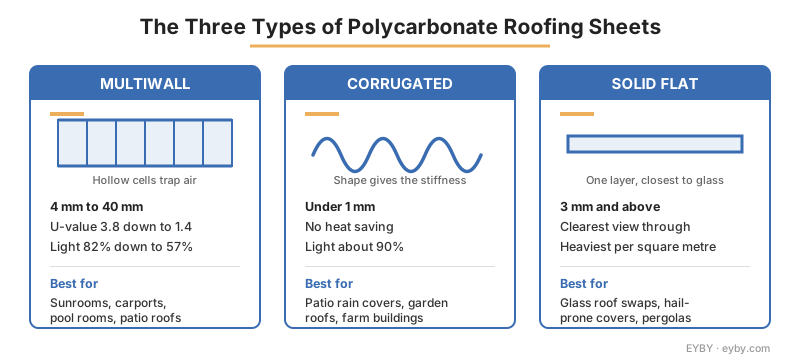
Multiwall polycarbonate roofing sheets are hollow, with two or more skins joined by inner ribs. The trapped air does the work.
Thickness runs from 4 mm to 40 mm. More layers buy lower heat loss and cost you daylight.
- Best for: sunrooms, glazed extensions, pool covers, carports and fixed patio roofs.
- Strength: the only polycarbonate roofing sheets that cut heat loss in a real way.
- Watch for: dust and damp inside the cells when the sheet ends are left open.
Corrugated and profiled sheets
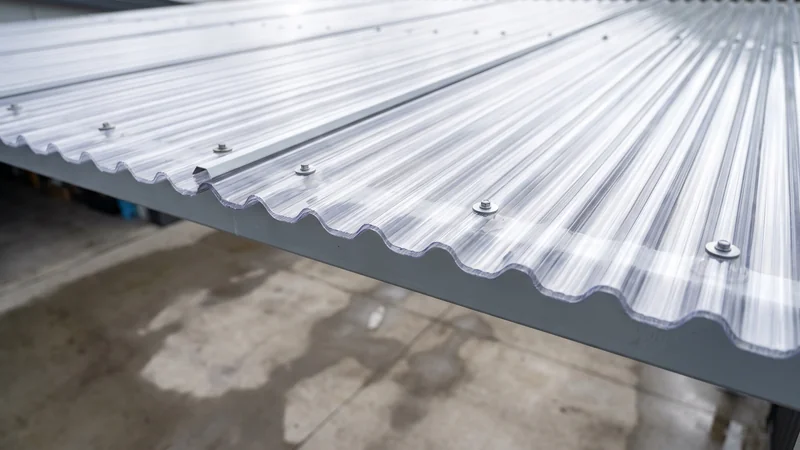
Corrugated polycarbonate roofing sheets are single-skin panels pressed into a wave or box shape. The shape, not the thickness, gives the stiffness. At well under a mm thick, they are the lightest option here.
- Best for: patio rain covers, garden roofs, farm buildings and skylights in metal roofs.
- Strength: shapes match common metal sheets, so a clear panel drops into a steel roof run. - Clear grades let through about 90% of visible light. - Working heat range spans roughly -40 °C to +100 °C.
- Watch for: no heat saving at all, and loud rain.
Solid flat sheets
Solid polycarbonate roofing sheets are single-layer glazing with no cells and no shape pressed in. They look closest to glass. From about 3 mm up they take hail, ice, snow and wind better than thin-walled panels.
- Best for: glass roof swaps, pergola roofs, hail-prone covers and standing-seam systems.
- Strength: the clearest view through of the three types.
- Watch for: the weakest heat saving per mm, and the highest weight.
Reading the Spec Sheet: Thickness, Light and U-Value
Three numbers split one panel from another. All the rest is packaging.
Light let through
Light is measured under ASTM D-1003 and printed as a percentage.
Clear twin-wall polycarbonate roofing sheets pass 82% of visible light at 4 mm, dropping to 79% at 10 mm. Thicker cell panels trade daylight for warmth, and a 40 mm X-structure sheet passes 57%.
U-value
U-value measures heat loss in watts per square metre per kelvin, and lower is better.
Twin-wall at 4 mm sits at the leakiest end of the multiwall range. A 40 mm X-structure panel cuts that heat loss by 63%, but weighs five times as much.
| Structure | Thickness | Area weight (kg/m²) | U-value (W/m²K) | Clear light |
|---|---|---|---|---|
| Twin wall | 4 mm | 0.8 | 3.8 | 82% |
| Twin wall | 6 mm | 1.3 | 3.5 | 80% |
| Twin wall | 10 mm | 1.7 | 2.9 | 79% |
| Triple wall | 16 mm | 2.7 | 2.3 | 76% |
| X-structure | 25 mm | 3.4 | 1.7 | 60% |
| X-structure | 40 mm | 4.1 | 1.4 | 57% |
Codes and approvals
- The International Code Council lists report ESR-1893 for light-passing plastic use.
- The Canadian Construction Materials Centre lists the same approval as report 13450-R.
- ASTM D-635 gives these sheets a CC-1 class. - ASTM E-84 yields a Class A surface burning rate. - That rating shifts with thickness, so check the grade you are buying.
Matching Polycarbonate Roofing Sheets to the Project
Garden and light-duty buildings
- 6 to 10 mm multiwall suits gazebos, greenhouses, cold frames and garden sheds.
- Thin corrugated suits light garden roof covers and patio rain covers.
- Neither needs more, because the space below is cold anyway.
Lived-in and part-heated spaces
- 10 to 16 mm multiwall suits sunrooms, glazed extensions, pool covers and carports.
- Fixed patio roofs sit in the same band.
- Heated spaces earn back the extra cost through lower running costs. - Pool rooms gain twice, since warmer inner glazing holds off damp. - Carports gain from bronze or opal grades that cut solar heat.
Harsh climates
Hail, ice, snow and high wind change the answer. Solid polycarbonate roofing sheets from roughly 3 mm up beat thin-walled panels here, and purpose-built hail-rated shapes exist for the worst of it.
| Project | Best type | Typical thickness | Why |
|---|---|---|---|
| Patio rain cover | Corrugated | Under 1 mm | Lightest, cheapest, sheds water |
| Greenhouse or gazebo | Multiwall | 6 to 10 mm | Soft light, basic heat saving |
| Carport or sunroom | Multiwall | 10 to 16 mm | Warmth with load capacity |
| Pool room | Multiwall | 10 to 16 mm | Holds off damp |
| Glass roof swap | Solid | 3 mm and above | Clear view, impact strength |
| Hail-prone cover | Solid, hail-rated | 3 mm and above | Takes repeat impact |
Colour and Solar Control
Clear is the default choice, and it is often the wrong one.
Colour shifts daylight and solar heat gain together. A 4 mm twin-wall panel shows the whole spread.
- Clear: 82% light with a solar heat gain figure of 0.83.
- Bronze: 35% light and a figure of 0.48, the pick for carports and west-facing covers.
- White opal: 30% light and a figure of 0.30, the lowest heat gain of the three. - Opal spreads light evenly instead of casting hard shadows. - Growers and warehouse designers pick it for that reason.
- Solar control grades: shiny metal layers cut heat gain further where cooling load rules.
Fitting Polycarbonate Roofing Sheets Without Callbacks
Most faults on these roofs are fitting faults, not sheet faults.
Polycarbonate moves with heat. A roof that ignores that will bow, warp and crack, then leak and age early.
Allow for the sheet to move
Multiwall polycarbonate roofing sheets grow along the line of their ribs. Profiled panels grow along the corrugation lines.
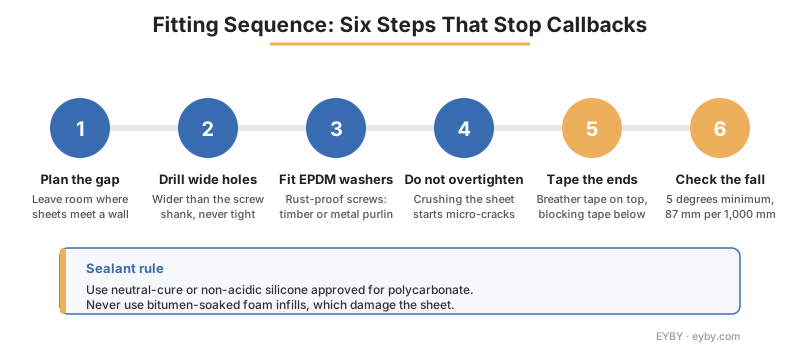
Leave a gap wherever a sheet meets a wall or any other fixed object.
Drill wide holes
Pre-drill each fixing hole wider than the screw shank.
Tight holes build up stress and start micro-cracks. Never overtighten a fixing either, because warping and sheet failure follow.
Choose the right fixings
- Soft EPDM washers seal the hole while still letting the sheet move.
- Self-tapping screws suit timber purlins. - Self-drilling screws suit metal purlins. - Either way, specify rust-proof fixings.
Sealants and infills
- Use neutral-cure or non-acidic silicone approved for polycarbonate.
- Avoid acidic silicones, which attack the sheet face.
- Never use bitumen-soaked foam infills, which damage polycarbonate roofing sheets.
Seal the sheet ends the right way round
- Each open cell must be sealed before the roof is closed up.
- Breather tape goes on the top end of the sheet. - Blocking tape goes on the lower end. - Swap the two and the cells cannot breathe, so the order matters.
- Fold the spare tape over both sheet faces to cover the inner cells.
- Fit an end cap over the taped edge to finish the seal.
Pitch and drainage
Corrugated polycarbonate roofing sheets need a minimum fall of 1:10 to drain clean, which is a slope of 5.7 degrees. Flat and multiwall panels need less, from 3 degrees as a stated minimum up to the 5 degrees some fitting guides call for.
Flatter runs pond water and hold dirt. Standing-seam systems remove most of this work, because their joints let panels grow freely with no pre-drilling.
Frequently Asked Questions About Polycarbonate Roofing Sheets
How long do polycarbonate roofing sheets last?
Most polycarbonate roofing sheets have a 25-year working life when fitted right. Warranties are shorter: ten years on multiwall panels, and a limited lifetime warranty on some corrugated lines.
Do polycarbonate roofing sheets block UV light?
Outdoor grades carry a bonded UV layer that blocks virtually all UV rays.
Standard sheets guard one face only, so which side points up matters. A two-sided grade is sold where both faces are exposed.
What thickness should I choose?
Match the thickness to the space below. Cold garden buildings work at 6 to 10 mm multiwall, while sunrooms, carports and pool rooms want 10 to 16 mm.
Can polycarbonate roofing sheets be cut on site?
Yes, and that is a real strength. Panels cut with basic hand and power tools, so trimming happens on the roof.
Are polycarbonate roofing sheets noisy in rain?
Single-skin corrugated panels pass on a lot of rain noise. Multiwall and solid panels are quieter, and makers sell solid shapes on that quiet-in-the-rain benefit.
Conclusion: Choosing Polycarbonate Roofing Sheets with Confidence
Polycarbonate roofing sheets reward a little homework upfront. Decide what sits under the roof first, then let that one answer choose the type, the thickness and the colour.
Cold buildings take corrugated or thin multiwall. Lived-in spaces take 10 to 16 mm multiwall. Hail country takes solid.
Then fit for movement, because that is where polycarbonate roofing sheets are won or lost. Wide holes, EPDM washers, approved sealants and a proper fall carry a roof through its full life.
Related categories on EYBY:
- Browse plastic sheets and bars for flat glazing stock.
- Compare plastic films and rolls for light, short-term covers.
- Review structural fibreglass reinforced plastics where a clear view is not needed.
Related Posts

What Bathroom Partitions Have to Survive
Pipe Fittings Explained: Types, Materials and How to Choose

Box Stapler Guide: Types, Staple Sizes and How to Choose One