Pipe Fittings Explained: Types, Materials and How to Choose
By Constantine Zhan · 1 September 2026
Every piping system is a straight run interrupted by decisions.
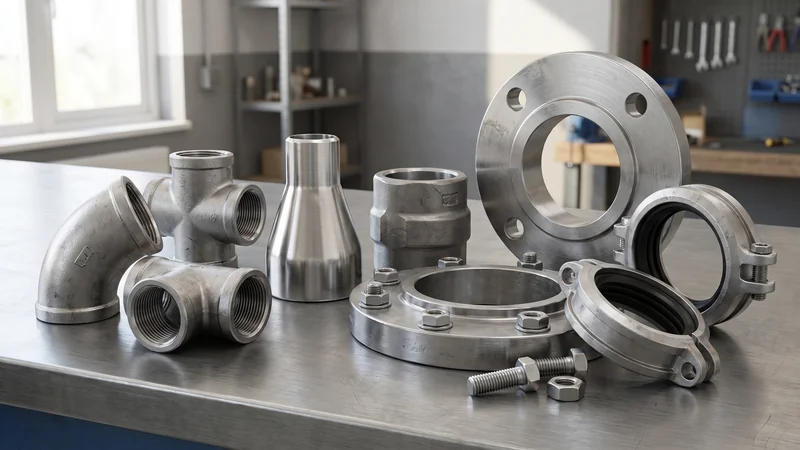
Pipe fittings are those decisions made physical. They turn a corner, split a flow, step a diameter down, or let a line be taken apart for service.
The catalogue is large because the duties are.
A fitting that suits a compressed air header will fail in a steam line. One sized for a small instrument branch has no business on a main. This guide sorts pipe fittings by what they do, the standards that govern them, and the questions that narrow any selection.
What Pipe Fittings Do in a Piping System
Strip away the part numbers and pipe fittings perform five jobs.
The five duties of pipe fittings
- Change direction, using elbows and bends.
- Split or combine flow, using tees, crosses and manifolds.
- Change size, using reducers and bushings.
- Terminate a line, using caps and plugs.
- Allow disassembly, using unions, couplings and flanges. - Unions break a small-bore line without cutting it. - Flanges do the same job on larger lines and at equipment.
That last duty matters more than it looks. A welded system is strong but permanent, so every point you might need to break has to be planned in.
Why the connection decides the fitting
The body of an elbow is not what makes it hard to choose. The ends are.
An elbow exists as a threaded part, a socket-weld part, a butt-weld part, a flanged part and a grooved part. Each version answers to a different standard. Each carries a different rating and needs a different install skill.
How Pipe Fittings Connect: The Five End Types
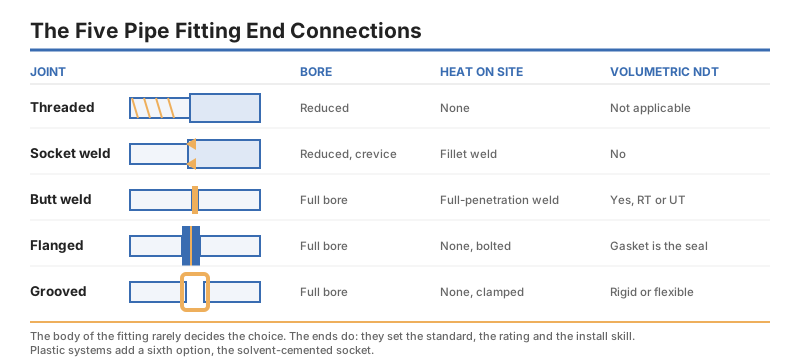
Metal pipe fittings on a plant use one of five end types.
Plastic systems add solvent cement to that list.
Threaded ends
Threads screw together with a sealant and no heat. Pipe threads conform to the general purpose NPT standard, so a thread cut anywhere to that spec will mate with any other.
Threaded pipe fittings suit small bore, low criticality and jobs where welding is not practical.
Socket-weld ends
The pipe drops into a recess and is fillet welded around the outside. It is faster than butt welding and needs less fit-up skill.
The trade-off is inspection. A fillet weld cannot be radiographed. That limits socket-weld pipe fittings to smaller sizes and less critical duty.
Butt-weld ends
The fitting is bevelled to match the pipe and welded end to end. The result is a full-penetration weld that can be checked by radiography or ultrasonic testing.
Butt-weld pipe fittings also keep a full bore, so there is no step for flow to trip over.
Flanged ends
Two faces are bolted together with a gasket between them. Flanged pipe fittings are the standard answer wherever a line must come apart often, or where a valve or pump has to be removed.
Grooved and bolted couplings
A groove is rolled or cut into the pipe end. A two-piece housing then clamps over it with a gasket. Rigid couplings hold the joint solid, and flexible couplings allow small movement and deflection.
Grooved pipe fittings go together fast, and they need no hot work on site.
The Standards Behind Pipe Fittings
Three ASME standards cover most metal pipe fittings, and two ASTM specifications cover rigid PVC. Knowing which one applies tells you the size range, the rating system and the marking to look for.
| Standard | Covers | Size range | Rating system |
|---|---|---|---|
| ASME B16.9 | Factory-made wrought butt-weld fittings | NPS 1/2 to NPS 48 | Inherits the pipe schedule |
| ASME B16.11 | Forged fittings, socket weld and threaded | NPS 1/8 to NPS 4 typical | Class 2000 to 9000 |
| ASME B16.5 | Pipe flanges and flanged fittings | NPS 1/2 to NPS 24 | Class 150 to 2500 |
| ASTM D2466 | PVC pressure fittings, Schedule 40 | Socket dimensions | Schedule based |
| ASTM D2467 | PVC pressure fittings, Schedule 80 | Socket dimensions | Schedule based |
Reading the forged fitting classes
Forged pipe fittings use a fixed class that does not change with size. Threaded ends run at Class 2000, 3000 and 6000, while socket-weld ends run at Class 3000, 6000 and 9000.
Plugs and bushings sit outside that system. They carry no class designation and are used up to Class 600.
Reading the flange classes
Flange class designations run 150, 300, 400, 600, 900, 1500 and 2500.
What a class number is and is not
- A class number is a dimensionless rating designation, not a pressure in psi.
- The allowable pressure comes from a pressure-temperature table for that material. - The same class in a different material carries a different pressure. - Allowable pressure falls as temperature rises.
- Class 2500 stops at NPS 12, while the lower classes run to NPS 24.
Where the standard stops
Installation welding sits outside the fitting standard. The applicable piping code governs how the joint is welded, not the standard that dimensioned the fitting.
Choosing the Material for Pipe Fittings
Material is set by the fluid, the temperature and the surrounding environment. It is rarely a free choice.
Carbon and alloy steel
Carbon steel is the default for general service pipe fittings. Forged parts are commonly supplied in A105 carbon steel, with A182 covering alloy and stainless grades.
Butt-weld pipe fittings use a different family: A234 for carbon steel, A403 for stainless and A420 for low-temperature duty.
Brass, bronze and copper alloys
Brass and bronze pipe fittings suit potable water, instrument air and light service. They machine well and take threads cleanly.
Stainless steel
Stainless pipe fittings are the corrosion answer, chosen for process, food, pharmaceutical and marine lines.
Plastics
Rigid PVC and CPVC pipe fittings handle chemical and drainage service without corroding. They are also light, which changes what the pipe supports have to carry.
PVC schedule facts worth knowing
- Schedule 40 PVC pressure fittings follow the ASTM D2466 specification.
- Schedule 80 PVC pressure fittings follow the ASTM D2467 specification.
- Both schedules share the same outside diameter and the same thread form. - The schedule changes the wall thickness, not the connection size. - A heavier schedule buys pressure capability, not a different fit.
Sizing, Schedule and Class
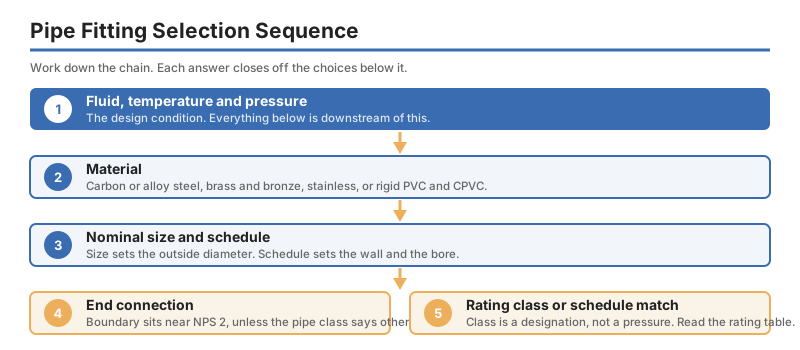
Size and schedule are two separate numbers. Confusing them is the most common specification error on pipe fittings.
Get these four right, in this order
- Nominal pipe size, which sets the outside diameter.
- Schedule, which sets the wall thickness and the bore.
- End connection, which must match the rest of the line.
- Rating class or schedule match, which must satisfy the design condition.
Where butt weld takes over from socket weld
The practical boundary between the two families sits at about NPS 2. Below it, socket-weld and threaded pipe fittings are the norm. Above it, butt weld takes over.
The exact crossover is not a rule of nature. It is written into the project pipe class specification, which always wins.
When to go butt weld anyway
Socket-weld and threaded ends leave a small step where the pipe meets the fitting. That step is a crevice, and a crevice is a corrosion and erosion site.
Where crevice corrosion or erosion is a live risk, butt weld is worth the extra fit-up even in small bore.
Dissimilar Metals and Flange Sealing
Two failure modes account for a large share of avoidable joint problems. Both are designed out at the fitting, not fixed later.
Joining dissimilar metals
Where two different metals meet directly, one gives up material and deteriorates while the other collects it. That process is galvanic corrosion.
A dielectric union or dielectric flange places an insulating barrier between the two metals. It stops the galvanic couple. It also breaks current flow, which removes stray-current corrosion at the same time.
Where to reach for a dielectric fitting
- Any copper to steel transition on a water line.
- Any point where a galvanised line meets a copper or brass component.
- Anywhere a cathodic protection scheme must stay electrically isolated.
Sealing a flanged joint
A flanged joint seals on the gasket, not on the bolts. The gasket material has to survive the fluid and the temperature it sits in.
Matching gasket to service
- Aramid with a nitrile binder for oil service.
- Aramid with an EPDM binder for steam.
- PTFE for aggressive chemicals.
- Graphite and metallic gaskets for the hot end. - Graphite covers high temperature duty. - Metallic gaskets cover extreme temperature duty.
Get this wrong and the flange leaks even when the bolting is perfect.
Frequently Asked Questions
What is the difference between butt-weld and forged pipe fittings?
They are two different families. ASME B16.9 covers factory-made wrought butt-weld fittings from NPS 1/2 to NPS 48, and they inherit the pressure rating of the pipe schedule they match.
ASME B16.11 covers forged socket-weld and threaded fittings for small bore. They are rated by a fixed class running from 2000 to 9000.
Do Schedule 40 and Schedule 80 fittings fit the same pipe?
Yes, for PVC. Both schedules use the same outside diameter and the same thread form, so the connection size does not change. What changes is wall thickness, and with it the pressure the part can take.
What does a Class 150 flange rating actually mean?
It is a rating designation, not a pressure figure. The allowable pressure is read from a pressure-temperature table for the specific material, and it drops as the temperature climbs. Two Class 150 flanges in different materials do not carry the same pressure.
When do I need a dielectric union?
Whenever two dissimilar metals would otherwise touch in a wet line, most commonly copper meeting steel. The insulating barrier prevents galvanic corrosion and breaks the current path that drives stray-current attack.
Conclusion
Pipe fittings look like a catalogue problem and are really a sequence problem. Fluid and duty set the material, the material and design condition set the schedule and class, and the line's own construction sets the end connection.
Work in that order and the part number falls out at the end.
The four questions that settle any selection
- What is the fluid, at what temperature and pressure?
- What material does that combination demand?
- What nominal size and schedule does the line run?
- Which end connection matches, and can it be inspected?
Related categories
Related Posts
What Bathroom Partitions Have to Survive
Box Stapler Guide: Types, Staple Sizes and How to Choose One