Hydraulic Accumulator: How to Choose the Type and Set the Precharge
By Miguel Duarte · 7 August 2026
Most people buy a hydraulic accumulator on size and price. Both matter less than the gas pressure you put in it before it ever sees oil.
Hydraulic accumulator precharge is a single number. Set it wrong and a bladder can be destroyed in one cycle. Set it right and the same unit runs for years.
What a Hydraulic Accumulator Actually Does
A hydraulic accumulator stores energy in squeezed gas and hands it back as fluid.
The basic cycle
Nitrogen sits on one side of a barrier and oil on the other. When system pressure rises above precharge, oil pushes in and squeezes the gas. When system pressure falls, that gas pushes the oil back out.
The jobs it takes on
Parker Hannifin lists a long duty sheet for the part.
- Topping up pump flow when demand outruns the pump.
- Soaking up shock from valves closing on moving fluid.
- Holding pressure against slow leaks. - Backup power after a pump stops is a fourth common duty.
Why shock control is the quiet win
In one Parker test a closing valve made a spike of 385 PSI over the relief setting. A piston hydraulic accumulator at the valve cut that to 100 PSI, and a bladder unit to 80. That is the part doing its least glamorous job.
A harsher second test spiked 2,011 PSI over the relief setting. The same fix brought it down to 107 PSI and 87 PSI.
The Three Hydraulic Accumulator Designs
Three designs rule industrial work.
They split gas from fluid in different ways, and that is the whole difference.
Bladder
A rubber bladder inside a steel shell holds the nitrogen.
Bladder accumulators react fast and cope with dirty oil better than a piston does.
Diaphragm
A moulded diaphragm is sealed into a small welded shell.
It is compact and cheap, and it cannot be repaired.
Piston
A free piston slides in a honed bore. Piston accumulators come in more sizes and take a higher precharge, so they give more oil back.
| Feature | Bladder | Diaphragm | Piston |
|---|---|---|---|
| Response under 25 ms | Yes | Yes | Marginal |
| Dirty oil tolerance | Good | Good | Poor |
| Failure mode | Sudden rupture | Sudden rupture | Gradual drift |
| Max standard flow | 220 GPM | 11 to 42 GPM | Up to 3,400 GPM |
| Compression ratio limit | 4:1 | As bladder | Higher |
| Repairable | Often | No | Yes |
Where each one wins
- Bladder for fast response and dirty oil.
- Diaphragm for small volumes and tight budgets.
- Piston for big outputs, hot oil and odd fluids.
Choosing a Hydraulic Accumulator by Failure Mode
This is the hydraulic accumulator rule most catalogues bury. Ask how you want the unit to fail before you ask how much it holds.
Sudden failure is sometimes the safer option
A bladder bursts without warning, and precharge drops to zero at once. On a high-speed machine that is useful, because scrap stops at once instead of drifting quietly out of spec.
Gradual failure suits anything that must keep running
A piston hydraulic accumulator fails slowly as its seal wears. Precharge drifts, the reading moves, and you can plan the repair.
Parker picks the piston type for braking and steering circuits for exactly that reason.
Speed, flow and cycling
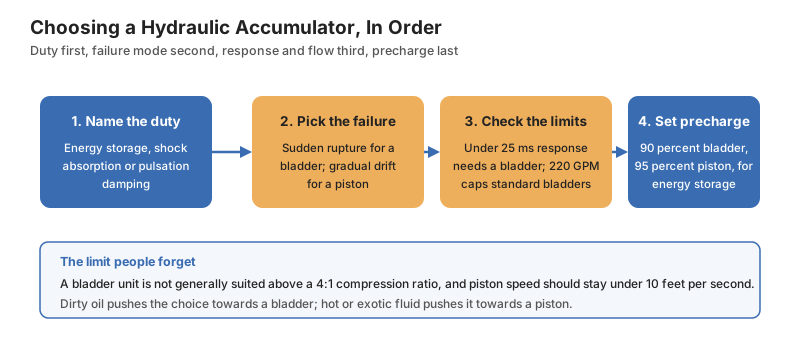
- Under 25 ms response calls for a bladder unit.
- Standard bladder flow stops at 220 GPM, or 600 with a high-flow port.
- Piston speed should stay under 10 feet per second. - Fast cycling makes a piston dither inside its own seal width.
Precharge Is the Number That Decides Everything
Precharge sets how much oil a hydraulic accumulator still holds at minimum system pressure.
The standard targets
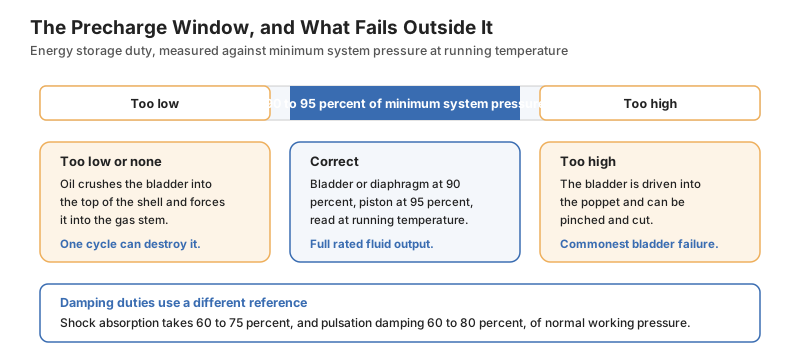
For energy storage, Parker precharges a bladder or diaphragm unit to 90 percent of minimum system pressure. A piston unit goes to 95 percent, read at the running temperature.
Too high
Too much precharge is the most common cause of bladder failure. The bladder is driven into the poppet assembly, where it can be pinched and cut. A piston hydraulic accumulator is more forgiving here.
Too low
An unprecharged bladder is worse. Oil crushes it into the top of the shell and forces it into the gas stem. One cycle of that is enough to destroy it.
Charging technique matters
Let the first 50 PSI of nitrogen in slowly.
- Wet the shell with system oil before the first charge.
- Open the nitrogen gently so cold gas cannot channel.
- Empty a piston unit of oil before reading its precharge.
Hydraulic Accumulator Precharge by Duty
The 90 percent figure applies to energy storage only. Damping duties use lower numbers.
| Duty | Precharge target | Measured against |
|---|---|---|
| Energy storage, bladder or diaphragm | 90 percent | Minimum system pressure |
| Energy storage, piston | 95 percent | Minimum system pressure |
| Shock absorption | 60 to 75 percent | Normal working pressure |
| Pulsation damping | 60 to 80 percent | Normal working pressure |
Read the reference pressure carefully
Energy storage works from minimum system pressure. The damping duties work from normal working pressure, which is a different and usually higher number.
Heat is part of the setting
Gas pressure moves with heat, so a charge set cold reads high once the machine warms up. Every published figure assumes the running temperature.
Compression ratio has a ceiling
A bladder unit is not generally suited above a 4:1 compression ratio. Past that the bladder deforms too far on every stroke.
Why a Hydraulic Accumulator Loses Its Charge
Nitrogen does not stay put, and that is the real hydraulic accumulator service story.
Rubber leaks slowly
The International Fluid Power Society's journal is clear that nitrogen seeps through bladder and diaphragm rubber into the oil. The loss is tiny in a piston unit, because steel does not breathe.
What speeds the loss up
- Higher running heat moves gas molecules faster.
- A higher compression ratio bares more bladder surface.
- More cycles means more exposure per week. - Injection moulding loses charge far faster than a standby duty.
Compound choice changes the interval
Rubber choice moves the service interval more than most buyers expect.
- Nitrile is the usual bladder material and holds gas well.
- Fluorocarbon resists harsh fluids but leaks gas badly.
- Low-temperature nitrile loses charge faster than plain nitrile.
Piston units drift too
Steel does not breathe, but seals wear. Dirty oil scores the bore, and gas then slips past the seal or a tired end-cap O-ring.
The interval most plants skip
- One week after start-up, check the charge.
- Three months in, check it again.
- Every three to six months after that, or longer once the loss is known.
Never open a charged circuit
A charged hydraulic accumulator holds stored energy after the pump stops. Fit safety blocks so the unit can be shut off and bled before anyone works on the circuit.
Frequently Asked Questions About Hydraulic Accumulators
What precharge pressure should I use?
For energy storage, use 90 percent of minimum system pressure for a bladder or diaphragm unit and 95 percent for a piston unit. Shock and damping duties use 60 to 80 percent of normal working pressure instead.
How often should a hydraulic accumulator be checked?
Check the precharge one week after start-up and again at three months. After that, every three to six months is normal, and the gap can stretch once you know the real loss rate.
Which type lasts longest in dirty oil?
Bladder and diaphragm units. Grit caught against a piston seal does more damage than the same grit trapped between a bladder and its shell. Water service is another case where a bladder hydraulic accumulator is preferred.
Why did my bladder fail with no warning at all?
That is how bladders fail. An intact bladder leaks nothing you can measure, so a burst cannot be predicted, and too much precharge is the most common cause.
Can I mount one on its side?
Vertical with the oil port downwards is best. Horizontal mounting is possible but wears a bladder unevenly and can trap oil away from the port.
Conclusion: Buy for the Duty, Then Guard the Precharge
A hydraulic accumulator is not really a storage tank purchase. It is a gas pressure commitment with a steel shell around it.
Decide the duty, decide the failure mode you can live with, then set and defend the precharge. The type almost picks itself once those three are settled.
- Pick the hydraulic accumulator failure mode before the size.
- Match the precharge target to the duty, not to habit.
- Diary the charge check at one week, three months, then quarterly.
Do that and the unit is invisible for a decade. Skip the precharge discipline and it will fail on the day you can least afford it.
Related Posts

Paper Bags: How to Choose Construction, Basis Weight and Handles


3 Ring Binder Sizes and Ring Types: A Buyer's Guide
AC Motor Types Explained: How to Choose the Right AC Motor