Standard Penetration Test: How the N-Value Is Driven, Corrected and Read
By Brandon Richter · 28 August 2026
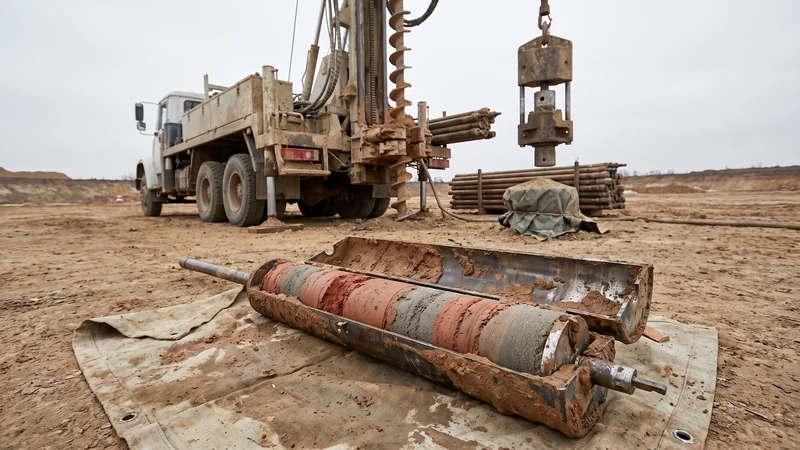
A borehole log hands you a column of numbers. Each came out of a standard penetration test, and each carries more assumptions than it looks.
Those figures end up setting footing depths and pile lengths.
ASTM calls the standard penetration test the most frequently used subsurface exploration drilling test in the world. It is also easy to run badly, and the log rarely says which happened.
What a Standard Penetration Test Measures
The Four Pieces of Kit
The kit list is short, and it has barely changed in decades.
- A 140 lb hammer drops 30 in. onto an anvil. - ASTM D1586 fixes the mass at 63.5 kg and the fall at 750 mm.
- Drill rods carry that blow down to the sampler.
- A split-barrel sampler of 2 in. diameter takes the driving. - Barrels and shoes sit with the soil core sampling kits.
Every part is a variable, and so is the crew. A standard penetration test means something only when all of it is held to spec.
Why the First Six Inches Do Not Count
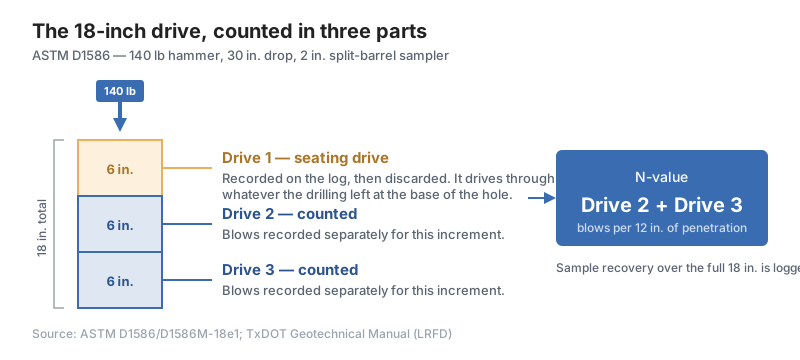
The sampler is driven eighteen inches in three equal drives of six. The first is a seating drive and gets thrown away. Blows from the second and third are added, and that sum is the N-value.
Texas DOT still asks for all three counts on the log, seating drive included, along with the sample recovery over the full drive. The count you discard stays part of the record a reviewer reads later.
How a Standard Penetration Test Is Run
Cleaning the Hole
The test happens at the bottom of a borehole. Whatever the rig did on the way down changes the answer.
- Clean the hole first, or the sampler drives through your own cuttings.
- Keep the water balanced so the base does not blow in.
- Record how the hole was made, because it helped make the number. - Hollow-stem work with soil augers behaves differently from rotary wash boring.
Marking, Driving and Spacing
Three chalk marks on the drill string set out the six-inch increments. From there a standard penetration test is a counting exercise.
- Count each increment separately and write all three down.
- Keep the blow rate steady rather than racing the hammer.
ASTM D1586 puts normal spacing at five feet, or wherever the ground visibly changes. Texas DOT applies that rule down to the base of the hole. A standard penetration test on that interval gives a profile, not a point.
When the Driving Stops
Refusal is the polite word for the hammer winning. Texas DOT treats anything above 100 blows as refusal, and takes it as the signal to stop the standard penetration test and start coring.
Hammer Energy Moves Every Standard Penetration Test
Most of the scatter in standard penetration test data starts here, because two rigs on the same soil return different numbers for purely mechanical reasons.
Why the Energy Ratio Varies
Theory says a 140 lb weight falling thirty inches delivers a fixed energy. Practice says much of it never arrives. ASTM records that real hammer systems pass between 45 and 95 % of that energy into the rods.
Rope-and-cathead rigs sit at the messy end, because a person controls every release. Automatic hammers repeat themselves, which is the argument for using one.
N moves the opposite way to the energy delivered, so a weak hammer flatters the ground and a strong one condemns it.
Calibrating the Hammer
Energy transfer is measured, never assumed.
- Measure the energy transfer ratio to ASTM D4633 on the rig in use.
- Recalibrate every year, and again whenever numbers look odd. - Texas DOT writes both duties into its drilling spec.
Put the efficiency on the log so the number can be corrected later.
An uncalibrated hammer does not hand you a wrong standard penetration test. It hands you one that nobody can ever correct.
Correcting Field N to N60 and (N1)60
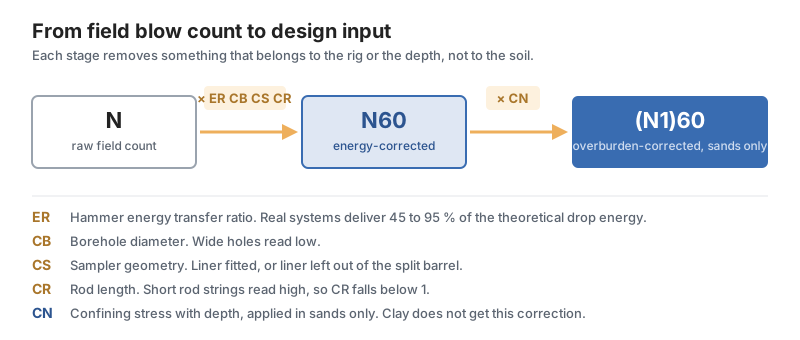
Raw field N from a standard penetration test is not a design input. It becomes one once the method and the depth are taken back out of it.
Energy and Procedure Corrections
The first correction rescales everything to a 60 % energy reference, which is what the subscript in N60 means.
| Correction | Symbol | What it takes out |
|---|---|---|
| Energy transfer ratio | ER | The hammer's own efficiency |
| Borehole width | CB | Wide holes that under-read |
| Sampler geometry | CS | Liner fitted, or liner left out |
| Rod length | CR | Short rod strings, which read high |
| Overburden stress | CN | Depth, in sands only |
The first four multiply together to give N60, and AASHTO's bridge design spec carries the equations most highway work runs on.
The Overburden Correction in Sands
A uniform sand at constant density reads higher as you go deeper, because confining stress rises and identical soil resists more. Multiplying N60 by CN gives (N1)60, the basis of liquefaction work. Clay does not get this correction.
ASTM Practice D6066 adds rules on hammers and drilling where loose sands are screened for liquefaction. A standard penetration test used for that job is held tighter than one under a strip footing.
Reading the N-Value Against Soil Behaviour
Links between blow count and soil properties are, as ASTM puts it, widely published. The bands below are Texas DOT's logging tables, and they use uncorrected N.
Cohesionless Soils
| Relative density | Uncorrected N |
|---|---|
| Very loose | Under 4 |
| Loose | 4 to 10 |
| Medium dense | 10 to 30 |
| Dense | 30 to 50 |
| Very dense | Over 50 |
- Below 10 means fill, loose alluvium or a liquefaction question.
- Between 10 and 30 is the ordinary shallow-foundation range.
- Above 50 check the sampler before believing it.
Cohesive Soils
| Consistency | Uncorrected N | Undrained shear strength |
|---|---|---|
| Very soft | Under 2 | Below 0.125 tsf |
| Soft | 2 to 4 | 0.125 to 0.25 |
| Medium stiff | 4 to 8 | 0.25 to 0.50 |
| Stiff | 8 to 15 | 0.50 to 1.0 |
| Very stiff | 15 to 30 | 1.0 to 2.0 |
| Hard | 30 to 60 | Above 2.0 |
Texas DOT labels those strength bands approximate, and means it. They are a sanity check against a laboratory result, never a replacement for one.
Where a Standard Penetration Test Should Not Be Trusted
Very Soft and Sensitive Clays
At the bottom of the scale the hammer barely separates one soft clay from the next. Texas DOT tells crews to use vane shear with extreme caution once a standard penetration test reads harder than 15 blows per foot.
- Cross-check soft ground with hand penetrometers. - Those readings are an index, not a design input.
One Number, Many Correlations
A standing criticism of the standard penetration test is that it is a one-number test. That is fair, and it is why the number is worth little without the log wrapped around it.
- Pair it with the sampler notes, because the spoon brings soil up.
- Pair it with the hammer efficiency, or no correction applies.
Then add the one thing nobody writes down.
- Pair it with the drilling method, since the hole made the number.
A standard penetration test is cheap, universal and easy to read, if the paperwork survives the drive back.
Frequently Asked Questions
What does the N-value from a standard penetration test mean?
It is the number of blows needed to drive the sampler through the second and third six-inch increments of an eighteen-inch drive. The first increment does not count.
What is the difference between N and N60?
N is the raw field count from a standard penetration test, carrying the efficiency of whatever hammer was on site. N60 rescales it to a 60 % energy reference, so different rigs can be compared.
How deep should each standard penetration test be taken?
ASTM D1586 puts routine spacing at five-foot intervals, or wherever the ground visibly changes. Texas DOT runs that interval down to the base of the boring.
Can a standard penetration test be used in gravel?
Not reliably. ASTM limits the method to soils that are not yet rock and below a ceiling on particle size, and a cobble in the drive shoe inflates the count without describing the deposit.
Conclusion
A standard penetration test is a simple mechanical event wrapped in a lot of bookkeeping.
The hammer mass, the drop and the three increments are fixed by ASTM D1586. What is not fixed is the energy reaching the sampler, and that is where the number quietly moves. Correcting field N to N60, and to (N1)60 in sands, turns a blow count into a design input.
Record the efficiency, the drilling method and all three increments. Do that and every standard penetration test on the log stays worth reading long after the rig has left.
Related Posts

What Bathroom Partitions Have to Survive
Pipe Fittings Explained: Types, Materials and How to Choose
Box Stapler Guide: Types, Staple Sizes and How to Choose One