Box Stapler Guide: Types, Staple Sizes and How to Choose One
By Adeo Fatohi · 1 September 2026
A box stapler is one of the oldest tools on a packing bench.
It still closes cartons that tape struggles to hold. Dust, damp and recycled board all work against adhesive, and steel does not care about dust.
Choosing one is less obvious than it looks.
The tool, the staple and the board all have to agree. A mismatch shows up later as a burst flap on a pallet. This guide covers the box stapler types, the staple dimensions that matter, and the settings that keep a closure intact.
What a Box Stapler Does and Where It Fits
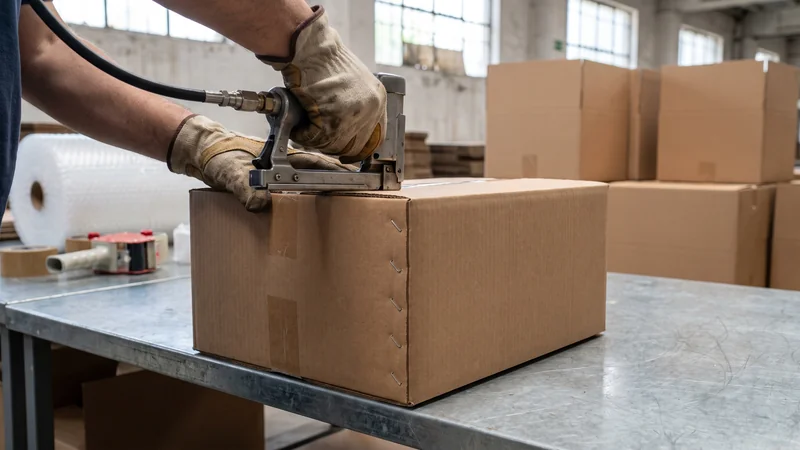
A box stapler drives a wide flat-wire staple through the outer flap of a carton and into the flap below. The legs then bend over and lock. That bend is the clinch, and it turns two loose flaps into one joint.
Why steel instead of tape
Staples hold mechanically, so nothing has to bond.
Where a mechanical joint wins
- Recycled liners with heavy dust loading still take a staple cleanly.
- Cold and humid rooms do not weaken a mechanical joint.
- Heavy contents load the flap edge, where a wide crown spreads the force. - More steel across the fibre means less tearing at the puncture point. - A narrow crown concentrates the same load into two small holes.
- A bad clinch is visible, so inspection takes a second.
What the standard says
ASTM International publishes the reference practice for this work. It describes several methods for closing, sealing and reinforcing fiberboard shipping boxes, and it treats staples and stitches as separate closure families.
The scope covers solid and corrugated fiberboard but excludes triple wall. Staples may be driven by portable tools, or by stationary heads inside semi-automatic and fully automatic equipment.
Closures are then qualified against a distribution-cycle test sequence, so the joint has to survive the journey the box will make.
The Main Box Stapler Types
Five box stapler families cover almost every packing line.
What decides the choice
- Carton volume per shift.
- How far the operator has to move.
- The staple leg length the board needs.
Manual hand-operated box staplers
These are hammer-action or squeeze-action box staplers with no power supply. They suit low volume benches and repair work, and they cost the least to own.
Pneumatic hand-operated box staplers
An air-driven box stapler fires on a trigger and reloads itself. It is the standard choice for a busy line, because the operator supplies no driving force.
The trade-off is the air line, which limits how far the tool can travel.
Battery-operated box staplers
A cordless box stapler gives most of the speed of an air tool without the hose. It suits dispatch bays and any station a trolley moves between.
Foot-operated bottom staplers
A foot-operated bottom stapler is a floor-standing box stapler. The operator drops the carton over the head and presses a pedal. The staple is then driven upward into the bottom flaps.
Bottom stapling carries the heaviest load, so a dedicated machine earns its floor space quickly.
Plier staplers
A plier stapler squeezes rather than strikes, so it is the most compact box stapler format on the bench. It reaches places a bench tool cannot, and it is common for tagging, closing sleeves and fixing labels to board.
Carton Staples: Crown, Leg and Wire
Three measurements define a carton staple, and every box stapler decision follows from them.
Crown width
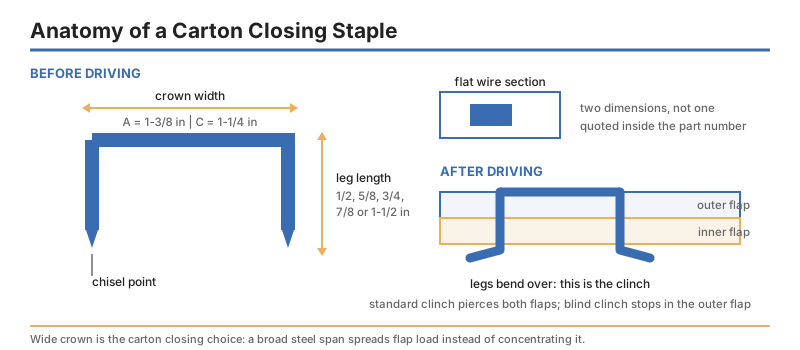
The crown is the top wire that joins the two legs. Carton closing uses a wide crown, because a broad span of steel spreads load instead of concentrating it.
Two crowns dominate. The A crown measures one and three-eighths of an inch. The C crown measures one and a quarter inches, and it is the more popular of the two in North America.
Leg length
The legs run down from each end of the crown. Common carton closing lengths are one half, five eighths, three quarters, seven eighths, and one and a half inches.
Fastener makers offer a rough starting rule: multiply material thickness by three.
Wire gauge and shape
Carton closing staples use flat wire, quoted as two dimensions rather than one. Those dimensions usually sit inside the part number itself. The working rule is short: the wider the crown and the thicker the wire, the more secure the fastener.
Gauge in one line
- American Wire Gauge runs backwards, so a higher number means thinner wire.
- Fine wire covers twenty-two to twenty gauge.
- Medium wire covers nineteen and eighteen gauge.
- Heavy wire runs from sixteen down to ten gauge.
Finish and material
Finish is chosen for the environment the carton will live in.
Matching finish to environment
- Galvanised steel is the default, and its zinc plating resists general corrosion.
- Copper-coated staples add the same protection and act as a mild lubricant in the tool.
- Aluminium staples avoid sparks and suit magnetic environments.
- Stainless grade 304 handles continuous outdoor exposure. - Grade 316 is the coastal and saltwater choice.
- Chisel points are the common leg point, and they drive straight before forcing the legs together.
Matching Staple Size to Board Thickness
Board grade is the first thing to check before loading a box stapler. The table below follows published guidance for standard C-flute corrugated board.
| Board grade | Typical leg lengths | Notes |
|---|---|---|
| Single wall | 1/2 in, 5/8 in, 3/4 in | Most general cartons sit here. |
| Double wall | 3/4 in, 7/8 in | Heavier contents and stacked loads. |
| Triple wall | 7/8 in, 1-1/2 in | Application dependent, and outside the ASTM closure practice scope. |
Reading the table in practice
Set the box stapler to the shortest leg that reaches through both flaps and still leaves wire to clinch. A leg that is too short will not turn over, and one that is too long will stand proud and snag.
Test on the board you actually ship, because liner weight and flute profile both change how a staple behaves.
When to move up a size
Go longer when
- Contents are dense and load the bottom flaps.
- Cartons are double stacked on a pallet.
- Board is damp, because wet fibre grips less.
Stay where you are when
- A longer leg starts to punch through the inner liner.
- The clinch already lies flat with no gap under the crown.
Stick Staples or Coil Staples
Feed style is a volume decision. Both styles hold the same way once driven, so the real question is how often you want to reload.
| Feed style | Best for | Practical effect |
|---|---|---|
| Stick or strip | Low and medium volume | Simple magazine, quick to clear, more frequent reloads. |
| Coil | Medium and high volume | Long runs between reloads, and a heavier tool head. |
Stick magazines
A stick magazine is the familiar strip of glued staples. It keeps the tool light and easy to strip down, which matters where several people share one box stapler.
Coil magazines
Coils carry far more fasteners. Published examples include a hand-held pneumatic coil tool holding one thousand staples per coil, and a floor-model bottom stapler holding four thousand. That capacity is the whole argument for coil.
Clinch Settings, Faults and Care
Most box stapler complaints are settings problems, not tool faults.
Standard clinch and blind clinch
Every carton closing box stapler carries a staple-length setting and a depth-of-drive setting. Together they decide how the legs finish.
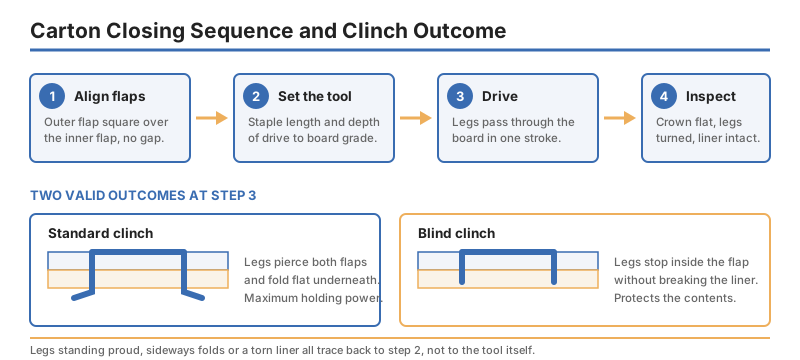
A standard clinch drives the legs fully through both flaps and folds them flat. A blind clinch drives through the outer flap only, without piercing the inner flap's bottom liner.
Use blind clinch whenever a projecting leg could scratch, snag or puncture the contents.
Faults worth knowing
Read the joint, then the tool
- Legs standing proud usually mean the leg length is too long for the board.
- Legs folding sideways point to a worn or dirty clinch area.
- Skipped staples trace back to low air pressure or a tired driver blade. - Check the regulator before blaming the tool. - Replace the blade if the skip repeats on clean air.
- Torn liner around the crown means the depth of drive is set too deep.
- Jams after a magazine change usually mean a mixed staple batch.
Keeping the tool honest
Blow out the box stapler magazine and driver channel at the end of each shift. Check the clinch surface on a bottom stapler, because a dirty block bends legs badly. Use one staple specification per tool.
End-of-shift routine
- Clear the magazine and blow out the driver channel.
- Wipe the clinch block or anvil face.
- Log any tool that skipped more than once.
Frequently Asked Questions
What is the difference between an A crown and a C crown staple?
Crown width is the only difference that matters at the bench. An A crown measures one and three-eighths of an inch across, and a C crown measures one and a quarter inches. The C crown is the more widely used of the two in North America.
Can a box stapler close triple wall board?
Tools and staples exist for it, and seven-eighths inch and one and a half inch legs are the usual choices. The ASTM closure practice for fiberboard boxes covers solid and corrugated board but excludes triple wall. Treat triple wall closures as an application-specific decision.
Is a staple stronger than packing tape?
Neither is automatically stronger. The ASTM practice lists staples, stitches, adhesives and tapes as separate closure methods, and each is qualified against a distribution test sequence rather than ranked against the others. Choose on contents, environment and handling.
Do I need a pneumatic tool or will a manual one do?
Volume answers this. A manual box stapler is fine for occasional work, a cordless box stapler suits mobile dispatch, and an air-driven or floor-model machine is the right call once cartons run continuously.
Conclusion
A box stapler has three variables that decide everything: crown width, leg length and wire. Match those to the board you actually ship, then set the clinch to suit the contents.
Get the pairing right and the closure stops being a risk.
Three steps to a reliable closure
- Identify the board grade first, single wall or double wall.
- Work back to the crown, leg length and finish that suit it.
- Choose the box stapler and feed style that match your volume.
Related categories
Related Posts

What Bathroom Partitions Have to Survive
Pipe Fittings Explained: Types, Materials and How to Choose