Emergency Lighting: What the Code Requires and How to Test It
By Peter Groothedde · 28 August 2026
Emergency lighting is the one system in a building designed for the worst day it will ever have.
It sits idle for years, then gets ninety minutes to justify itself.
That is a hard thing to buy well, and an easy thing to let quietly rot in a ceiling.
The codes are unusually specific about what emergency lighting has to deliver. They are just as specific about proving it still does.
Emergency lighting rules are national, and the figures below are the US ones, from NFPA 101 and OSHA. Other countries set their own numbers, but they all pin down the same four things: duration, level, even spread and proof.
What Emergency Lighting Has to Do
The Trigger Is Wider Than a Blackout
Most people picture a power cut. NFPA's Life Safety Code is broader than that, and the difference matters when you hand a building over.
- Loss of normal power to the building or to that circuit.
- An opened circuit breaker, which may affect one area only.
- A manual act, such as opening a switch to the normal lighting. - All three have to bring the emergency lighting up on their own.
A tripped breaker in a single panel counts.
So does an electrician throwing a switch during a fit-out.
Where It Has to Reach
NFPA 101 asks for emergency lighting in designated stairs, aisles, corridors and passageways leading to an exit. The list is long, and it takes in assembly, educational, hotel, mercantile and business buildings.
- The path of egress is the thing being lit, not the room.
- Floor level is where the light gets measured, not the desk.
How Bright Emergency Lighting Has to Be
The Numbers NFPA 101 Sets
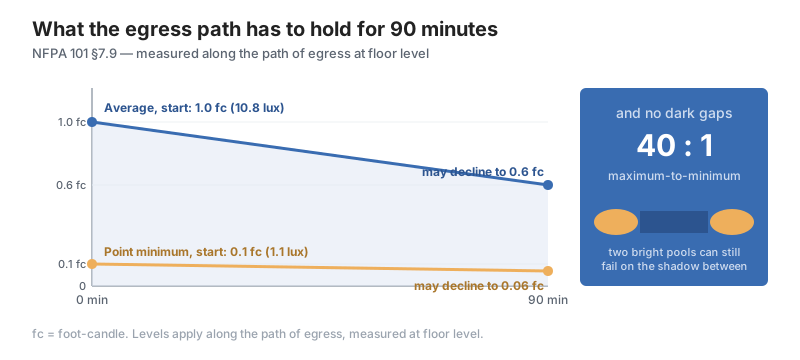
Section 7.9 puts figures on it, and they are lower than most people expect. The job is to let people walk out, not to let them read.
| Requirement | At the start | After 90 minutes |
|---|---|---|
| Average along the egress path | 1 ft-candle (10.8 lux) | 0.6 ft-candle |
| Minimum at any single point | 0.1 ft-candle (1.1 lux) | 0.06 ft-candle |
| Maximum-to-minimum ratio | 40 to 1 | 40 to 1 |
Batteries sag as they discharge, so the code lets the level fall across the run.
What it never allows is a dark patch.
Why the Ratio Beats the Average
The forty to one limit is the clause that catches bad layouts. A corridor can hit its average with two bright pools and a long shadow between them, and still fail. An even spread is what stops a stair nosing vanishing into that shadow.
Two Ways to Power Emergency Lighting
Central Generator and Transfer Switch
One route is a building generator with an automatic transfer switch, carrying part of the normal lighting straight through the outage. Its testing then follows NFPA 110 rather than the unit-level rules below.
Self-Contained Battery Units
The other route is separate emergency lighting units, wired to building power purely to keep their own batteries charged. When the supply goes, the on-board battery runs the lamps.
- Twin-head units are the familiar white box with two aimable lamps. - Most buildings stock these from the emergency light fixtures range.
- Remote heads put lamps where the battery pack cannot sensibly go.
Each unit is its own little power station, which is the strength and the weakness of the approach.
- Combination units carry a sign and emergency lamps in one housing.
- Wet location versions exist for car parks, plant rooms and outdoor routes.
Exit Signs Are a Separate Requirement
Emergency lighting lights the route. Signs say which way to go, and OSHA writes the rules for them in plain numbers.
What OSHA Puts in Writing
| Rule, 29 CFR 1910.37 | Requirement |
|---|---|
| Sign illumination | At least 5 foot-candles (54 lux) from a reliable source |
| Self-luminous alternative | At least 0.06 footlamberts (0.21 cd/m²) surface luminance |
| Letter height | Not less than 6 in. (15.2 cm) |
| Principal stroke width | Not less than 3/4 in. (1.9 cm) |
| Colour | Distinctive in colour |
- Directional signs are needed wherever the way out is not obvious.
- Line of sight to an exit sign has to be clear at all times.
- Look-alike doors must be marked "Not an Exit" or by their actual use.
Lit Signs and Self-Luminous Signs
Signs may be lit from inside or outside, and NFPA wants them on emergency power wherever emergency lighting itself is needed. Self-luminous signs need no supply at all. OSHA allows those, so long as the surface luminance clears its floor.
- Lit signs are the default, and the lighted exit signs range covers edge-lit, wet-location and vandal-resistant forms.
- Self-luminous signs suit places where running a supply is hard. - They still owe the same visibility from every direction of approach.
Testing Emergency Lighting: Three Accepted Routes
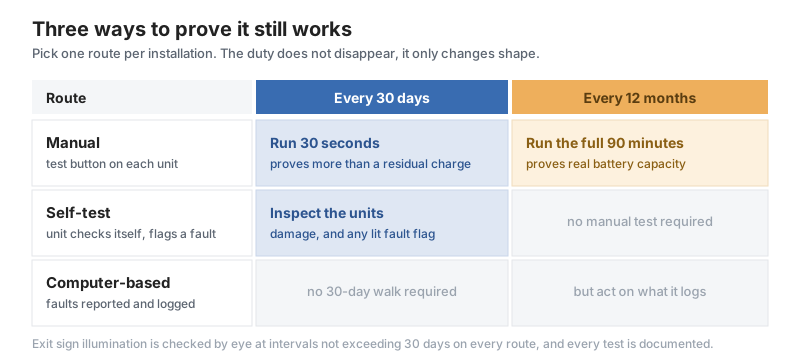
This is where most buildings fall out of step. NFPA sets out three ways to prove emergency lighting still works, and they are not equally hard.
Manual Testing
- Every month, run each unit for at least thirty seconds on its test button. - That proves the battery is holding more than a residual charge.
- Every year, run the full ninety minutes to test real capacity.
The monthly test is quick enough that nobody has an excuse.
The annual one is the honest test.
Self-Testing Units
Self-test units run their own checks and flag a fault on a small light. They need no manual monthly or annual test, but somebody still has to look at them every thirty days for damage and for lit flags.
Computer-Based Systems
A watched system logs and reports its own faults, which removes the thirty-day walk. It does not remove the duty to act on what it logs.
- Exit sign lighting gets a look at intervals no longer than thirty days.
- The written record is part of the rule, not an extra.
Where Emergency Lighting Quietly Fails
Batteries
A thirty-second test tells you the battery is not flat.
Only the annual ninety-minute test tells you it will go the distance.
- Keep spares on the shelf from the exit sign and emergency light batteries range.
- Replace on evidence, not on hope. - A unit that passes at thirty seconds can still fail at ninety minutes.
Obstruction and Aim
- Aim the heads along the path of travel, not at a wall.
- Recheck sight lines to every sign after a fit-out.
- Keep decorations off exit route doors.
The Paperwork
OSHA's wording is that exit lighting must be in proper working order at all times. The test record is how a building shows it was.
Frequently Asked Questions
How long does emergency lighting have to stay on?
At least ninety minutes from the moment normal power is lost. NFPA's Life Safety Code sets that time, and the annual test proves the batteries can still reach it.
How bright does emergency lighting have to be?
NFPA 101 asks for an average of one foot-candle along the egress path at the start, with no point below a tenth of a foot-candle. Those levels may fall to a lower stated average by the end of the ninety minutes.
How often should emergency lighting be tested?
Units on the manual route need thirty seconds every month and ninety minutes every year. Self-test units drop both, but still need a look every thirty days.
Do exit signs need to be on emergency power?
Where the building needs emergency lighting, lit exit signs have to be fed from emergency power too. Self-luminous signs are the exception, because they need no supply.
How big do the letters on an exit sign have to be?
OSHA sets a floor of six inches high, with the principal strokes at least three-quarters of an inch wide. The sign also has to be distinctive in colour and lit to the stated level.
Conclusion
Emergency lighting is bought once and judged once, usually years apart.
The code makes both moments checkable. Ninety minutes of run time, a stated average and point minimum along the egress path, a ratio that outlaws dark gaps, and a sign spec measured in inches. None of it is vague.
What decides whether a building passes is the boring part: thirty seconds a month, ninety minutes a year, and a written record of both. Emergency lighting that has never run the full ninety minutes is a guess wearing a fixture.
Related Posts


What Bathroom Partitions Have to Survive

Pipe Fittings Explained: Types, Materials and How to Choose

Box Stapler Guide: Types, Staple Sizes and How to Choose One