Jack Stands: How to Choose the Right Type for Every Job
By Mohamed Azam · 15 July 2026
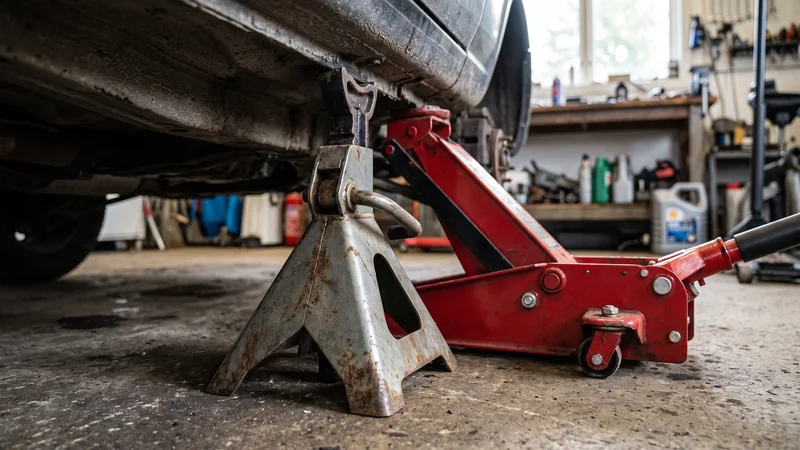
A floor jack lifts a vehicle. A floor jack does not hold one up. That single distinction is the reason jack stands exist, and getting the pairing wrong is one of the most common causes of garage injuries.
Every shop, fleet bay, and home garage needs a set of jack stands rated for the vehicles it services.
On a jack stand, the wrong tonnage, the wrong base width, or a worn locking pin turns a routine brake job into a serious hazard.
This guide covers the two main jack stand designs, the floor jacks they pair with, and the weight-capacity math that keeps a lifted vehicle exactly where you left it.
What Jack Stands Do (and Why a Jack Alone Is Not Enough)
A floor jack relies on a hydraulic seal and a column of fluid to hold a vehicle in the air. That fluid column is the only thing between the vehicle and the ground.
Seals fail. Fluid leaks. A bumped handle can release pressure in an instant.
None of that is dangerous if a jack stand is doing the actual holding. It becomes dangerous the moment a person works under a vehicle supported only by the jack.
The One Rule That Matters Most
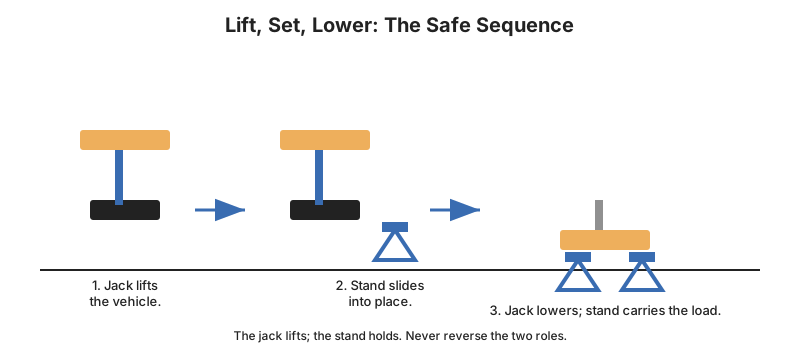
Lift with the jack. Set the stands.
Lower the vehicle onto the jack stands and confirm it has settled before any part of the body goes underneath. There is no exception to this sequence, regardless of how quick the job is.
- Position the jack under the vehicle's designated lift point, not an arbitrary spot on the floor pan.
- Lift just high enough to slide a jack stand into place with a small gap remaining.
- Set the jack stand so its saddle grips a structural point, not sheet metal.
- Lower the jack slowly until the vehicle's full weight rests on the jack stand.
- Push the vehicle laterally by hand before crawling underneath to confirm it is stable.
Floor Jack Types to Pair With Your Stands
Jack stands do the holding, but the floor jack still has to lift the vehicle first. Matching the right jack to the job makes that first step, and the handoff to the jack stands, easier and safer.
- Low-profile jacks have a shorter lifting arm and lower overall height, built for limited ground clearance.
- Long-reach jacks add adjustable extensions for extra lifting height and reach.
- Trolley jacks combine a wheeled base with a hydraulic cylinder for easy movement across a shop floor.
- Off-road (hi-lift) jacks use a tall ratcheting mechanism to lift trucks and SUVs with large tires.
- Bottle jacks use a compact, vertical hydraulic or air-powered cylinder for heavy, straight-up lifts.
- Long ram jacks extend a horizontal piston for a longer lifting stroke, often used with engine hoists.
Air Bottle Jacks vs. Hydraulic Bottle Jacks
- Air bottle jacks use compressed air, lift faster, and need less manual effort, but only where an air compressor is already available.
- Hydraulic bottle jacks are manually pumped, offer more controlled lifting, and cost less to buy.
Sizing a Bottle Jack
Bottle jack capacity must clear the full weight of the object being lifted, with room to spare. Most passenger vehicles need 2 to 3 tons of capacity, while trucks and industrial equipment often call for 10 tons or more.
Jack Stand Types: Pin-Style vs. Ratchet-Style
Once the vehicle is off the ground, the design of jack stands determines how quickly and securely they lock in place. Both common designs meet the same load ratings, but they trade off speed against simplicity.
| Stand Type | Locking Mechanism | Best For |
|---|---|---|
| Pin-style | Steel pin through pre-drilled height holes | Fixed, well-known lift heights |
| Ratchet-style | Ratcheting pawl that engages at any tooth | Frequent height changes, faster setup |
Pin-Style Jack Stands
A pin-style stand locks at fixed intervals, using a steel pin dropped through pre-drilled holes in the frame. The fixed holes make the lock simple to inspect at a glance.
Ratchet-Style Jack Stands
A ratchet-style stand uses a spring-loaded pawl that catches at nearly any height along a toothed bar. That flexibility speeds up setup when the same jack stands need to serve several vehicle heights in one shift.
What to Look for on Either Design
- Weight capacity should be printed clearly on every jack stand and never assumed.
- A wide base resists tipping better than a narrow footprint.
- A frame-gripping saddle holds the vehicle's structural point instead of slipping on smooth metal.
- A visible lock indicator shows at a glance whether the jack stand's pin or pawl is fully engaged.
Matching Weight Capacity to Your Vehicle
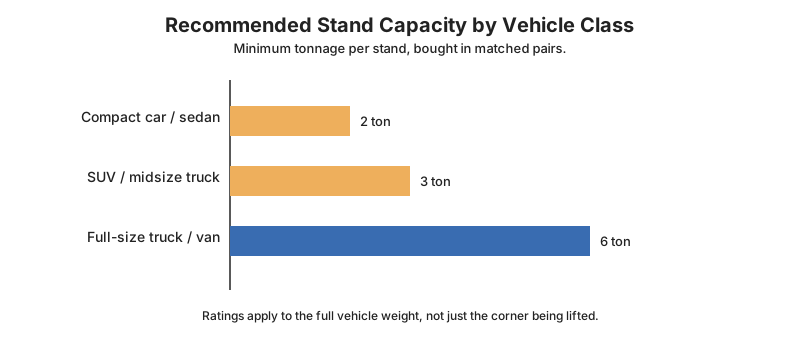
Tonnage ratings apply to the full vehicle, not just the corner being lifted. A 2-ton jack stand under one wheel of a 4,000-pound truck is not a 2-ton margin; it is barely enough.
| Vehicle Class | Approx. Weight | Jack Capacity | Stand Capacity |
|---|---|---|---|
| Compact car or sedan | Under 4,000 lb | 2 ton (3 ton safer) | 2 ton minimum |
| SUV, crossover, midsize truck | 4,000 to 6,000 lb | 3 ton | 3 ton |
| Full-size truck, ¾-ton, van | 6,000 to 9,000 lb | 3.5 to 4 ton | 6 ton |
Why Tonnage Applies to the Whole Vehicle
Buying by the vehicle's curb weight, not by habit or price, keeps a comfortable safety margin in place. Several everyday factors push actual weight well past the base spec:
- A heavier trim or option package adds hundreds of pounds over the base model.
- A full fuel tank alone can add over 100 pounds on larger vehicles.
- A loaded truck bed or roof rack shifts real weight further from the published curb figure.
Buying Stands in Matched Pairs
Stands should always be bought and used in matched pairs rated at or above the jack's own capacity.
Mismatched pairs create an uneven, unpredictable lock height on each side of the vehicle.
Finding the Right Jack Points
Modern unibody cars are not solid steel boxes, and lifting in the wrong spot can punch a jack saddle straight through the floor pan. A few extra seconds checking the right point avoids an expensive repair.
- Pinch welds are the reinforced seam along the rocker panel used on most unibody cars.
- Subframe and crossmember points are solid structural members common on trucks and body-on-frame SUVs.
- Differential housing or axle tube points serve as a rear lift point on solid-axle vehicles.
- Control-arm pickup points are used when the suspension needs to stay loaded during the job.
The owner's manual lists the exact jack points for that specific vehicle. Checking it takes less time than guessing wrong.
Surfaces That Won't Move
The ground under a floor jack and jack stands matters as much as the equipment itself. A stable floor keeps the whole setup square while the vehicle is in the air.
- Level, dry concrete is the ideal surface for any lift. - Cracked or uneven concrete should be avoided or bridged with a steel plate.
- Soft asphalt lets a floor jack or jack stands sink unevenly under a heavy vehicle. - A wide plywood or steel plate spreads the load if asphalt is the only option.
- Sloped or gravel surfaces should be avoided entirely for lift work.
Safety Checklist Before You Get Underneath
A short checklist catches the mistakes that cause most garage injuries. Running through it takes less than a minute, and none of it requires special tools.
- Chock both sides of every wheel remaining on the ground. - The parking brake alone only locks the rear wheels on most vehicles.
- Confirm the jack stand's lock indicator shows a full, seated engagement. - A pin resting on top of a hole, not through it, is not locked.
- Leave the floor jack in place as a backup after the jack stand takes the load. - It should no longer be load-bearing, but it adds a margin if a jack stand fails.
- Re-torque any wheels removed during the job before driving away. - Hand-tight is not torque spec; use a torque wrench and the manufacturer's value.
Frequently Asked Questions
Can I work under a car supported only by a floor jack?
No. A floor jack is a lifting tool, not a holding tool, and hydraulic seals can fail without warning. Always lower the vehicle onto jack stands before working underneath.
What weight capacity jack stand do I need?
Match the jack stand's rated capacity to the vehicle's full curb weight, not just the corner being lifted, and buy jack stands in matched pairs. A compact car needs at least 2-ton jack stands, while a full-size truck typically needs 6-ton jack stands.
Are ratchet-style or pin-style jack stands better?
Pin-style jack stands lock at fixed, easy-to-inspect intervals and suit shops that service similar vehicle heights repeatedly. Ratchet-style jack stands adjust to nearly any height, which speeds up setup in a shop working on mixed vehicle types.
Can I use blocks of wood or bricks instead of jack stands?
No. Stacked blocks or bricks have no tolerance for shifting or lateral load and can fail without warning under a vehicle's weight. Rated jack stands are built and tested specifically for this kind of load.
Conclusion
Choosing jack stands comes down to three checks. Answering them honestly before buying prevents the wrong purchase.
Does the rated capacity clear the vehicle's full weight with margin? Does the locking design fit how often the height needs to change? Does the base and saddle hold the vehicle securely on the surface available?
Get those three answers right, and a jack stand does exactly what it is built for: holding a lifted vehicle steady while the real work happens underneath.
Related categories: Vehicle Stands · Vehicle Service Jacks · Vehicle Jack Accessories
Related Posts


What Bathroom Partitions Have to Survive
Pipe Fittings Explained: Types, Materials and How to Choose

Box Stapler Guide: Types, Staple Sizes and How to Choose One