Wheel Chocks: How to Size, Choose and Use Them Safely
By Neomi Barriga · 30 August 2026
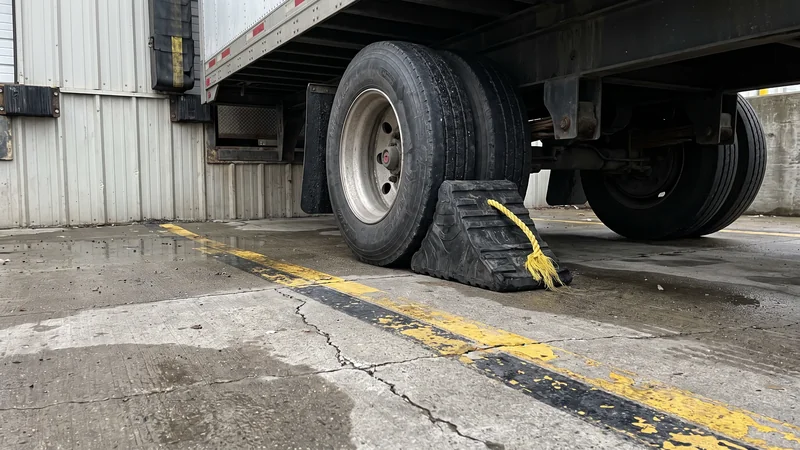
A parked trailer is not really a still object. It is a heavy object that has, for the moment, chosen not to move.
Wheel chocks are the part of the loading dock that takes that choice away.
They cost less than almost anything else in the yard. They are also among the most heavily regulated items you will buy.
That is why wheel chocks appear in binding regulation rather than in polite advice.
Chocking Is a Duty, Not a Courtesy
Plenty of yards still treat wheel chocks as good practice. In several countries they are a written duty with a citation attached.
Trailers at the Dock Face
The powered industrial truck standard from OSHA is blunt about highway trucks. Brakes must be set and wheel chocks placed under the rear wheels before a forklift boards the trailer.
- Set the brakes first — the chock backs up a working brake and never replaces one.
- Put the wheel chocks under the rear wheels — the regulation names the rear wheels, not any convenient axle.
- Add fixed jacks when the trailer is uncoupled — OSHA notes these may be needed under a semitrailer with no tractor. - An uncoupled trailer can tip forward under a loaded forklift even when it cannot roll.
Railcars and Wheel Stops
Rail sidings get their own clause in the same standard. Wheel stops or other recognised positive protection must be provided to stop railroad cars moving during loading or unloading.
- Railcar wheel chocks are shaped for steel on steel — a flanged rail wheel needs a chock cut to the rail.
- Derails and skates are also used as positive protection — they belong to the same family of mechanical stops.
- Ordinary tyre chocks do not satisfy the clause — swapping one type for the other leaves the siding unsafe.
Plant Left on a Grade
Mine sites answer to a different regulator. The US mine safety authority requires unattended mobile equipment to be left in park with any brake set. On a grade the wheels must be either chocked or turned into a bank.
- Chock the downhill side first — gravity has already chosen the direction of travel.
- A bank counts as an equivalent measure — where one exists, the ground itself becomes the stop. - Loose spoil is not a bank, so confirm the material will hold a wheel under load.
- Unattended is the trigger word — the duty starts the moment the operator steps down.
How to Size Wheel Chocks to the Tyre
The Quarter-Diameter Rule
Sizing is where most wheel chocks purchases quietly go wrong. Too short and the tyre climbs over the chock, too tall and it never seats.
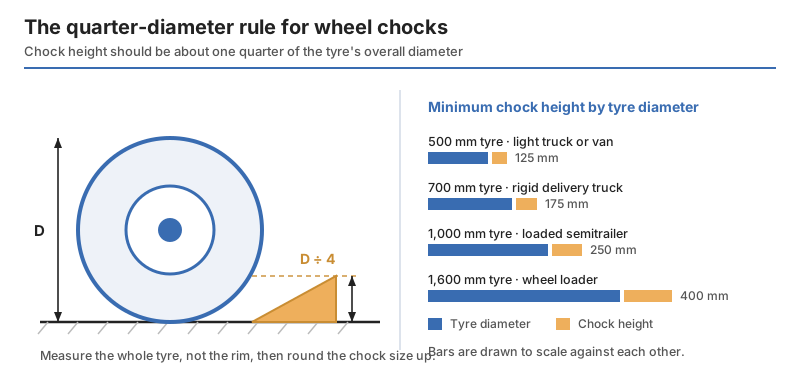
Industry practice across suppliers converges on one simple ratio. Chock height should be about one quarter of the tyre's overall diameter. Treat that as a widely used working convention, then check the manufacturer's load rating against the weight of the vehicle.
| Tyre diameter | Typical vehicle | Minimum chock height |
|---|---|---|
| 500 mm (20 in) | Light truck or van | 125 mm (5 in) |
| 700 mm (28 in) | Rigid delivery truck | 175 mm (7 in) |
| 1,000 mm (39 in) | Loaded semitrailer | 250 mm (10 in) |
| 1,600 mm (63 in) | Wheel loader | 400 mm (16 in) |
| 3,500 mm (138 in) | Ultra-class haul truck | 875 mm (34 in) |
Reading the Sizing Table
The step from a delivery van to a haul truck is a factor of seven in height. No single pair of wheel chocks covers a mixed yard.
- Measure the tyre and not the rim — a 22-inch rim often carries a tyre over a metre tall.
- Round up rather than down — the larger chock costs a few dollars and ends the argument.
- Check the load rating against gross vehicle mass — catalogues quote it per chock or per pair.
Slopes and Soft Ground
A slope reduces the working height of the chock. It also increases the force pushing the wheel past it.
- Go one size taller on any real slope — a chock sized for level ground is undersized once the surface tilts.
- Chock both sides on a steep grade — uphill and downhill, so nothing depends on the parking brake.
- Watch what soft ground does — gravel and hot asphalt let wheel chocks sink or slide out of position. - A steel plate under the chock restores a firm bearing surface on unmade standing.
Materials and What Each One Survives
Recycled Rubber
Recycled rubber is the default on most docks. It grips bare concrete, stays where it is put and costs very little. That combination is hard to beat inside a sheltered bay.
Polyurethane
Oil, diesel and prolonged sunlight all degrade rubber over time. Polyurethane resists those, tolerates weather better, and weighs less for the same physical size.
Aluminium and Steel
Metal wheel chocks suit the heaviest vehicles and the longest service lives. Aluminium keeps the handling weight down and resists corrosion without any coating.
- Choose metal for heavy plant and fixed installations — load rating rather than portability drives the decision.
- Keep metal chocks away from live electrical work — conductivity turns a safety device into a hazard.
- Inspect metal chocks for sharp edges after damage — deformed plate cuts the hands that place it next.
Timber
Timber blocks are what people improvise with when nothing proper is available. They split without warning and carry no load rating at all.
Matching Wheel Chocks to the Vehicle
General Purpose and Dock Use
General purpose wheel chocks cover trucks, trailers and vans across the apron. This is the volume category, and most sites standardise on it first.
Motorcycle and Aircraft Chocks
A motorcycle chock holds the front wheel upright for transport rather than blocking a parked vehicle. Aircraft chocks are built light and highly visible, because apron handling matters more than blocking mass.
Mining and Pipe Chocks
Mine sites size wheel chocks against tyres several metres tall, which pushes them into polyurethane or aluminium.
- Match the chock shape to the wheel it faces — rail, tyre and pipe are three different contact geometries.
- Use pipe chocks for rolled stock — cylinders and tube need a cradle rather than a wedge. - Compare every rating against gross vehicle mass rather than unladen kerb weight.
- Specify visibility for airside and dock work — bright chocks are less likely to be left behind.
Placing Wheel Chocks Correctly
On Level Ground
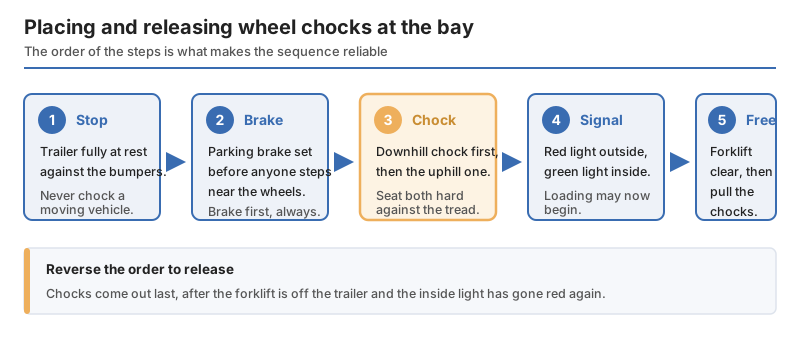
Placement is a sequence rather than a single action. The order of the steps is what makes it reliable.
- Stop, set the brake, then chock — chocking a vehicle that is still moving is how operators lose feet.
- Seat each chock hard against the tread — even a small gap lets the tyre gather momentum.
- Always work in pairs — a single chock leaves an entire direction of travel open.
On a Grade
A slope removes the symmetry that makes level ground simple. The downhill chock carries the load and the uphill one is insurance against rollback.
Signalling and Storage
The chock is only half of a working system, and the other half is making sure nobody drives away against it.
Inspecting and Retiring Wheel Chocks
What to Look For
Wheel chocks live outdoors and get run over regularly. Inspection belongs on a fixed cycle rather than on suspicion.
- Look for cracks and missing chunks — any loss from the contact face reduces the working height.
- Reject glazed or oil-soaked faces — a chock without grip slides along the slab instead of blocking.
- Fit a chock holder at every bay — wheel chocks kept in a bracket get used, and ones in a corner do not. - Interlocked dock lights and chock alarms give the driver a reason to check before pulling away.
When to Replace
No chock carries a printed expiry date. Judge each one on geometry and grip rather than on age. Anything crushed should be retired, because internal damage does not always show on the surface.
Design and manufacture are covered by a recommended practice from SAE International, last revised in 2020.
Frequently Asked Questions
What size wheel chock do I need?
Take the overall diameter of the tyre, use about a quarter of it as the chock height, then confirm the load rating covers your vehicle.
Are wheel chocks legally required at a loading dock?
Under the powered industrial truck standard from OSHA, brakes must be set and wheel chocks placed under a highway truck's rear wheels before a forklift boards it.
Can I use one chock instead of two?
One chock blocks a single direction of travel, so a matched pair is the working minimum and both sides need chocking on a grade.
Do railcars need the same chocks as trucks?
No, because railcars require wheel stops or other positive protection shaped for a flanged steel wheel running on rail.
Is rubber or polyurethane better?
Rubber grips well and costs less in sheltered use, while polyurethane resists oil and weather and is lighter to handle outdoors.
Do wheel chocks replace a powered vehicle restraint?
No, because a restraint hooks the trailer to the dock, and wheel chocks remain the manual fallback wherever no restraint is fitted.
Conclusion
Wheel chocks are the simplest item on the dock and one of very few named directly in regulation.
Three choices decide whether a pair works. Height is set against tyre diameter, material against the working environment, and placement against the slope of the ground. Get those three right and the device disappears quietly into the daily routine.
Buy per vehicle class rather than per site, and keep a holder at every bay. Wheel chocks earn their keep by preventing events that nobody ever writes down.
Related categories
Related Posts


What Bathroom Partitions Have to Survive
Pipe Fittings Explained: Types, Materials and How to Choose
Box Stapler Guide: Types, Staple Sizes and How to Choose One